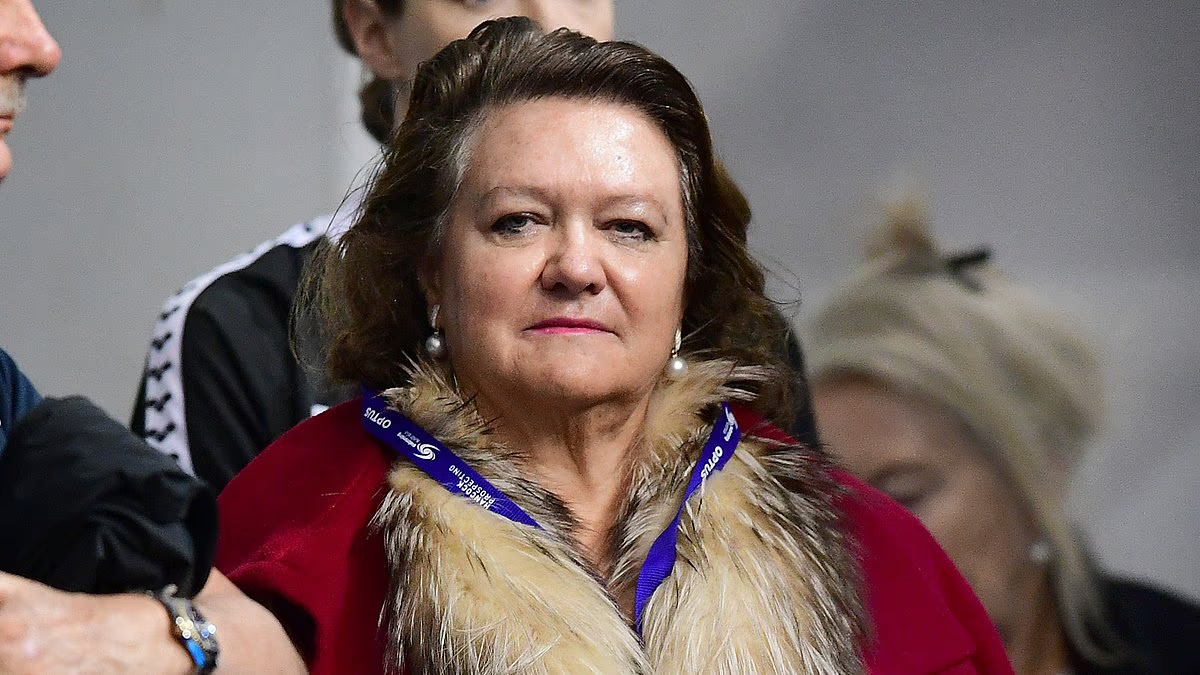

Several of Australia’s most prominent business figures are warning that the country could be heading towards recession. Among them is Australia’s richest person, Gina Rinehart, who says government decisions are largely responsible for the economy’s mounting difficulties.
The cost-of-living crisis intensified this week when inflation climbed from 4.3 per cent to 4.9 per cent, moving above 4.7 per cent for the first time in three years.
The Reserve Bank has lifted the cash rate five times this year to 4.85 per cent in an effort to curb price growth. Inflation, however, remains well above the central bank’s two-to-three per cent target range.
Mining magnate Mrs Rinehart told Our News Outlet that those running the country lacked direct business experience.
“For far too long, their policy decisions have been made based on green left ideology and growing the size of expensive government, and its interference in our lives and businesses.”
She said the approach had created additional pressure for small and medium-sized businesses, along with major industries including mining, energy and agriculture.
“Despite the overactive spin machine and fake news about overseas happenings being the main contributor to the hurtful mess that Australia is in, with families sadly struggling across our country, let’s face reality, our problems are well and truly Aussie government-made,” she said.
“[The] record government spending, record waste, record bloated bureaucracy, record business failures, increasing size of costly government, increasing tape and regulations, and record $1trillion-plus debt is destroying the economy and our children’s future. We really cannot pretend otherwise.”

A number of leading business figures have warned Australia may be approaching a recession, including wealthiest Australian Gina Rinehart, who blames government policy for the country’s economic difficulties

Mrs Rinehart said those running the Australian government had never operated a business. Prime Minister Anthony Albanese is pictured at the ASEAN Summit in November
“Bigger, more costly government and bigger government spending mean more taxes and higher government charges. Some of these bigger tax plans are already on the public agenda.
“And what is the consequence of this? Companies increasingly don’t want to invest in Australia, real new investment is reducing, and this is bad for future jobs, opportunities, revenue and our standard of living.”
According to the ABS, transport prices rose 10.6 per cent over the past year, while housing costs increased 6.4 per cent, adding to the inflationary pressure facing households.
Weak employment figures released last week also led Macquarie economists to join HSBC chief economist Paul Bloxham in estimating a 50 per cent chance that Australia will enter a technical recession.
Retired businessman and multi-millionaire Dick Smith said his career had exposed him to several recession “cycles” and that he believed another downturn was approaching.
“It is interesting how we go in cycles all the time and I think we are heading towards recession,” he told Our News Outlet.
“The typical working person, about a third of our population who live pay packet to pay packet, will be affected, so I’m quite worried about that.”
Geoff Crittenden, chief executive of Weld Australia, suggested the nation’s economic problems had been developing for some time.

Retired businessman and multi-millionaire Dick Smith said he had witnessed several recession “cycles” during his career and believed another was imminent.
“I think we’ve been heading towards recession for some time, and I think it’s almost entirely out of our hands,” he said.
Harvey Norman chairman Gerry Harvey delivered a similar warning during media briefings after the retailer released its latest trading update.
“Between February and June next year will be extremely difficult. On the figures that I’m seeing, you’ll see more bankruptcies than you’ve seen for a very long time,” he told the AFR on Thursday.
Harvey Norman has announced a hiring freeze and indicated some positions could be eliminated after the holiday season, when Black Friday and Christmas sales are particularly important to the retailer.
The combined sales reported by Australian franchisees between November 1 and 20 this year fell 1.5 per cent compared with the same period in 2025. Comparable sales declined 1.6 per cent, according to the update.
“If [the RBA] increases interest rates, even though inflation says that they should, if that decision tips the economy into recession, like a bad recession, it can fall off a cliff fairly quickly.
EXPLORE MORE: GOP Rep. Brian Fitzpatrick Issues Warning
“Once [that occurs], it takes a long time to recover.”
Mrs Rinehart has echoed those concerns, repeatedly warning about the difficult economic conditions confronting Australian households.

Weld Australia chief executive Geoff Crittenden said the Reserve Bank was “doing its best” but criticised its continued interest-rate increases

Harvey Norman chairman Gerry Harvey predicted there would be “more bankruptcies than we’ve seen in a long time”
“I have for decades consistently and publicly called for the same things: less regulation, less government tape, smaller government, less wasteful spending, which would have enabled less taxes, and stood up for our essential primary industries,” she said.
“Sadly, rarely have I been joined publicly in such calls, and it should not be a surprise Australians are now struggling with the consequences, increased costs of living, lower living standards, threat to our freedoms and genuine concerns for the future of our next generations.”
Mrs Rinehart has also criticised the use of taxpayers’ money on “green hydrogen projects”, the $150 million cost of Australia’s leadership role at climate summit COP31, renewable energy programs, electric vehicle subsidies and Snowy 2.0.
“More devastation for farmers and the businesses that depend on farmers, and higher electricity charges ahead whichever uni-party wins the Victorian government,” she said, referring to the state election this weekend.
She also attacked the new Digital Duty of Care laws, which require online platforms to take proactive steps to protect users from foreseeable online harms.
The mining magnate warned that Labor and the Greens would use the legislation “to censor any commonsense Australians who have an opposing view and are concerned about the future of Australia, and maintaining our freedom”.
Economists have suggested that the sharp rise in inflation could lead to further interest-rate increases as policymakers work to bring price growth back under control.
“The question for the RBA now is whether it’s already done enough, or whether mortgage holders are going to cop another hit,” Our News Outlet politics and economics editor Peter van Onselen said this week.

Mrs Rinehart has raised concerns about taxpayer funding for “green hydrogen projects”, the $150 million cost of Australia’s COP31 leadership role, renewable energy initiatives, electric vehicle subsidies and Snowy 2.0
“If Labor don’t dramatically slash government spending now, we’re going to be left with a high-inflation recession with ever-rising debt.”
The latest inflation figures are among the final major economic indicators due before the Reserve Bank’s last board meeting of 2026 on December 8.
Mr Crittenden said the central bank was “doing its best”, but argued that continued rate rises were making conditions more difficult.
“I think it’s not helping the economy if they keep pushing up the interest rates,” he said.
“From the perspective of my members in the industry, it’s just making everything harder and harder. We have to borrow money to finance projects and finance growth, and that’s becoming more and more expensive. People are being laid off.
“The inflation is affecting employment in our industry. It’s overseas imported steel coming in, heavily subsidised by our international competitors, which is causing people to be laid off.
“It’s not a good situation.”
Treasurer Jim Chalmers said on Wednesday that 2026 had been “an especially difficult year for people” and acknowledged that the government expected inflation to remain elevated for longer than hoped.
“But we also expect inflation to return to the target band in 2027,” he said.
“The Treasury and the Reserve Bank forecasts also expect real wages growth to return in 2027, and we expect the economy to continue growing.”
Mr Crittenden said he hoped the forecast proved accurate, although he viewed it as aspirational.
“I’d be very happy if it was 2027. I think it might take a little bit longer than that, but I’m happy to agree with the Treasurer on that one,” he said.
“Fortunately, there is a huge amount of work in the pipeline in terms of the Olympics and rare earth minerals plants and submarines and ships so it will pick up quickly, I think, once we get through the other side.”