The 2026 FIFA World Cup, staged across the United States, Canada and Mexico, is the first edition to feature 48 teams — and it was never going to be just about the matches. With more host cities than ever, a complex political backdrop and unprecedented global attention, the tournament has already produced moments that reach well beyond the field. From breakout stars to viral celebrations, these are the pop culture storylines shaping the World Cup’s early days.

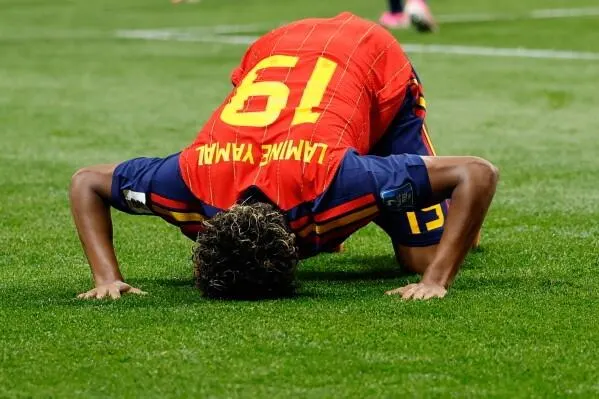
Lamine Yamal celebrates after scoring his first goal
AP
1. Lamine Yamal Ends Spain’s Goal Drought — and Marks the Moment in Prayer
Spain’s teenage sensation Lamine Yamal delivered a historic moment on June 21, scoring in the 10th minute against Saudi Arabia at Mercedes-Benz Stadium in Atlanta. At 18, he became only the second player aged 18 or younger to open the scoring in a World Cup match, following Pelé, who achieved the feat as a 17-year-old in 1958.
The significance of the goal went far beyond the scoreline. It brought an end to Spain’s 299-minute World Cup goal drought, a troubling stretch for the 2010 champions that included a scoreless opener against Cape Verde — one of the tournament’s early shocks. After finding the net, Yamal fell to the turf in sujood, the Islamic act of prostration performed in gratitude, creating an image that spread rapidly across social media.
Yamal, a practicing Muslim whose father is Moroccan, has emerged as one of the most prominent faces of Spain’s multicultural identity. His celebration did not appear staged or symbolic for effect; faith has long been a visible part of his public life. He has prayed before matches and has spoken out against Islamophobia, including after anti-Muslim chants were heard during a Spain-Egypt friendly. In response, he wrote on Instagram: “I am a Muslim, thank God… using religion as something to mock people in a football stadium leaves you as ignorant and racist people.”
His World Cup arrival had already drawn attention after he wore custom boots featuring the flags of Morocco, honoring his father’s roots, and Equatorial Guinea, reflecting his mother’s heritage. While the gesture was criticized in parts of Spain’s right-wing media, many fans abroad praised it as a celebration of identity. Against that backdrop, Yamal’s sujood on football’s biggest stage felt like more than a goal celebration — it was a powerful statement of who he is.
LAS VEGAS, NEVADA – JUNE 28: Vinicius Junior of Brazil celebrates after scoring the team’s first goal during the CONMEBOL Copa America 2024 Group D match between Paraguay and Brazil at Allegiant Stadium on June 28, 2024 in Las Vegas, Nevada. (Photo by Kevork Djansezian/Getty Images)
Getty Images
2. The First-Ever Red Card for Covering a Mouth — And Why It Happened
Paraguay’s Miguel Almirón became the first player ever to be sent off for covering his mouth during an altercation, receiving a red card in the Group D match against Türkiye on June 20. The incident happened late in the first half: Almirón and Türkiye right back Mert Müldür exchanged words following a foul near midfield. Almirón covered his mouth while saying something to Müldür, who immediately appealed to referee Ivan Barton. Barton went to video review and quickly ruled that Almirón would be given a red card.
The rule itself has become widely known as the “Vinícius Law.” It follows the fallout from a high-profile incident during February’s Champions League knockout playoff between Benfica and Real Madrid, in which Benfica winger Gianluca Prestianni was seen pulling his shirt over his mouth while speaking to Real Madrid’s Vinícius Júnior. Vinícius reacted immediately, informing the referee, and play was halted for 10 minutes under UEFA’s racist abuse protocol. Because Prestianni had covered his mouth during the exchange, UEFA was unable to gather sufficient evidence to substantiate Vinícius’s claims, though Prestianni was nonetheless sanctioned for discriminatory conduct.
FIFA proposed the rule change shortly after the incident, and the International Football Association Board (IFAB) ratified it by unanimous agreement ahead of the World Cup. FIFA president Gianni Infantino framed the logic plainly: “If you do not have something to hide, you don’t hide your mouth when you say something.”
Paraguay coach Gustavo Alfaro accepted the decision but voiced concern about the broader implications: “The fear I have is that football loses its essence. In football, there’s frictions, fights, clashes.” Regardless, the rule has arrived — and Almirón’s red card will be the moment students of the game study for decades.
KANSAS CITY, KANSAS – JUNE 19: Lisandro Martinez #6 of Argentina during the training of Argentina ahead of the FIFA World Cup 2026 Group J match between Argentina and Algeria at Sporting Kansas City Training Centre on June 19, 2026 in Kansas City, Kansas. (Photo by Richard Pelham/Getty Images)
Getty Images
3. Algeria and Lawrence, Kansas Fall in Love With Each Other
Nobody saw this one coming and that’s exactly what makes it the most wholesome subplot of the tournament. In a matter of days, the Algerian national soccer team captivated the city of Lawrence, Kansas, with World Cup fever, a whirlwind romance that blossomed before they even played their first match in Kansas City.
Lawrence, home to the University of Kansas Jayhawks, became an unexpected international darling as the college town made headlines around the world for its mutual love affair with the Algerian men’s national soccer team, known as Les Fennecs. The team rolled into Lawrence after midnight on June 8, greeted by flag-waving fans who waited out thunderstorms just to watch the players arrive.
Algerian players received a tour of KU’s facilities, kicking field goals, throwing American footballs at the under-construction Kansas Memorial Stadium, and hitting the batting cages at Hoglund Ballpark. Artist Stan Herd created a giant Algerian flag on the grounds of the University of Kansas in their honor. The phrase “Rock Chalk Algeria” — a play on the KU cheer “Rock Chalk Jayhawk” — spread across social media instantly. One resident’s heartfelt video went viral: “I wanna say thank you to Team Algeria for choosing our hometown Lawrence, Kansas, to come here. Welcome to United States, welcome to Kansas!”
The result is a rare World Cup story that feels spontaneous rather than manufactured: part diaspora homecoming, part local festival, and part internet romance. Mayor Brad Finkeldei summed it up simply: “We’ve embraced them, and they’ve embraced us.” In a tournament shadowed by visa restrictions and political tension, the Algeria-Lawrence love story has been a necessary reminder of what the World Cup is supposed to feel like.
ATLANTA, GEORGIA – JUNE 15: Vozinha #1 of Cabo Verde applaud fans after the 0-0 draw during the FIFA World Cup 2026 Group H match between Spain and Cabo Verde at Atlanta Stadium on June 15, 2026 in Atlanta, Georgia. (Photo by Patrick Smith – FIFA/FIFA via Getty Images)
FIFA via Getty Images
4. Vozinha: The 40-Year-Old Goalkeeper Who Broke the Internet
Vozinha woke up on June 15 as an unheralded 40-year-old goalkeeper enjoying the back end of a 19-year career that had taken him through clubs in Portugal, Cape Verde, Moldova, Angola, Cyprus, and Slovakia. He had won a single trophy in his career — the 2018-19 Cypriot Cup with AEL Limassol.
By the time he went to sleep that night, he had 14 million Instagram followers.
In Cape Verde’s historic World Cup debut against Spain — the No. 2-ranked team in FIFA world rankings — Vozinha made seven saves, helping the tiny island nation earn a 0-0 draw against the European champions. Spain threw everything at him, including 27 shots. Soccer’s brightest young stars came off the bench and couldn’t find a way past him. He dazzled with reflex stops, diving saves, and a magnificent early denial of Pedri.
After the final whistle, Vozinha broke down in tears on the pitch. “I cried because I grew up with my grandparents and unfortunately they were not here; they died a few years ago,” he said. “I also cried because my mum didn’t manage to be here because of the visa. Because of the money we had to pay for the visa, we didn’t manage [to get it done] on time.”
Before the match, Vozinha had approximately 56,000 Instagram followers. Within hours of the final whistle, that number had climbed past 13.8 million — surpassing the follower counts of Travis Kelce, Patrick Mahomes, and Victor Wembanyama. Brazilian broadcaster CazéTV had encouraged its viewers to follow Vozinha during the match, and the response was immediate — his following swelled to 1 million within minutes of the final whistle.
“I have worked my whole life for this moment,” he said after in his post-match interview after being named Man of the Match. “I’m 40 years old. I started playing football professionally when I was 25. I thought about leaving, but I continued because of this dream.” The internet, predictably, was undone.
INGLEWOOD, CALIFORNIA – JUNE 15: Mohammad Mohebbi #8 of IR Iran celebrates with teammate Mehdi Ghayedi #10 after scoring his team’s second goal during the FIFA World Cup 2026 Group G match between IR Iran and New Zealand at Los Angeles Stadium on June 15, 2026 in Inglewood, California. (Photo by Stu Forster/Getty Images)
Getty Images
5. Iran’s World Cup Nightmare — and Tijuana’s Unexpected Grace
No story at this World Cup has landed heavier than Iran’s. Iran’s training base was relocated from Tucson, Arizona, to Tijuana, Mexico, and the team’s ticket allocation was revoked days before the tournament began. Portions of Iran’s coaching and administrative staff were denied visas, and Iranian authorities threatened to withdraw the team on multiple occasions before ultimately confirming participation.
All three of Iran’s group matches are on U.S. soil, but the team has been barred from staying in America for the duration of its involvement in the tournament. Iran is only allowed in the country for matches — team official Abolfazl Pasandideh confirmed the terms plainly: “We can enter in the morning and we must leave the same day.”
After their opening 2-2 draw with New Zealand, Iran was told immediately after the match that everyone must get on a plane for the 140-mile trip back to Tijuana. Captain Mehdi Taremi said the team endured five hours of travel and security checks during what is normally a very short journey from the Los Angeles area to the border. Coach Amir Ghalenoei was pointed in his assessment: “I think perhaps our team is the most oppressed team in the whole World Cup.”
Iran’s players were granted visas to enter the U.S. as late as June 5 — just 10 days before group play began — while some coaches, support staff, and officials had their applications rejected entirely. Mexican President Claudia Sheinbaum offered a pointed contrast to U.S. policy: “We have no problem. There is no reason to deny them the possibility of staying in Mexico.”
It is one of the deepest contradictions of a tournament built on the language of unity: in one part of the bracket, a team is being questioned, delayed, and turned away at borders. In another, a Midwestern college town is hanging flags and learning chants for a country most of its residents had never thought much about before June. The Iran situation has broken hearts around the world — and in Tijuana, at least, a city stepped up to offer the dignity that politics withheld.


