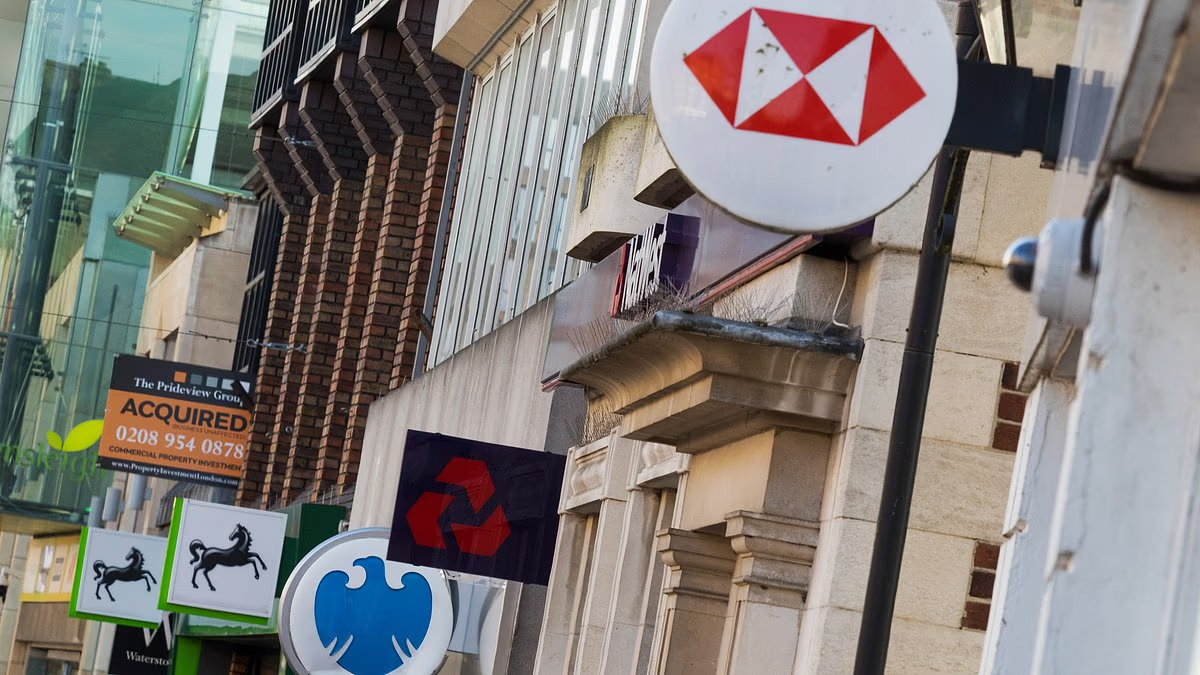

British banks and financial groups could be forgiven for feeling confused.
On one side, Katharine Braddick, the new head of the Bank of England’s regulatory arm, is moving to cut the red tape surrounding senior appointments — a long-standing frustration for the industry.
On the other, the Chancellor is preparing to impose a fresh levy on banks in next week’s Autumn Budget.
The financial sector is also at the heart of the artificial intelligence revolution. While the prospect of hostile actors disrupting payment networks or trading platforms is a serious and immediate risk,
AI is also creating significant opportunities for shareholders, particularly through the cost savings promised by the latest technology.
Barclays expects AI tools to replace around 5,000 roles. That should concern the 30,000 NatWest employees currently working from home and resisting pressure to spend more time back at their desks.

The Chancellor is preparing to impose a new levy on UK banks in next week’s Autumn Budget
They may want to think carefully about what they wish for. The financial industry has spent years calling for a simpler system to approve and certify its employees.
I have endured countless lunches listening to banking and insurance executives complain about regulatory delays. Under the new approach, only the most senior figures and those working in audit will face the toughest scrutiny. Yet the safeguards surrounding chief executives are far from foolproof.
Jes Staley reached the top job at Barclays despite his former employer, JP Morgan, being prepared to disclose his links to Jeffrey Epstein — revelations that ultimately led to his collapse and disgrace.
Barclays’ latest figures offered little encouragement. Third-quarter profits came in at £2.3billion, falling short of market expectations.
The investment bank’s strength has traditionally been in fixed income, a legacy of Bob Diamond’s tenure.
But despite — or perhaps because of — the heavy debt burden weighing on government and commercial markets, that business has lost momentum. Equity activity, helped by the technology and AI boom, delivered a much stronger performance.
Chief executive CS Venkatakrishnan offered investors a welcome £500million share buyback, partly offsetting the damage caused by a share price that has fallen 13 per cent since the start of the year.
Barclays’ reliance on investment banking also leaves it exposed to sudden shocks in an era defined by geopolitical turbulence and AI-driven disruption.
The shine is coming off bank stocks.
Data champs
Julia Hoggett is unequivocal. Writing for this paper, the head of the London Stock Exchange warned that the shrinking of the UK market had become a matter of ‘national security’.
Her intervention came as Ashtead Technology, which owns valuable maritime technology, agreed to be bought by Ember, a New York-based private equity group.
The deal follows a series of prized British defence companies passing into foreign ownership. They include flight-refuelling specialist Cobham, satellite pioneer Inmarsat, sonar expert Ultra Electronics, engineering group Senior and F-35 fighter-component maker Meggitt.
Military and aerospace technology remain among Britain’s key industrial strengths. Allowing American buyers to pick off these assets is becoming increasingly difficult to defend.
At least the stock market’s parent company, the London Stock Exchange Group (LSEG), is willing to defend its turf as a global data and trading powerhouse. Its role is vital to maintaining the City’s leadership as a financial centre.
The LSEG is snapping up New York credit intelligence concern Octus for £2.6billion – its biggest deal since acquiring Refinitiv in 2019.
LSEG stock has been under pressure this year, along with another UK data champion, Relx, over fears AI could disrupt world-leading skills. Yet, in reports on latest trading, both showed no sign of fatigue, with income sharply up.
Food for thought
Small victories count in the cut-throat grocery world as food prices look set to take off.
Having grabbed big shares of UK supermarket sales, the Competition and Markets Authority has ruled no-frills German-owned supermarkets should be subject to the same rules on land banking as Britain’s established players.
No longer will they be able to prevent rivals opening next door.
Sainsbury’s price-matching of Aldi and Lidl is still working, with operating profits up 3.6 per cent to £525million in the first six months of the year and guidance for the full year up.
The search for greater reach,via a merger with private equity-owned Morrisons or Asda, may not have fully played out.
SIPPS: INVEST TO BUILD YOUR PENSION

AJ Bell
AJ Bell
0.25% account fee. Full range of investments

Hargreaves Lansdown
Hargreaves Lansdown
Free fund dealing, 40% off account fees

Interactive Investor
Interactive Investor
From £5.99 per month, £100 of free trades

InvestEngine
InvestEngine
Fee-free ETF investing, £100 welcome bonus

Prosper
Prosper
No account fee and 30 ETF fees refunded
Affiliate links: If you take out a product This is Money may earn a commission. These deals are chosen by our editorial team, as we think they are worth highlighting. This does not affect our editorial independence.
Compare the best Sipp for you: Our full reviews


