
When the International Monetary Fund (IMF) and World Bank last staged their annual meeting in Bangkok in 1991, the global landscape looked radically different.
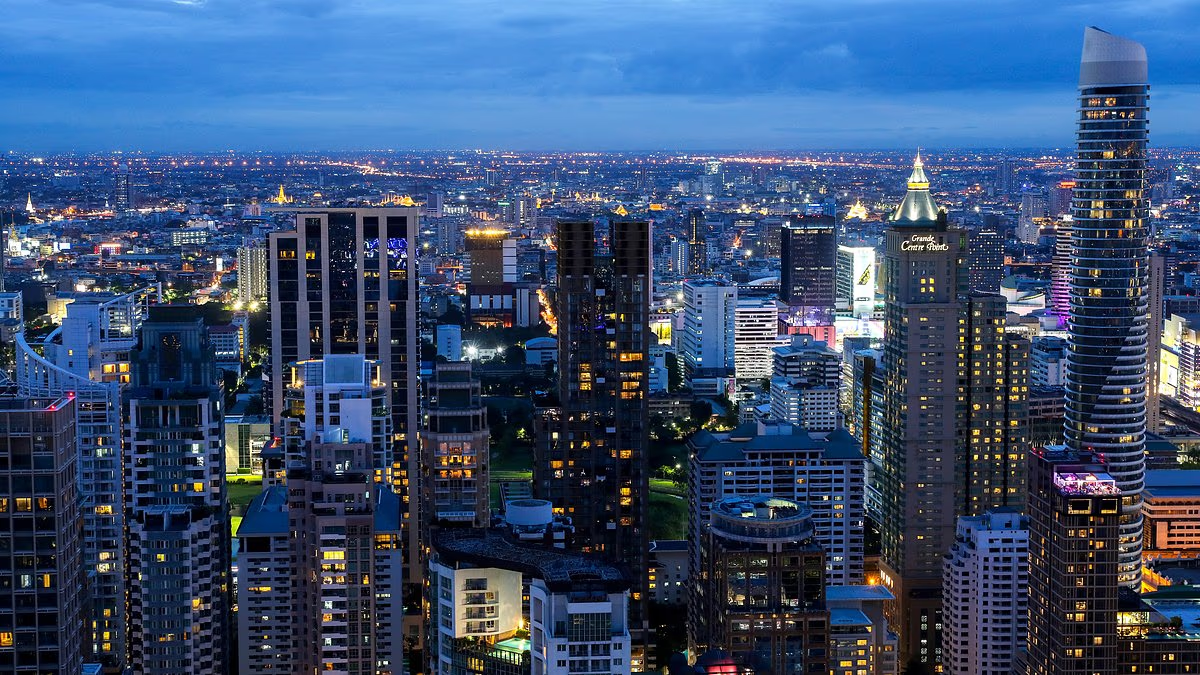
Thailand’s capital has since evolved into a vast metropolis, its skyline now dominated by dozens of glass-and-steel skyscrapers.
Yet at street level, much remains familiar: food vendors crowd the pavements, open-fronted bars invite passers-by inside and Thai massage parlours remain seemingly everywhere.
When I arrived 35 years ago, one of the first stories to catch my attention was a press release revealing that Boris Yeltsin’s Russia had applied to join the IMF, the stronghold of free-market capitalism.
Many of the discussions that followed focused on how the Fund and Western governments could mobilise the money needed to modernise Russia, the former Soviet republics and the countries of the Eastern bloc.
Among the Group of Seven industrialised nations, there was a clear sense of triumph at the prospect of introducing free-market principles to a new group of converts.

Thailand’s capital Bangkok, pictured, has blossomed into a metropolis with dozens of glass-and-steel towers reaching to the heavens
Britain, it was assumed, could release money tied up in defence and enjoy the benefits of a peace dividend. How dramatically circumstances have changed.
As former UK Defence Secretary John Healey, now Chancellor, arrives for a packed schedule of meetings, he must surely be thinking about the latest Budget warning from the Institute for Fiscal Studies.
The institute estimates that the Government will need to raise £35billion between now and the end of this Parliament to cover rising welfare costs and Britain’s military commitments to Nato.
The optimistic era in which Russia was regarded as a friend deserving Western support ended with its unprovoked invasion of Ukraine in 2022.
Today, Russia is treated as the sworn enemy of Europe’s democracies. Only President Trump, through what is described as a bizarre Kremlin deal involving the supply of diesel, is offering Vladimir Putin, Yeltsin’s successor, any room for manoeuvre.
The wider world has also moved on. In 1991, Thailand was classified as one of Asia’s tiger economies, recording a blistering growth rate of 11 per cent.
Asia was surging, and it remains the fastest-growing region globally, expanding at around 5 per cent, powered largely by China and India. Thailand’s growth, by contrast, has settled at 2.25 per cent.
During the 1991 meeting, Thai officials were so worried about gridlock caused by the arrival of 12,000 delegates and private-sector bankers that the government declared several public holidays to keep residents off the roads.
The traffic remains notoriously bad, although the colourful tuk-tuks have been partly replaced by digital ride-hailing platforms such as Grab.
The rise of online working also means Thai authorities can now instruct office workers to stay home in 2026, helping to reduce the congestion caused by official limousines.
At the 1991 gathering, the central question for Western democracies — before the G20 had even been created — was whether the IMF, World Bank and Western banking system could raise enough capital to finance the reforms needed to turn Russia and the former Eastern bloc into functioning modern states.
The London-based European Bank for Reconstruction and Development (EBRD), established amid considerable fanfare, was created to help deliver that transformation.
This year’s meetings confront almost the reverse problem. Government, household and financial-sector debt has exploded in recent years, reaching a total of $365 trillion.
A combination of sovereign borrowing following the great financial crisis, Covid, the war in Ukraine and conflict in the Middle East means that debt now exceeds output in almost all G7 countries.
HM Treasury says Healey will be advising fellow finance ministers to put ‘fiscal discipline’ at the heart of what they do to control borrowing costs.
Tell that to the Americans. Monday’s Wall Street Journal highlighted Britain’s fiscal nightmare, pointing out that a bloated welfare bill is imperilling financial stability and the UK is now paying ‘even more for its debt than spendthrift France’.
The paper notes that debt interest payments are on track to hit £130billion by the end of this Parliament.
It doesn’t look as if the world is ready for any lectures from Labour.
DIY INVESTING PLATFORMS
AJ Bell
AJ Bell
Easy investing and ready-made portfolios
Hargreaves Lansdown
Hargreaves Lansdown
Free fund dealing and investment ideas

interactive investor
interactive investor
Flat-fee investing from £4.99 per month

Freetrade
Freetrade
Investing Isa now free on basic plan

Trading 212
Trading 212
Free share dealing and no account fee
Affiliate links: If you take out a product This is Money may earn a commission. These deals are chosen by our editorial team, as we think they are worth highlighting. This does not affect our editorial independence.
Compare the best investing account for you


