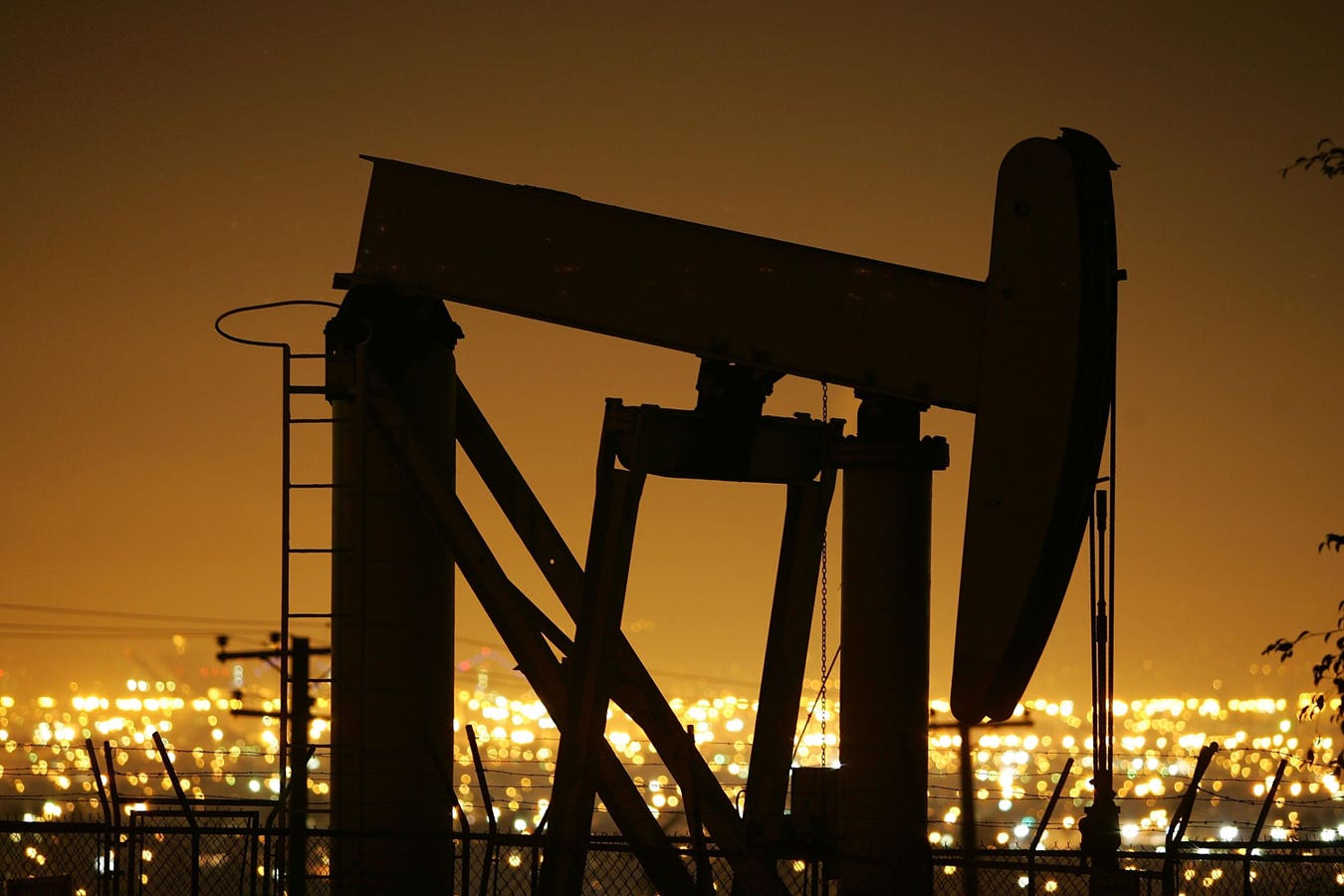

SIGNAL HILL, CA – MARCH 5: Pumps draw petroleum from oil wells through the night as the cost of crude oil tops $104 per barrel in its surge to new record high prices March 5, 2008 in Signal Hill, California. The cost of crude has California drivers paying more than ever. Statewide gas prices are now 58 cents a gallon higher than the same time last year. (Photo by David McNew/Getty Images)
Getty Images
The U.S. Energy Information Administration released its short-term energy outlook this week, predicting that oil prices will continue to slide into next year. Brent crude, which averaged $71 per barrel in July, is forecast to drop to $58 per barrel for the 4th quarter of 2025 and is expected to slide further to $50 per barrel in early 2026. Brent crude is the global benchmark sourced from the North Sea and typically trades at a premium to West Texas Intermediate, the U.S. benchmark from Texas. If this forecast holds up, it will put WTI in the $47 per barrel range in 2026, far below break-even prices.
The average break-even price for large oil producers in the U.S. is $61, according to the Federal Reserve Bank of Dallas. Smaller producers come in with a break-even of $66. There is variability between firms; some can drill wells profitably with oil at $45. Oil producers have told us what they would do if these prices occurred in a recent energy survey put out by the Dallas Fed. Every quarter, a survey is sent out to exploration and production firms across the country. The survey captures data on drilling activity, capital spending, and supply chain conditions, as well as comment sections where oil and gas executives can share their thoughts on what they think needs to happen moving forward. The second quarter survey yielded responses from 85 different oil and gas executives.
Rig Counts Could Decline Even Further
In the most recent survey, oil executives were asked about their drilling activity if the price of oil were to fall to $50. 46% of respondents said they would decrease drilling activity significantly, with 42% answering they would decrease drilling activity slightly. That would lead to a significant decline in rig count, according to J.P. Morgan; the rig count would fall by up to 30% to around 300 rigs. That would put us back to the rig count numbers we were seeing in 2020 during the pandemic.
The drop in oil prices is primarily driven by the Organization of Petroleum Exporting Countries returning 2.2 million barrels of oil production a day to the market that they cut in 2023 to keep an $80 per barrel price floor on oil. This coincides with record oil output from the United States, as we produced 13.488 million barrels of oil a day in May 2025, according to the EIA. As crude oil inventories begin to build around the world, oil prices should fall.
Good News For Drivers
The good news for drivers in the U.S. is that if oil prices fall as predicted, they will see more relief at the pump. Gas prices this summer are 30 cents a gallon cheaper than this time a year ago, according to the American Automobile Association. Gas prices have not fallen below $3 a gallon on a national average since 2021. With oil prices falling, we will likely see gas prices fall well below that mark this winter as demand falls and we switch to the cheaper winter blend of gasoline.


