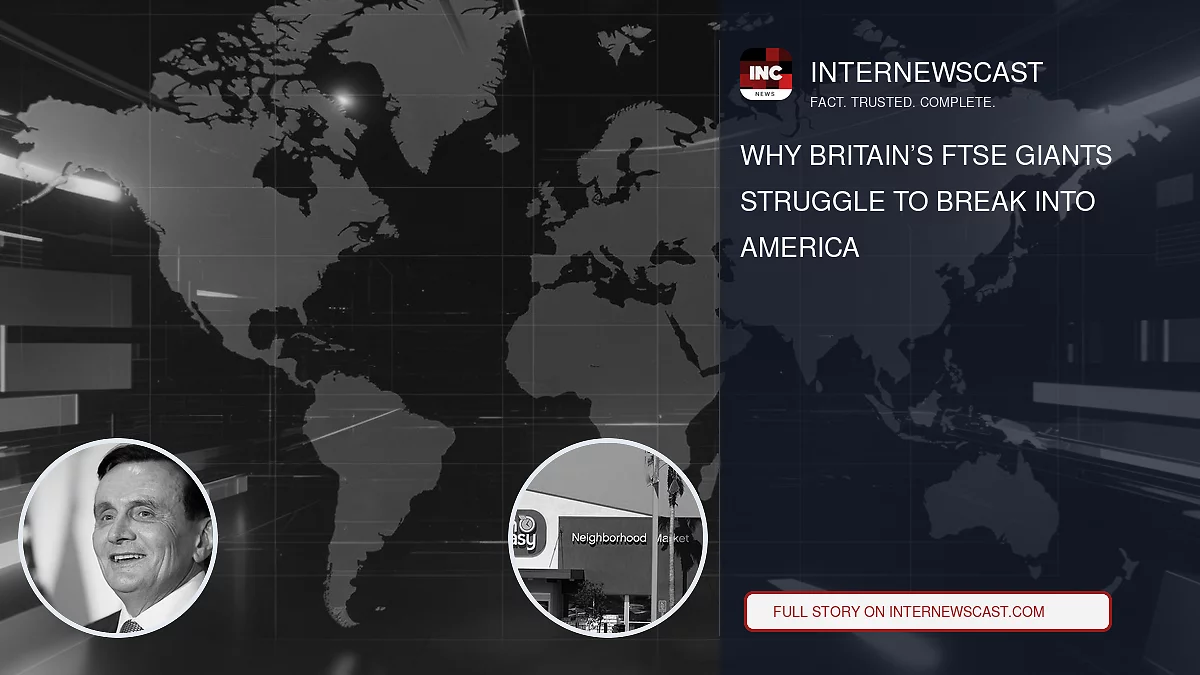

From Tesco’s Fresh & Easy push to the US ambitions of HSBC and M&S, and from bold takeovers to mega-mergers, cracking America has rarely proved straightforward for British business, writes Hamish McRae.
On the face of it, there is something reassuring about a British-based company being linked with the takeover of an American rival, rather than yet another deal moving in the opposite direction.
US companies have bought a steady stream of UK businesses, with easyJet among the most recent names in the spotlight, so the idea of AstraZeneca making a move for Bristol Myers Squibb might initially look like a welcome reversal of the trend.
Yet the prospect prompts three important questions. The first is whether such a deal would actually benefit AstraZeneca. The second is why some transatlantic corporate combinations succeed while others collapse under the weight of cultural and managerial differences.
The third is broader still: how much should national strategic independence matter when trade, investment and ownership are now so deeply intertwined across borders?
The answer to the first question appears straightforward: investors did not like it. AstraZeneca’s shares fell 9 per cent on the reported interest before recovering some ground after Reuters said there were no continuing talks.

Market scepticism: AstraZeneca chief executive Pascal Soriot, pictured, was reported to be interested in a mega-merger with US rival Bristol Myers Squibb, but investors reacted badly to the idea
Join the discussion
What do you think holds British giants back from truly succeeding in the American market?
The firm is good at developing new drugs, especially for cancer, briefly becoming the most valuable London-listed firm this year.
A takeover in the US would be a huge disruption and run counter to the reason for its current success, which is organic growth.
The cultural issue is more complex. AstraZeneca is itself a cross-border creature, formed in 1999 by the merger of Astra, founded by Swedish doctors in 1913, and Zeneca, the pharmaceutical arm of Imperial Chemical Industries, spun off in 1993.
So the one chunk left of what was once our biggest industrial firm has again become a symbol of excellence, while the old chemical business collapsed and what was left was bought by Dutch group AkzoNobel in 2008.
There are a couple of lessons. Culturally we seem to be good at pharmaceuticals but not at more basic industries. And a Swedish-British partnership (with a French chief executive, Sir Pascal Soriot) can work very well.
What about US-UK mergers? Do they work? Here the evidence is mixed. In pharmaceuticals, the other big UK-headquartered group GSK, formerly GlaxoSmithKline, has done all right, but failed to live up to the hopes when Glaxo Wellcome merged with SmithKline Beecham in 2000.
The two had a value of more than £100 billion, but its market capitalisation is now £80 billion.
So while it is a successful enterprise, it is not the global powerhouse it might have become.
In other areas, UK attempts to build a US business have been disappointing. HSBC, now the most valuable member of the FTSE 100 index, tried to establish an American banking arm when it took over Marine Midland Bank in the 1980s. At one stage it was the 13th largest bank in the US.
It still does corporate banking, but the retail business was progressively wound down and it now mainly does wealth management for high-net-worth clients.

Tesco tried to crack the US with convenience stores called Fresh & Easy. It lost almost £1.2bn
Tesco, 20 years ago the second or third largest retailer in the world, tried and failed to break into the US with top-end convenience stores called Fresh & Easy. It lost close to $2 billion (then £1.2 billion) on the venture.
Sainsbury’s and Marks & Spencer tried and failed too, though M&S is now selling some clothes in the US through partnership deals.
There are bright points: BAE Systems is now the sixth or seventh largest US defence contractor as well as number four or five in the world.
And quite a few of what we regard as US enterprises are actually British-based. Did you know the group behind InterContinental Hotels and Holiday Inn has its HQ a few hundred yards from Windsor Castle?
But in general, getting into the US market is a tough project.
And national security? We learnt about the importance of producing drugs in the UK in the pandemic, when Europe tried to shut us out from Covid vaccines. We are learning more now about the value of keeping investment in the North Sea oil and gas industry instead of running it down.
We should surely be looking at food security, too. So let’s do what we can to support UK-based production – which is why encouraging AstraZeneca to do as much of its work here as is practical is plain common sense.
This is Money podcast


