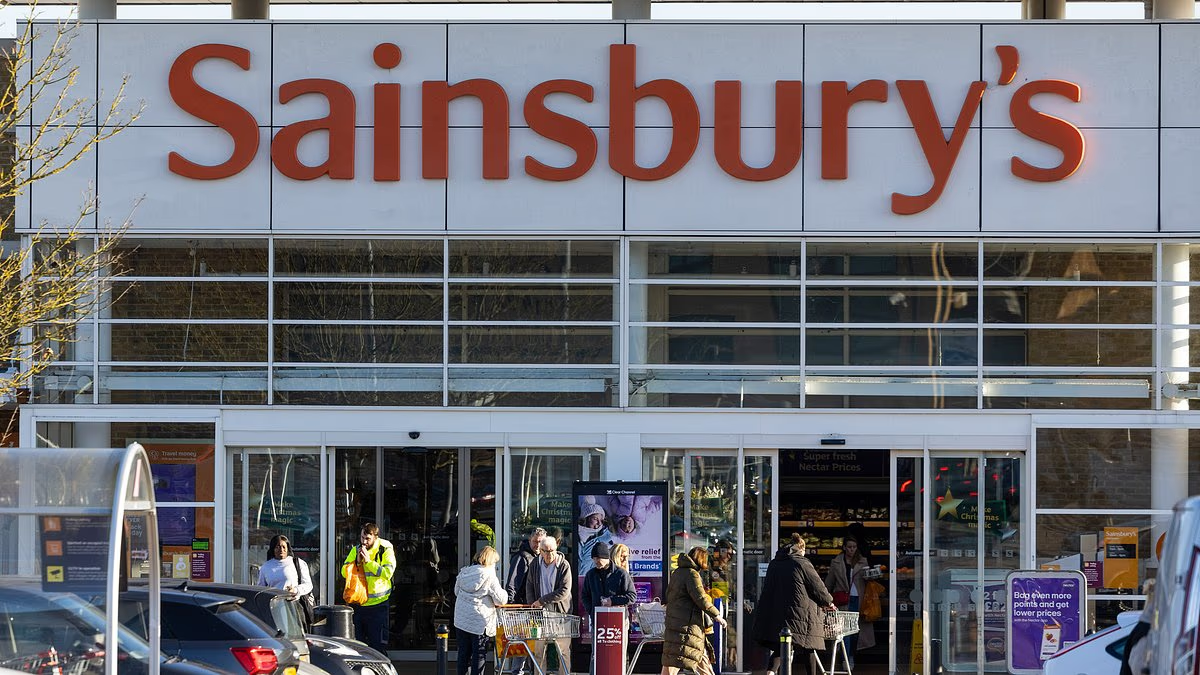
Tesco and Sainsbury’s have long been regarded as dependable staples in a well-balanced investment portfolio.
However, a fresh political dispute over supermarket pricing is raising questions about whether those defensive qualities can be relied upon.
After Andy Burnham pledged to crack down on consumer rip-offs, chancellor John Healey said the government was “watching closely for any suggestions that customers are being taken for a ride at the pump or the till.”
Speculation that the Budget could include measures to make the weekly shop more affordable has focused attention on Tesco, Sainsbury’s and Marks & Spencer—the publicly listed companies among Britain’s £196billion grocery market.
Could supermarkets face a Budget backlash? Or can Tesco and Sainsbury’s rebut accusations that their loyalty schemes rely on misleading discounts?
Tesco’s customer reach is anchored by its Clubcard scheme, while Sainsbury’s draws shoppers in through Nectar.

At the top: Ken Murphy is the chief executive of Tesco
The allegations of price-gouging have come from Giles Hurley, chief executive of Aldi, the privately owned German retailer, which does not run a loyalty scheme.
The dispute has resurfaced five years after the cost-of-living crisis began in August 2021, when inflation jumped to 3.2 per cent before reaching a peak of 11 per cent in October 2022.
Inflation currently stands at 2.9 per cent, while food inflation has eased to 1.3 per cent despite rising energy costs. A long, hot summer may have lifted sales of drinks, ice cream and snacks, although drought across the UK and Europe is expected to damage crops and could push up supermarket prices.
Against that backdrop, influential retail analyst Clive Black has defended the listed supermarkets, arguing that their enormous scale does not translate into large profit margins.
Tesco’s margin is only 4.3 per cent, reflecting what chief executive Ken Murphy describes as an “intensely competitive market”. Aldi, Asda, Lidl, M&S, Morrisons, Sainsbury’s and Tesco remain locked in a relentless battle for shoppers.
Black says retailers are currently helping households by “absorbing undoubted cost pressures”. In his view, the government should acknowledge that consumers may not be paying too much for food, but too little to support the industry sustainably.
Food retailers have traditionally been seen as defensive investments during difficult economic periods. Yet should the government’s campaign against these household names, however poorly conceived, make investors more cautious? Here is our guide.
Abuse of pricing power?
Investors can draw some reassurance from the Competition and Markets Authority’s 2023 investigation into the supermarket sector, which found no evidence of profiteering.
Susannah Streeter of the Wealth Club notes that, even if the government reopens the inquiry, the supermarkets’ wafer-thin margins could make it difficult to establish evidence of price-gouging.
More recently, former chancellor Rachel Reeves abandoned plans for price caps on bread, eggs, milk and other essentials after facing opposition from the Bank of England and retailers.
Stuart Machin, chief executive of M&S, described the proposal as “completely preposterous”. He said the chain lost money on products such as milk, which carried a “negative 7 per cent margin”.
Streeter adds that Aldi may feel it has little to lose by continuing to present itself as the consumer’s moral champion.
Tesco and Sainsbury’s, meanwhile, would have to defend their discounting practices against claims that they first inflate prices before marking them down.
If sufficient publicity surrounds such a war of words, customers could become suspicious which could be bad news for sales – and the shares.
At the same time Lale Akoner, global strategist at eToro, says that the supermarkets will come under pressure to keep prices down, even as energy, wages and other overheads go up.
But, if you believe that the British trust in supermarkets may be greater than our confidence in any government, this is the outlook for their shares
Tesco
Tesco is the £27.7billion titan of the grocery trade with a 28.5 per cent slice of the market. Its empire also encompasses the food wholesaler Booker and 560 central Europe stores, although these may be sold off, spelling an end to global dominance ambitions.
Tesco shares stand at 446p, having fallen by 10 per cent over the past six months, amid apprehension over the impact of the drought.
However, at the height of alarm over the 2014 accounting scandal that engulfed this high street stalwart, the shares slumped to as low as 169p.
Today the average target price for the shares is 550p. Bank of America is one of Tesco’s fans, citing its strong return on capital and reckoning that that it can take market share from “structurally weaker” rivals. Like Morrisons, maybe?
But Black of Shore Capital, although a long-term admirer of Tesco’s operational performance, now believes that the shares are fairly valued at their current level as competition gets tougher.
I am a long-term holder of Tesco, as I am impressed by so many aspects of the business.
Tesco offers ‘more dash than cash’ fashion under the F&F label: its Finest premium private label range skilfully caters for households looking for restaurant-level cuisine – and it can rely on Booker.
The sway of this business should ensure that Tesco should benefit from the best deals with food producers in the months ahead.

Competitive: Sainsbury’s is Britain’s second biggest supermarket
Sainsbury’s
Sainsbury’s is Britain’s number two supermarket with a 15.2 per cent market share. Asda, Aldi, Lidl and Morrisons have 11.5 per cent, 10.7 per cent, 8.8 per cent and 8.5 per cent respectively.
The £7.2billion business is selling off its Argos homeware arm next February to pursue a ‘food first’ strategy.
The news that Sainsbury’s would no longer try to be a ‘multi-product, multi-channel retailer’ gave a small lift to Sainsbury’s shares. The City prefers supermarkets content to be humble grocers.
Currently, however, just two of the analysts that follow the shares rate them a ‘buy’ at 336p. The rest consider Sainsbury’s to be a ‘hold’.
As Ankoner explains, there are questions as to whether Sainsbury can sustain its recent market-share gain, while protecting its margins in an increasingly price-sensitive market.
It also seems that brokers would like Sainsbury’s chief executive Simon Roberts to snap up one of its competitors.
In 2018, Sainsbury’s was barred from acquiring Asda. But a potential target is the US private equity owned Morrisons.
Roberts could assure the government that the resulting economies of scale would produce eye-popping bargains.
It is worth staying on board to observe whether increased political scrutiny reshapes the sector.
Marks & Spencer
M&S is the fastest growing name in grocery, controlling 4.5 per cent of the market, following a 16 per cent bounce in sales in the four weeks to August 9, helped by its re-styled Sparks loyalty programme and the popularity of its ‘picky bits’ ranges.
These are snacks for sultry summer evenings when it’s too hot to cook.
Food is the ‘outstanding performer’ in the £8.07billion company’s latest results, although there may have been more headlines about Marks’ new cool status in fashion.
The shares have risen by 17 per cent since the start of the year to 384p. But a majority of analysts rate them a ‘buy’, with an average target price of 437p.
Am I going to stay loyal to my M&S shares? Definitely. I am hoping that analysts’ projections prove reliable, and looking forward to Machin’s robust response to even a hint of Budget action.
DIY INVESTING PLATFORMS

AJ Bell
AJ Bell
Easy investing and ready-made portfolios

Hargreaves Lansdown
Hargreaves Lansdown
Free fund dealing and investment ideas

interactive investor
interactive investor
Flat-fee investing from £4.99 per month

Freetrade
Freetrade
Investing Isa now free on basic plan

Trading 212
Trading 212
Free share dealing and no account fee
Affiliate links: If you take out a product This is Money may earn a commission. These deals are chosen by our editorial team, as we think they are worth highlighting. This does not affect our editorial independence.
Compare the best investing account for you


