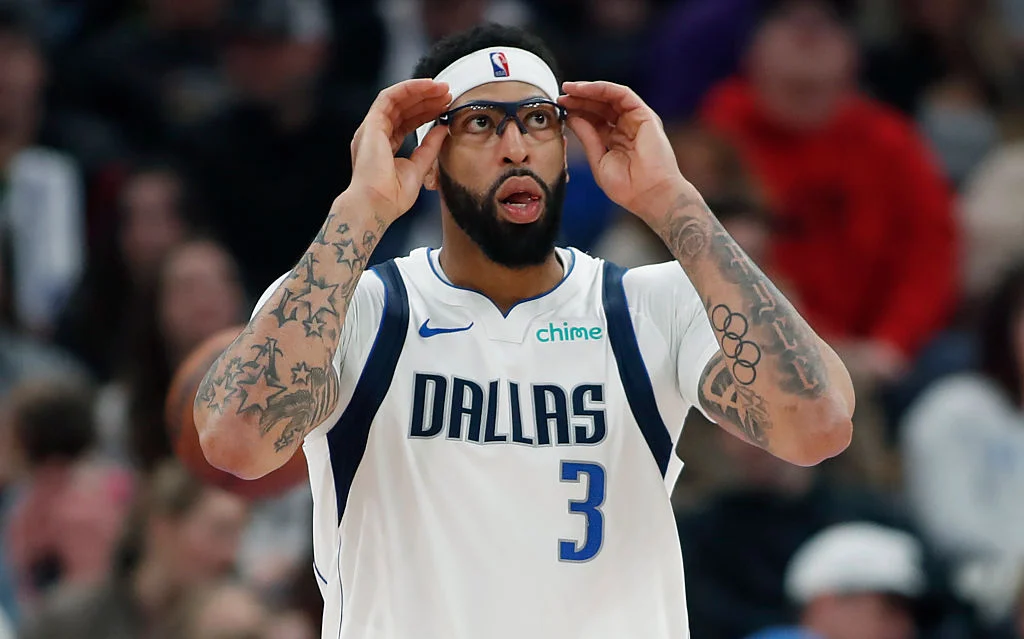

Anthony Davis entered the NBA as the New Orleans Pelicans’ No. 1 overall pick in the 2012 draft and quickly established himself as one of basketball’s premier talents. More than a decade later, he remains in the conversation as a top-10 to top-25 player, depending on the evaluator. Davis continues to impact games as an elite defender and productive big man, recently completing another double-double season with averages of at least 20 points and 10 rebounds. It marked the 10th time in his career he has reached that benchmark.
But the familiar saying that availability is the best ability has followed Davis throughout his career. He has never appeared in all 82 games of a season, and his availability has become an even greater concern in recent years. During his latest campaign, Davis suited up for only 20 games, missing 62 of the 82 contests available to him while playing for the Dallas Mavericks.
Dallas acquired Davis in the stunning February trade that sent Luka Dončić out of town, but the partnership lasted only one season. The Mavericks moved on from Davis a year after making the deal, with the veteran appearing in just 29 games for the franchise. He was injured in his Dallas debut, an early warning of the durability issues that would continue to define his brief tenure.

Chris Gardner/Getty Images
The Mavericks traded Davis to the Washington Wizards in February. He has yet to take the court for Washington, but his future contract is already becoming a major storyline.
According to reports, Davis and his agent, Rich Paul, are seeking a four-year contract valued at $275 million. That price tag could be difficult for the Wizards to embrace, particularly given Davis’ age and injury record. He is already under contract for the upcoming season and holds a player option for the year after that, meaning he would be 34—and potentially 35—when a new deal would begin.
If Washington is unwilling to make that kind of commitment, Paul may have to explore other teams. The central question is whether any potential trade partner would be prepared to meet Davis’ lofty asking price.
Davis has missed 203 games since the 2020-21 season, an average of roughly 48 absences per year during that stretch. If that pattern continued under a $275 million contract—equivalent to $68.75 million annually—he would effectively earn about $1.43 million per game played.
For teams, the risk is obvious. A 33-year-old big man coming off a season in which he played only 20 games may be viewed as a significant injury gamble, especially at a cost exceeding a quarter-billion dollars. NBA history offers plenty of examples of teams growing cautious when age, health concerns and massive contracts collide.
Still, Davis should not be faulted for pursuing the biggest deal possible. NBA owners are billionaires, and the league’s top stars have every incentive to maximize their earnings. The challenge for Davis and Paul may simply be recognizing that their current expectations could need some adjustment.
Davis has already earned more than $364.4 million during his NBA career, with another $120 million-plus still scheduled to come his way—approximately $58 million this season and $62 million next season if he exercises his final-year option. Even so, there is little downside to aiming high. Perhaps a general manager or owner will focus on Davis’ two-way impact, his star power and his ability to generate excitement, deciding that the potential reward outweighs the injury concerns. As the saying goes, it never hurts to ask.


