A former technology journalist, a literature graduate, a college dropout, three physicists and an engineer who once launched a dating app to overcome his shyness.
Those seven individuals now stand behind one of the most remarkable collections of founder wealth Silicon Valley has ever seen. Following Anthropic’s blockbuster IPO, their combined holdings are worth $186.6 billion in stock.
Anthropic shares opened on the Nasdaq at $111.50, a remarkable 34% above the $83 IPO price set only hours earlier. That opening trade lifted the five-year-old artificial intelligence company’s fully diluted valuation to approximately $2 trillion.
Seven Founders, Seven Extraordinary Fortunes
When this story was first published Wednesday night, Anthropic had priced its IPO at $83 per share, placing the company’s valuation at roughly $1.5 trillion. At that price, each of the seven founders held a stock fortune approaching $20 billion.
Then trading began Thursday morning.
Anthropic’s first trade reached $111.50 per share, sending its fully diluted valuation to about $2 trillion. The move instantly increased the combined value of the founders’ remaining stakes from $138.9 billion to $186.6 billion.
Here is how those fortunes compare at Anthropic’s opening share price:
| Founder | Stock Value at $2T |
|---|---|
| Tom Brown | $26.85 billion |
| Sam McCandlish | $26.76 billion |
| Christopher Olah | $26.70 billion |
| Jared Kaplan | $26.65 billion |
| Jack Clark | $26.64 billion |
| Daniela Amodei | $26.54 billion |
| Dario Amodei | $26.45 billion |
| Combined | $186.59 billion |
Each founder sold 3,378,378 shares in the IPO at $83 apiece, producing $280.4 million in gross proceeds each before taxes and fees.
What stands out most is the even distribution of that wealth. Anthropic has a clearly identified CEO and a high-profile president, yet its ownership structure reflects the shared financial success of all seven founders.
The founders also retain extraordinary control of the company. Through a special Class F share held by a founder-controlled entity, they collectively control 50.1% of the voting power on matters generally submitted to shareholders. Separately, Anthropic’s Long-Term Benefit Trust can appoint a majority of the board. Together, those arrangements allow the founders and the trust to preserve significant influence as outside investors acquire shares.
Dario Amodei: The Scientist Who Became Anthropic’s Public Face
At 43, Dario Amodei is Anthropic’s CEO and most recognizable public figure. Before becoming one of the leading personalities of the AI boom, he pursued a very different path in biophysics and later conducted cancer-related research at Stanford’s medical school.
His transition into artificial intelligence took him to Baidu and Google before OpenAI recruited him in 2016. He eventually became the company’s vice president of research, helping lead the development of language models that laid the foundation for today’s chatbot revolution.
Amodei later parted ways with Sam Altman and joined the group that founded Anthropic. The new company made AI safety a defining part of its identity while undertaking the costly research required to compete at the industry’s highest levels.
That combination has turned Dario into an unusual kind of business celebrity. He promotes the potential of increasingly capable AI while warning about the risks those systems may create. Anthropic’s commercial rise has given his views influence well beyond the world of academic research.

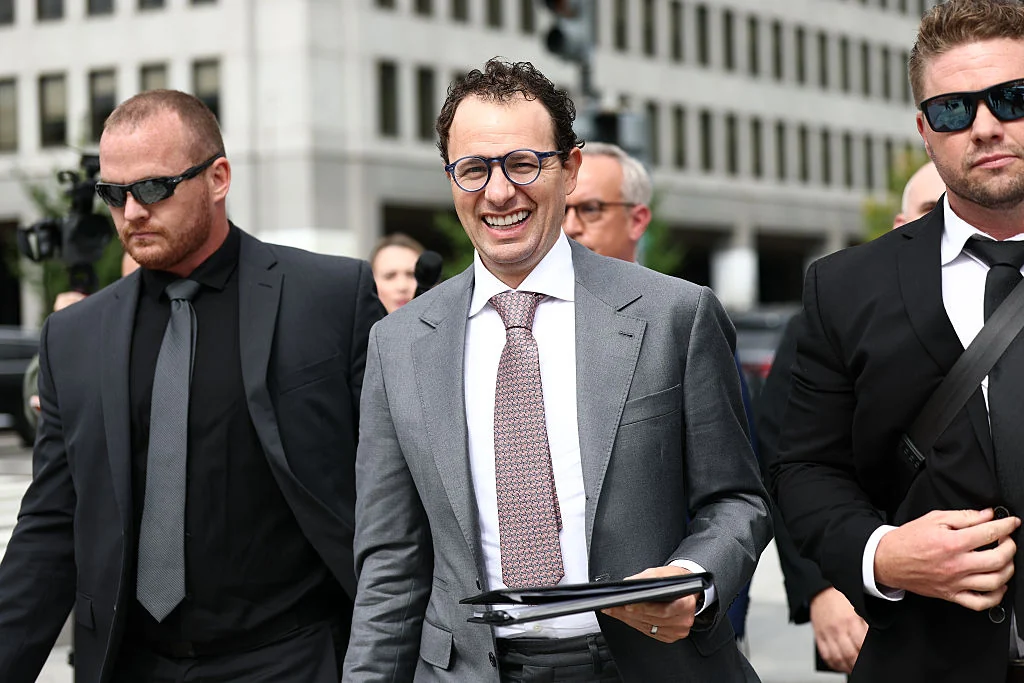
(Photo by Finn Gomez/Getty Images)
Daniela Amodei: The Literature Major Running The Business
Dario’s younger sister, Daniela Amodei, 39, is Anthropic’s president and board chair. Her route into the industry began with a literature degree from the University of California, Santa Cruz, rather than a computer science doctorate.
After graduating in 2009, she worked in politics before joining Stripe and then OpenAI. Those jobs helped develop the skills that would become central to her work at Anthropic: recruiting people, managing teams, handling risk, and building an organization that could keep pace with its technology.
As president, Daniela oversees work across research, engineering, product development, governance, and commercial operations. She also brings something no other executive can offer: a lifetime of experience dealing with the CEO as her older brother.
There is a financial sibling twist, too. Daniela’s disclosed holdings exceed Dario’s by 770,960 shares. She remains ahead even after excluding awards belonging to her husband, Holden Karnofsky.
Tom Brown: The Engineer Securing The Computing Power
Tom Brown, 39, is Anthropic’s chief compute officer. His job includes securing and expanding the computing resources required to build and operate the company’s models, making him responsible for a crucial ingredient in Anthropic’s growth.
Brown graduated from MIT and worked as an engineer before becoming a major AI researcher. His earlier ventures included a dating app, which he has said he co-founded partly to help overcome his own shyness.
At OpenAI, Brown contributed to the research behind modern language models. He was also a co-author of the 2020 paper “Scaling Laws for Neural Language Models,” alongside several of his future Anthropic co-founders.
His responsibilities now extend beyond technical research. As The Wall Street Journal described, Brown has negotiated chip deals and helped navigate sensitive relationships with Washington, including the company’s dealings with the Pentagon. The engineer who once built a dating app now works on decisions involving some of the most expensive infrastructure in the technology industry.
Jack Clark: The Journalist Who Joined The Story
Jack Clark took a route into AI that will be particularly interesting to anyone who has ever written about wealthy technology founders for a living. Before becoming one himself, he was a technology journalist.
Clark covered the industry for publications including Bloomberg Businessweek, developing a strong interest in the machine-learning research that would eventually underpin products such as Claude. He then moved into OpenAI, working on communications and policy, before joining the Anthropic founding team.
At Anthropic, he became a leading voice on policy and the broader consequences of advanced AI. In March 2026, the company announced that he would lead the Anthropic Institute and become its head of public benefit.
Clark has also continued writing through his “Import AI” newsletter. His work now spans both the development of powerful technology and questions about how governments, workers, and society should respond to it.
Jared Kaplan: The Physicist Behind The Scaling Research
Jared Kaplan, 42, studied physics and mathematics at Stanford, earned a physics doctorate at Harvard, and joined the faculty at Johns Hopkins. His academic interests included quantum gravity before his career moved deeper into machine learning.
He began consulting for OpenAI in 2019 and became a leading author of “Scaling Laws for Neural Language Models.” The paper examined how language-model performance changes as researchers increase model size, training data, and computing resources.
That research helped make a hugely expensive technical undertaking more predictable. It gave researchers a way to study how they could allocate computing budgets and what improvements larger training efforts might produce.
Kaplan became Anthropic’s chief science officer, leading technical research. His career connects the theoretical questions studied in university physics departments with the practical decisions involved in building a major commercial AI laboratory.
Sam McCandlish: The Architect Behind The Models
Sam McCandlish, 36, also came through physics. He studied mathematics and physics at Brandeis before earning his doctorate at Stanford.
At OpenAI, McCandlish worked with Kaplan on the scaling research that helped explain the relationship between larger training efforts and better model performance. Their collaboration continued into Anthropic, where McCandlish became chief architect.
His work focuses on large-scale model training, including pretraining, research productivity, and reinforcement-learning infrastructure. These are the systems and processes behind the improvements users encounter when a new version of Claude arrives.
McCandlish has a much lower public profile than the Amodei siblings. His place in the founding team nevertheless puts him alongside them financially, illustrating how much of the company’s value rests on the researchers building its underlying technology.
Christopher Olah: The Dropout Trying To Understand AI’s Mind
Christopher Olah, 34, stands out in a group that includes three doctorate holders. A college dropout, he became a major figure in AI research through his work on interpretability: understanding what happens inside a model as it produces an answer.
Olah leads that research at Anthropic. The challenge goes beyond checking whether Claude gives a useful response; researchers want to understand the internal mechanisms that produced it.
His interests also reach into questions that sound more philosophical than commercial. The Wall Street Journal reported that Olah participated in discussions with religious leaders about the possibility of AI consciousness and met Pope Leo XIV.
That combination of technical research and moral inquiry fits Anthropic’s stated ambition to build powerful systems while understanding their risks. It has also placed Olah among the beneficiaries of one of the largest wealth-creation events in the industry’s history.
The Promise To Give Most Of It Away
There is one more unusual element to these fortunes. Anthropic says its founders pledged at the company’s creation to donate 80% of their personal equity holdings to philanthropic causes.
The company has also announced a separate Public Benefit Fund, designed to direct part of Anthropic’s equity value toward public-benefit work. Its stated areas of interest include the disruption AI could cause in the labor market.
There is an important distinction between a philanthropic pledge and an actual donation. Anthropic’s prospectus describes the founders’ commitments as voluntary and revocable, with no legally binding obligation to complete the donations. The timing, recipients, and structure of any future gifts remain up to the individual founders.
At Anthropic’s opening share price, these seven founders collectively held stock worth nearly $187 billion. Whether they keep it, sell it, or ultimately give most of it away is a story that begins, rather than ends, with Anthropic’s blockbuster IPO.


