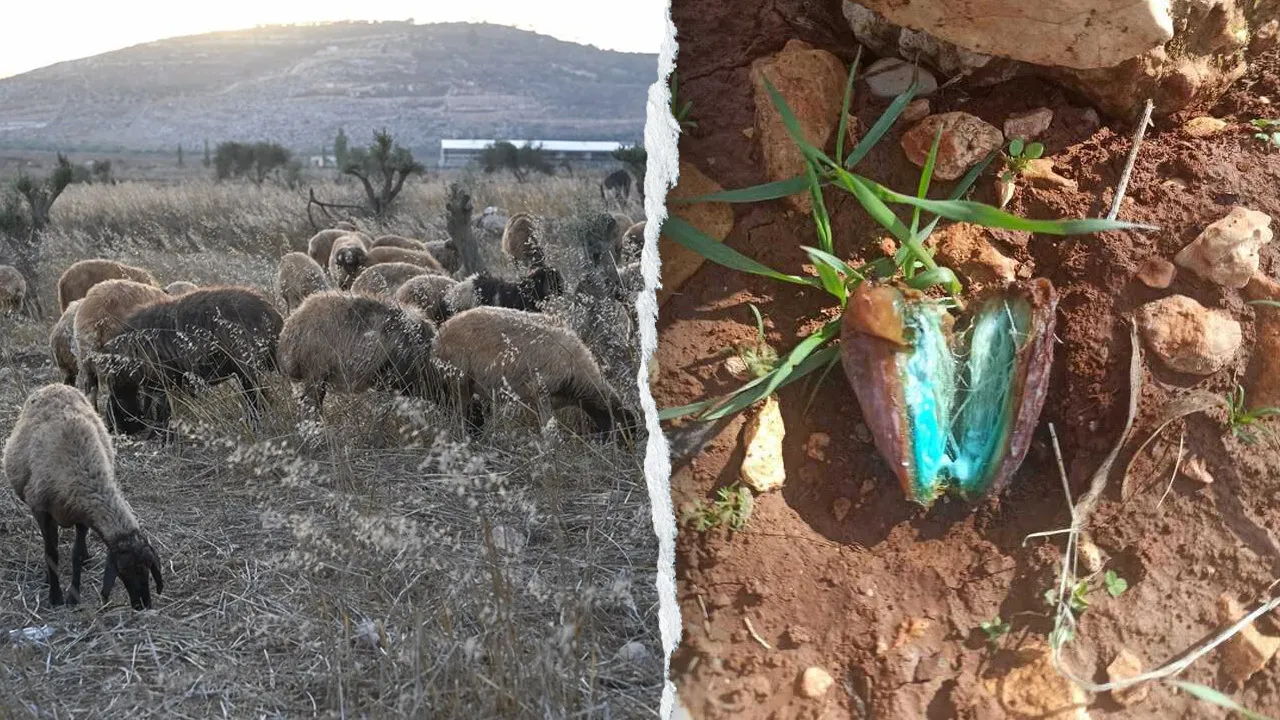

A string of suspected animal-poisoning attacks has alarmed Israeli security officials, farmers and regional leaders, who say the incidents pose a growing threat to agricultural communities. Farmers report substantial livestock losses and warn that contaminated food and water could endanger wildlife, pets and nearby residents.
An Israeli source told News Outlet that military officials are treating reports of animals being poisoned on Jewish-owned farms in the West Bank — referred to in Israel as Judea and Samaria — as “agricultural terror.”
The issue gained broader attention after an investigation by The Press Service of Israel (TPS-IL) documented a cluster of suspected poisonings at farms throughout the Binyamin region during the past year.

Goats graze at an Israeli farm near the West Bank in July 2026. Israeli agricultural workers say Palestinian militants have carried out a series of livestock-poisoning attacks since November 2025. (Yoav Dudkevitch/TPS-IL)
In a TPS-IL video, an Israeli farmer said the suspected toxins had been hidden in food, including dates and pita bread.
“We have two populations with warm blood,” the source said, referring to Israelis and Palestinians in the disputed region. “Sometimes this manifests as verbal or physical violence, attacks, arson, property damage and, among other things, agricultural terrorism involving harm to animals.”
The source said officials had recently received an increasing number of reports alleging that Palestinians were attempting to poison animals, describing dozens of cases in recent weeks. “We act against terror,” the source said, adding that authorities would detain a Palestinian if they received intelligence indicating that the person intended to poison someone or had done so previously.
The source urged farmers to keep their animals within approved grazing areas, mark livestock as directed and report every incident to the appropriate authorities, noting that poisoning animals is considered a cruel act.

An Israeli shepherd examines a dead goat from his herd that he says was poisoned by Palestinian militants. Local shepherds have reported a series of livestock-poisoning incidents since November 2025. (Yoav Dudkevitch/ TPS-IL)
Evyatar Karo, a leader of the farming movement whose Metzudat David farm is in the Binyamin region north of Jerusalem, said his operation has been among the hardest hit. He told News Outlet that the incidents began in November 2025. During one daily visit to the pasture, Karo said, he found a goat gasping and drooling on the ground, then discovered another animal in the same condition.
“Suddenly, we found dates scattered about — strange, because they weren’t natural; they had a blue substance inside,” he said.
Karo said he mixed veterinary medicine with water and gave it to the goats in an effort to slow the toxin’s effects. One goat survived, while four died.

Poisoned food was found near a grazing area used by Israeli farmers and shepherds. Palestinian militants are blamed for poisoning Israeli livestock. (Yoav Dudkevitch/ TPS-IL)
“We brought in the Nature and Parks Authority to investigate the matter. The poison is lethal. If the carcass of an animal that died from this substance is left in the field, it poses a danger to other animals that might eat it. It works like a chain that can affect other wildlife,” he told News Outlet.
Karo alleged that one of the substances used was Lannate, a broad-spectrum carbamate insecticide commonly used in agriculture, but said it had been applied at a highly concentrated level.
“We lost 25 animals. It’s a terrible thing. The animals just die in your hands. They scream and cry. You can see them choking — it’s a horrible substance,” he said.
Karo said police had begun an investigation, but warned that the attacks could intensify.
“It’s not just me, either — it involves a whole network, a lot of places. It occurred in Gush Etzion and Shiloh, including incidents involving poisoned water cisterns,” he said. “We are speaking of organized Palestinian squads. They see where we take our animals and spread the poison there. It starts with animal lives, but eventually they can hurt people.”

An Israeli shepherd checks a well for poison in July 2026. Israeli farmers and shepherds blame Palestinian militants for the suspected poisonings. (Yoav Dudkevitch/ TPS-IL)
TPS-IL reported additional suspected poisonings in January and February 2026, followed by several more incidents. On May 5, contaminated water was found in roughly 10 cisterns near Alon Road, close to al-Mughayyir. At Shlisha Farm on June 7, two sheep died and about 15 others became ill. In July, poisoned food bait was found near Tel Talpiot, close to Gush Shiloh. Two guard dogs died within minutes in that incident, and a goat reportedly also died.
MORE STORY: Irish Woman Nikita Hand Details Alleged Ordeal Involving Conor McGregor
Palestinians, however, have accused Israeli settlers of retaliatory attacks against their livestock. WAFA, the official Palestinian Authority news agency, reported last Thursday that 13 sheep died and several others became ill after an alleged attack by “Israeli colonists” west of al-Auja, north of Jericho.
Suleiman Mleihat, who owns the sheep, told WAFA that dozens of “Israeli settlers” sprayed toxic substances across the area where his flock was grazing. He said a veterinarian examined the animals and concluded that poisoning caused the deaths.
Mleihat said his sheep are kept at a farm on the edge of the area, which Israeli residents and security forces visit daily.
The term “Hilltop Youth” is often used broadly for people who establish outposts in volatile areas near Palestinian communities, sometimes triggering violent confrontations. Most residents of Judea and Samaria reject the label.
Yisrael Ganz, governor of the Binyamin region and chairman of the Yesha Council, which represents Jewish communities in Judea and Samaria, said anyone willing to poison a goat could eventually turn against local residents.

An Israeli farm in the West Bank in July 2026. (Yoav Dudkevitch/ TPS-IL)
“It could be a child tomorrow who sees the dates on the ground and eats them. Think about a shepherd who takes his children out into the area. If they’re able to poison our water sources, they could hurt thousands of people,” Ganz told News Outlet. “They killed goats, dogs and cows, and we are sure we will be the next targets. It could happen today, with the same dates left near a playground or daycare.
“The terrorists will have no more mercy for humans than they do for goats,” he continued. “When someone kills goats to terrorize the shepherd, they can kill the shepherd, too. When someone says he wants to kill you and has found a way to do so, you have to worry that one day he will succeed. We don’t have to wait for that.”

An Israeli farmer points to blue powder on a West Bank farm in July 2026. Israeli farmers say the substance is linked to a wave of incidents that began in November 2025, when livestock were reportedly targeted and killed amid continuing tensions with Palestinians. (Yoav Dudkevitch/ TPS-IL)
Ganz cited 16 incidents, but said the growing frequency was most troubling. He said reports had recently emerged nearly every week. “When they see that they are succeeding, they improve their techniques,” he said.
As an immediate measure, Ganz said donors had funded dozens of body cameras for shepherds. He emphasized, however, that the equipment could not substitute for action by authorities.
Ganz called the incidents a top priority and warned that contamination of water sources serving Jerusalem or other parts of Judea and Samaria could produce a major attack.
Israel’s Coordinator of Government Activities in the Territories (COGAT) told News Outlet that the Civil Administration treats reports of suspected poisoning involving grazing areas, water sources or animals with the utmost seriousness and investigates every case brought to its attention.
Through its Agriculture Unit, the Civil Administration maintains regular communication and cooperation with relevant authorities and professional counterparts to help protect animals in Judea and Samaria and address agricultural and livestock-related needs.

Sheep stand on an Israeli farm near the West Bank in July 2026. (Yoav Dudkevitch/ TPS-IL)
“Upon receiving a report, the unit’s professional personnel conduct field inspections, collect findings and evidence, and, when necessary, take samples of the suspected substance and submit them for testing at specialized laboratories, including the Ministry of Agriculture’s laboratories in Beit Dagan, in order to determine the circumstances of the incident and establish a professional assessment of the situation. Based on the findings and identified needs, the unit coordinates assistance, including the provision of medicines, food and water,” COGAT said.
“The potential effects of toxic substances on soil, water sources and the environment depend, among other factors, on the type of substance, its concentration and the characteristics of the affected area. Therefore, each case is assessed individually. The Civil Administration attaches great importance to environmental protection in Judea and Samaria and acts within its authority to identify and address environmental hazards,” it added.
COGAT said that investigating the incidents and pursuing those responsible falls under the authority of the Israel Police.
News Outlet contacted the Israel Police but had not received a response before publication.


