
NVIDIA was brought to life in 1993 by the visionary trio of Jensen Huang, Chris Malachowsky, and Curtis Priem. Just six years down the line, on January 22, 1999, NVIDIA made its debut on the stock market. By the end of its first trading day, the company boasted a market capitalization of $550 million.
Over the ensuing years, NVIDIA’s stock witnessed a steady climb as its graphics processors became the gold standard in high-performance PC gaming. By January 2000, the company’s market cap had reached $1 billion, doubling within a few months, and climbing to approximately $3.5 billion before the dot-com bubble’s burst. The early 2000s were tumultuous for NVIDIA, as it neared a $7 billion valuation before a tech sector crash and an SEC investigation into its accounting practices slowed its momentum. A decline in PC demand and an ill-timed product transition further eroded investor confidence, dropping its market cap to about $870 million by September 2002.
Despite these challenges, NVIDIA gradually regained its footing, driven by innovative GPU architectures, the rising popularity of 3D gaming, and significant partnerships with console giants like Microsoft’s Xbox and Sony’s PlayStation 3. By 2004, NVIDIA stabilized within the $2–3 billion range, reaching beyond $10 billion in 2006. Mid-2007 marked a milestone as its valuation surged to approximately $15 billion, solidifying its dominance in the graphics technology arena.
In this period of renewed success, Jensen Huang and his wife Lori contemplated leveraging their wealth for a greater good. Thus, in the summer of 2007, they founded the Jen-Hsun and Lori Huang Foundation, funding it with an initial donation of 370,000 NVIDIA shares valued at $12.6 million at the time—before future stock splits.
In contrast to the vast fortunes propelling Silicon Valley’s giant foundations—like those from Hewlett-Packard, Intel, eBay, Dell, and Google—the foundation’s initial sum seemed modest. It was a far cry from the resources behind the Bill & Melinda Gates Foundation, sitting on a colossal $33 billion.
Fast forward to the present, and NVIDIA has transformed from a niche gaming graphics card producer into the world’s most valuable company, with its market cap rapidly nearing $6 trillion. Concurrently, the Jen-Hsun and Lori Huang Foundation has evolved from a little-known charity into a significantly larger and more influential entity.
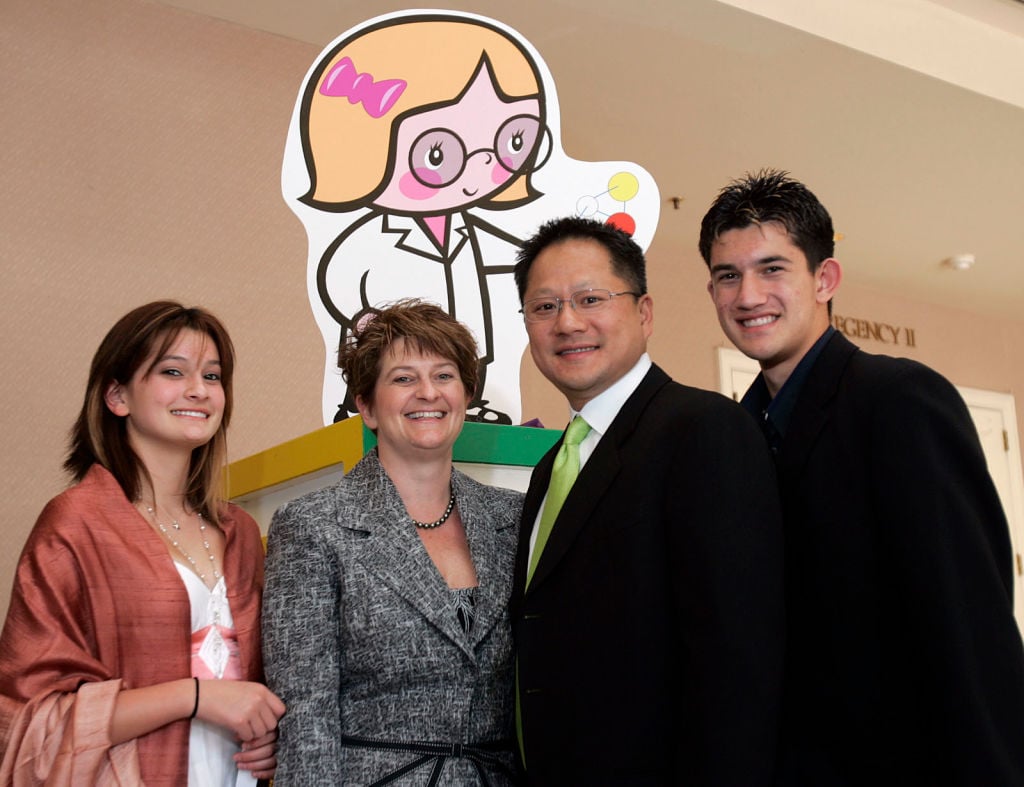
Jensun with his family, Madison, Lori, and Spencer in 2007 (Thu Hoang Ly/Mercury News) (Photo by MediaNews Group/The Mercury News via Getty Images)
From Modest Gift To Mega Foundation
To reiterate, the Jen-Hsun and Lori Huang Foundation was quietly seeded in 2007 with a donation of 370,000 NVIDIA shares, then worth around $12.6 million.
As you know, over the next 17 years, but especially in the last few years, NVIDIA’s stock has gone absolutely parabolic. During that period, the company executed three stock splits, turning the Huangs’ original 370,000 shares into roughly 14.8 million today. At NVIDIA’s current $6 trillion market capitalization, that initial donation alone would be worth $3.7 billion—enough to rank the foundation among the 50 largest in the world.
But wait. There’s more!
The Huangs have continued to add to their foundation’s holdings over the years. In June 2025, for example, they contributed another 440,000 shares, valued at approximately $60 million at the time of transfer.
According to its latest filing, as of the end of 2023, the foundation held 68.5 million shares of NVIDIA. If you add the 440,000 shares from the June 2025 transfer, it’s probably safe to call it 69 million today. At today’s $6 trillion valuation, those 69 million shares are now worth around…
$17.2 billion
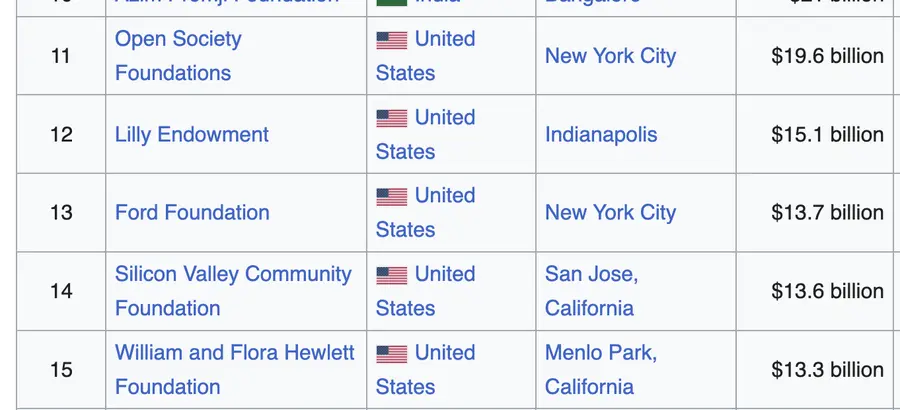
That’s enough to rank the Jen-Hsun and Lori Huang Foundation as the 13th largest charitable foundation on the planet, ahead of both the Ford Foundation ($13.7 billion) and the Lilly Endowment ($15.1 billion).
Yet if you look at Wikipedia’s ranking of the world’s largest foundations, you will not find the Jen-Hsun and Lori Huang Foundation listed. Not lower in the rankings with an outdated number. The foundation is not listed at all.
The reason is simple: the Jen-Hsun and Lori Huang Foundation keeps a remarkably low profile. It has no website, no public address, and no digital footprint beyond mandatory filings. A LinkedIn search for employees turns up nothing. For comparison, the Ford Foundation employs 423 full-time people. The Gates Foundation employs over 2,000 people. The Jen-Hsun and Lori Huang Foundation? Employs ZERO people.
Where the Money Is Going
Like many modern tech philanthropists, the Huangs have relied heavily on donor-advised funds (DAFs) as an initial vehicle for giving. In 2023, roughly 77% of the foundation’s disbursements—about $46 million—went to a Schwab-managed DAF. These accounts are popular among wealthy donors because they allow for an immediate tax deduction while postponing the actual deployment of funds. DAFs are not required to distribute assets on any schedule and are not obligated to publicly disclose where their eventual grants go, which makes them a convenient but opaque tool for large-scale philanthropy.
The Huangs have also made several major direct gifts from their foundation. In 2022, they pledged $50 million to Oregon State University, their alma mater, to fund a new research and education complex. In early 2025, they announced a $22.5 million grant to the California College of the Arts, aimed at strengthening the school’s endowment and academic programs. Other public records show additional support for institutions like Stanford University and select community and mental health organizations.
As the foundation’s assets continue to grow, so too will the required level of annual giving. U.S. law mandates that private foundations distribute at least 5% of their assets each year, whether through direct grants or DAF contributions. Based on the company’s 2024 average market cap, the foundation likely had to distribute around $350 million this year to meet its 5% minimum. Assuming NVIDIA maintains its current $6+ trillion market cap, next year the foundation will be required to distribute $860 million!
For most charitable organizations, $860 million would represent a generational war chest.
For the Jen-Hsun and Lori Huang Foundation, it could soon be the annual minimum.
BTW, What Happened To His Co-Founders?
If you recall the first sentence of this article: “NVIDIA was founded in 1993 by Jensen Huang, Chris Malachowsky, and Curtis Priem.” When NVIDIA went public:
- Jensen owned 15% of the company
- Chris owned 10%
- Curtis owned 12.8%
Today, Jensen owns 3.5% of NVIDIA, which at today’s $5 trillion market cap, gives him a net worth of $200billion. He is the #7 richest person on earth.
Chris Malachowsky still works at the company, holding the title of NVIDIA Fellow and remaining deeply involved in research and high-performance computing initiatives. His net worth is not known, but he is not a confirmed billionaire. If he still owned his 10% stake, today he would be worth $500 billion.
Curtis Priem walked away two decades ago and proceeded to give nearly all of his fortune to his alma mater, Rensselaer Polytechnic Institute. After transferring most of his NVIDIA stock to a charitable foundation in 1999, Priem went on to donate more than $275 million to RPI—including a $40 million performing-arts center that bears his name and a $95 million pledge to bring an IBM Quantum System One computer to campus. At one point, he owned 12.8% of NVIDIA. If he still owned that much, today he would be worth $768 billion. According to a November 2023 Forbes profile of Curtis, at that point, he was worth around $30 million.
(function() {
var _fbq = window._fbq || (window._fbq = []);
if (!_fbq.loaded) {
var fbds = document.createElement(‘script’);
fbds.async = true;
fbds.src=”
var s = document.getElementsByTagName(‘script’)[0];
s.parentNode.insertBefore(fbds, s);
_fbq.loaded = true;
}
_fbq.push([‘addPixelId’, ‘1471602713096627’]);
})();
window._fbq = window._fbq || [];
window._fbq.push([‘track’, ‘PixelInitialized’, {}]);


