
Netflix is set to premiere a new Mr. T documentary, “Untold Mr. T: I Pity the Fool,” on September 8.
Mr. T was deeply involved in the project, giving extensive interviews and speaking candidly about his upbringing, rise to fame, faith, career, and life after “The A-Team.” But the final cut reportedly left him livid. After watching the completed documentary, he felt it leaned too hard into the well-worn tough-guy image that made him famous, while giving far less weight to the parts of his life he considers most important: his military service, religious beliefs, charitable work, and personal values. One inclusion especially upset him: a former agent with whom he had a serious falling-out.
Despite that frustration, Mr. T is still participating in media coverage tied to the documentary’s release.
One of the most revealing examples is a wide-ranging new interview with “The Guardian.” The profile is filled with memorable Mr. T anecdotes, from the story behind his name and the reason he wore so much gold to his years as a celebrity bodyguard. He also discusses his uneasy dynamic with “The A-Team” co-star George Peppard, his disappointment with Hollywood, and why he insists money was never the main prize he was chasing.
Still, one moment from the conversation stood out to us at CelebrityNetWorth.
Toward the end of the interview, Mr. T was asked a direct question: Does he have much money left?
His answer was classic Mr. T:
“No. Let’s say I’m broke, because that sells better. People want to hear, he’s broke and he’s run out of money. It works better.”
When the interviewer pushed back and said he didn’t want to claim Mr. T was broke unless it was actually true, Mr. T refused to reveal what was in his wallet. He instead emphasized that money was no longer how he measured his life. Earlier in the same conversation, when asked whether he would take a good role in another “Rocky” movie, Mr. T said no. In his words, the money he made years ago gave him the freedom to spend his time doing what he considers his true calling.
So, no, we don’t interpret Mr. T’s “I’m broke” comment as a literal declaration that he has no money. But here’s the fascinating thing: Mr. T really did go broke once. Or at least very, very close.
And thanks to a remarkable series of lawsuits, court filings, tax-return disclosures, real estate records, and interviews from the 1980s and 1990s, we can reconstruct one of the wildest celebrity financial roller coasters we’ve ever encountered…

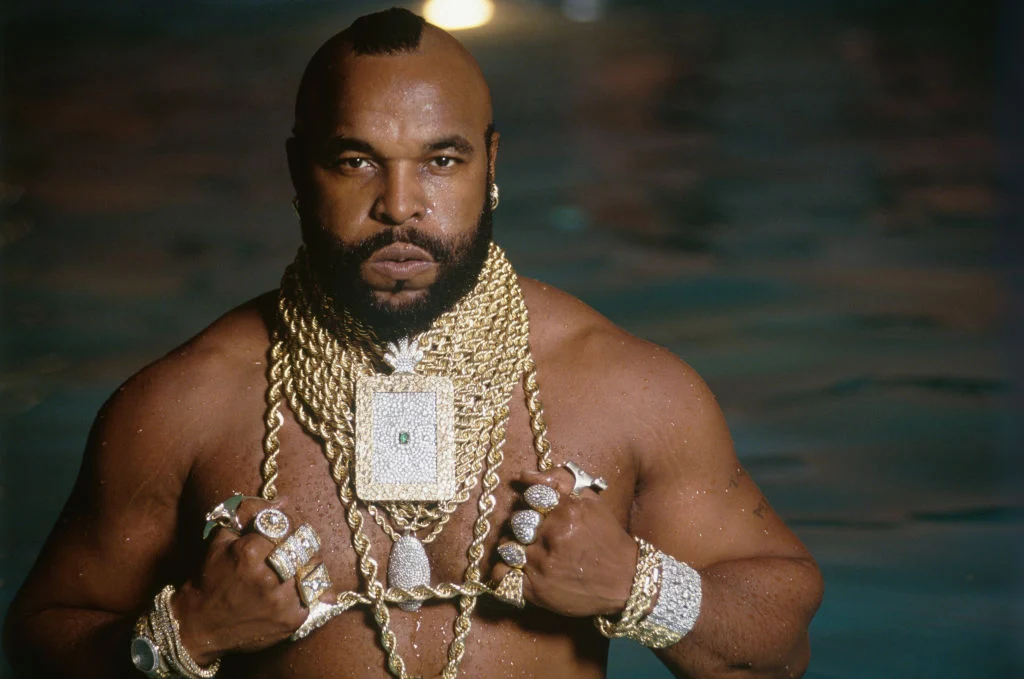
Mr T at home in Los Angeles in 1991. (Photo by Eric Robert/Sygma/Sygma via Getty Images)
From Chicago Bouncer To $5 Million-A-Year Superstar
Mr. T grew up poor on Chicago’s South Side as one of 12 children. After serving in the Army, trying unsuccessfully to make it in professional football, and working as a nightclub bouncer, he became a celebrity bodyguard whose clients included Muhammad Ali, Michael Jackson, Diana Ross, and Steve McQueen. His distinctive mohawk, massive collection of gold chains, and larger-than-life personality eventually caught Hollywood’s attention, leading Sylvester Stallone to cast the completely inexperienced actor as Clubber Lang in 1982’s “Rocky III.”
A year later, Mr. T became B.A. Baracus on “The A-Team,” and his fame exploded. Soon, he wasn’t simply starring in one of the world’s biggest television shows. He had his own NBC cartoon, Mr. T action figures, lunchboxes, Halloween costumes, records, motivational videos, breakfast cereal, advertising deals, movie roles, and lucrative appearances. In 1985, he teamed with Hulk Hogan in the main event of the first WrestleMania at Madison Square Garden.
In the late 1980s and early 1990s, Mr. T was one of the highest-paid celebrities in the world. At his peak, he was making around $5 million per year. That’s the same as roughly $13 million per year today. A lawsuit would later reveal that between 1983 and 1994, Mr. T earned more than $25 million. Call it around $60 million in today’s dollars.
So we aren’t talking about someone who merely looked rich because he wore 40 pounds of gold around his neck. Mr. T genuinely made a fortune.
The Lawsuit That Opened Mr. T’s Books
The lawsuit responsible for revealing those numbers actually began while Mr. T’s career was still exploding. In September 1984, two Chicago men named Calvin Hollins and John Bitoy sued him for $4 million. They claimed they had helped create the Mr. T persona, gotten him work at the Dingbats nightclub, placed him in televised tough-man competitions, and helped arrange the screen test that ultimately led to “Rocky III.”
Their most important allegation was financial. Hollins and Bitoy claimed Mr. T had orally promised to give them 20% of his earnings for life. Contemporary UPI reporting said their attorney estimated that Mr. T had already generated around $20 million in salary, wages, and royalties by the time the lawsuit was filed in 1984.
Mr. T disputed their version of events. He maintained that he split from Hollins and Bitoy in 1982 and that the men had done nothing afterward to justify receiving a permanent percentage of the fortune he subsequently earned.
The case dragged on for more than a decade. Court proceedings showed that Mr. T had made more than $25 million between 1983 and 1994 and had reported income of at least $5 million a year on his tax returns through 1993.
The same court battle also produced a much less pleasant number.
$4.9 million.
That’s how much Cook County Circuit Judge Kenneth Gillis ordered Mr. T to pay Hollins and Bitoy.
The Judgment Came At The Worst Possible Time
Had Mr. T still been making $5 million a year, a $4.9 million judgment would have been painful but potentially manageable. Unfortunately, by 1996, his peak earning years were behind him. “The A-Team” had ended in 1987, his follow-up series “T. and T.” ended in 1990, and the blockbuster movie offers, and enormous merchandising machine had largely dried up.
Much more seriously, Mr. T was battling lymphoma. Contemporary court reporting said he had undergone months of daily radiation therapy and was suffering from severe depression during treatment. In other words, at almost exactly the moment his earning power collapsed, he was fighting cancer and staring at a judgment roughly equal to an entire year of income from his absolute peak.
And Hollins and Bitoy weren’t content to leave the judgment sitting on paper. They started looking for assets.
Creditors Went After His Mansion
At the height of his fame in 1986, Mr. T paid $1.7 million for Two Gables, a 10,000-square-foot English Tudor mansion on 7.4 acres in Lake Forest, Illinois.
The estate is perhaps best remembered for the infamous “Lake Forest Chain Saw Massacre,” when Mr. T cut down more than 100 mature trees on the property, claiming they aggravated his allergies. His tree-loving neighbors were horrified.
But a decade later, Two Gables became part of a much more serious financial controversy. Mr. T had transferred the mansion to Phyllis Clark in 1993. After winning their judgment, Hollins and Bitoy asked a judge to invalidate that transfer and allow the property to be sold to help satisfy the money Mr. T owed them.
That detail is particularly revealing. Whatever ultimately happened with the full $4.9 million judgment, this wasn’t merely a theoretical liability. His creditors were actively pursuing major assets.
Two Gables was eventually sold in 1999 for $2.4 million. Here is a video tour of Two Gables from when it popped up for sale in 2020. Note the enormous manicured lawns? That’s where a forest of 100 trees previously sat:
$200 In The Bank
Then came 1998.
During an interview with “Entertainment Tonight,” Mr. T was asked about his finances. His answer was astonishing:
“I’m probably broke. I’ve probably got $200 in the bank. I gave [my jewelry] to my family for them to sell, make money, whatever they want to do.”
The World’s Most Durable Pitchman
Fortunately for Mr. T, there was one asset nobody could repossess: Mr. T.
Long after his acting career faded, advertisers kept paying for the mohawk, the gravelly voice, the catchphrases, and the nostalgia. He appeared in major campaigns for MCI, World of Warcraft, Snickers, Fuze Iced Tea, Gold Promise, and other companies.
And the endorsement career has lasted an astonishingly long time. In 2023, Skechers hired Mr. T for an advertising campaign. In 2024, more than 40 years after “Rocky III,” the company put him in a Super Bowl commercial.
Today, there is also the celebrity convention business. Mr. T has been appearing at Fan Expo events, where fans pay around $160 for a standard autograph and around $180 for a photo. Certain premium autographs can cost hundreds of dollars more.
Add licensing, residuals, occasional television work, endorsements, paid appearances, and now the renewed attention from Netflix, and Mr. T has clearly spent the last couple of decades recovering from his late-1990s financial low.
Is Mr. T Actually Broke Today?
We don’t think so. CelebrityNetWorth currently estimates Mr. T’s net worth at $2 million.
Whatever he has in the bank, it’s apparently enough. Or as he explained to The Guardian:
“See, if I’ve got God, I’ve got all I need anyway. All I wanted to do is done – buy my mother a house and pretty dresses. I am complete. I. Am. Complete. All right brother, God bless you.”
(function() {
var _fbq = window._fbq || (window._fbq = []);
if (!_fbq.loaded) {
var fbds = document.createElement(‘script’);
fbds.async = true;
fbds.src = ”
var s = document.getElementsByTagName(‘script’)[0];
s.parentNode.insertBefore(fbds, s);
_fbq.loaded = true;
}
_fbq.push([‘addPixelId’, ‘1471602713096627’]);
})();
window._fbq = window._fbq || [];
window._fbq.push([‘track’, ‘PixelInitialized’, {}]);


