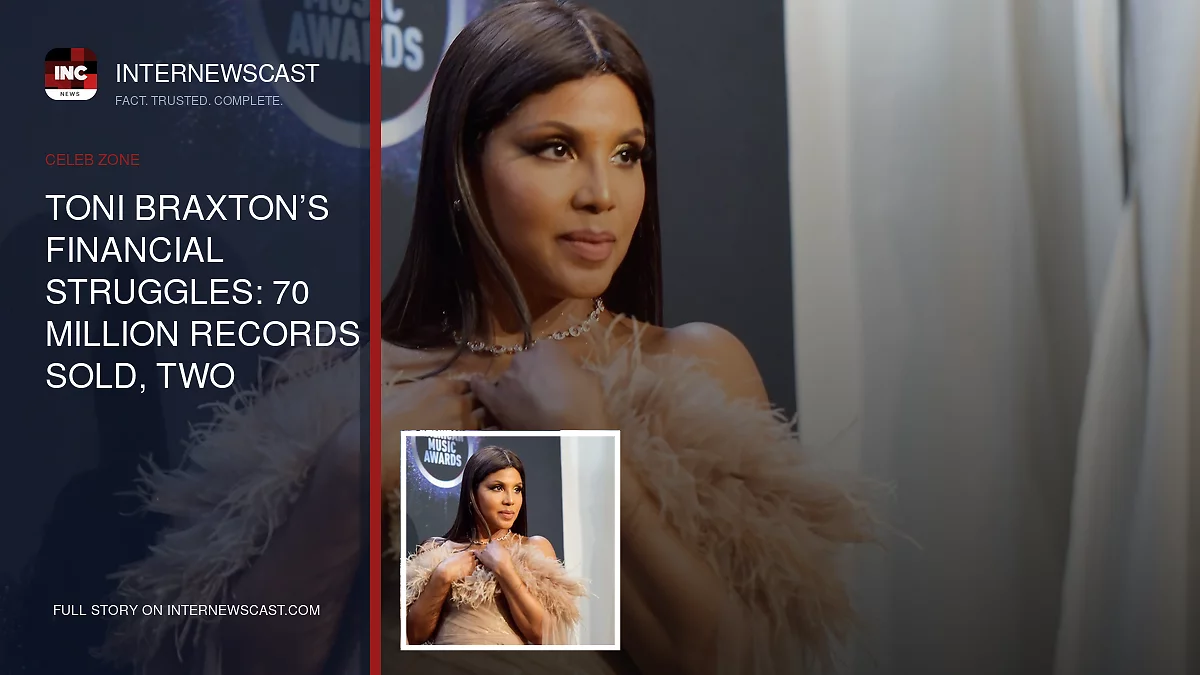

TMZ reported this morning that Toni Braxton has cleared up a tax debt totaling nearly $600,000 with the IRS. Federal records showed that the Grammy-winning singer was issued a tax lien in June over alleged unpaid balances of $69,390 for 2022, $278,876 for 2023, and $250,358 for 2024. Altogether, the lien came to $598,624. A representative for Braxton told TMZ that the matter has now been resolved.
For longtime followers of Toni Braxton’s career, the IRS headline may feel familiar. The R&B icon, who has sold nearly 70 million records and ranks among the most successful singers in the genre’s history, has faced financial and tax troubles before. Over the past three decades, she has filed for bankruptcy twice while dealing at various points with the IRS and California’s Franchise Tax Board.
What makes Braxton’s financial history so striking is the timing. Her money problems surfaced during a period when, from the outside, she appeared to be at the height of her fame, visibility, and commercial power. So how did one of the biggest voices in R&B end up in that position?
How Does A Superstar Go Bankrupt?
In January 1998, Toni Braxton stunned the music business when she filed for Chapter 7 bankruptcy protection. The move came after a remarkable run. Her 1993 self-titled debut album had been a breakout smash, and her 1996 sophomore release, “Secrets,” elevated her to global superstardom with hits such as “You’re Makin’ Me High” and the career-defining ballad “Un-Break My Heart.”
By the time Braxton entered bankruptcy, those first two albums had sold well over 15 million copies worldwide and were believed to have generated around $170 million or more in sales. Despite that massive commercial success, she was facing serious debt.
Much of the answer lay in the complicated and often unforgiving math of her record deal. One month before filing for bankruptcy, Braxton sued LaFace Records and its parent company, Arista Records, in an effort to end her contract. Her attorneys argued that even though she had produced enormous revenue for the labels, she was earning less than 35 cents in royalties for every album sold.
Braxton later shared an even more startling figure. After the success of her first album, she said her royalty check came to just $1,972.
Her situation reflected a broader reality for many major-label artists of that era. Advances helped pay for recording and other upfront costs, but they were not free money. Studio time, music videos, travel, styling, promotion, tour expenses, and related costs could be charged back against an artist’s royalty account. As a result, a performer could sell millions of albums, dominate the charts, and still be considered unrecouped — effectively owing money to the label on paper.
Toni has admitted that her own spending habits didn’t help. She developed a taste for expensive furnishings, clothing, dishes, and other luxury purchases after becoming famous. Her spending became a major part of the public narrative surrounding the bankruptcy, particularly after an uncomfortable appearance on “The Oprah Winfrey Show.” During the interview, Oprah questioned why she allegedly made luxury purchases like Gucci silverware. Looking back on the interview years later, Toni claimed that she felt that Oprah, someone whom she admired greatly, used the interview to embarrass and reprimand her. She has also claimed that the interview completely changed her career, by making people look down on her.
The Comeback
Braxton eventually settled her dispute with LaFace and managed an impressive career comeback. In 2000, she released “The Heat,” which sold millions of copies and produced the hit “He Wasn’t Man Enough.” She continued recording, touring, acting, and performing on Broadway, and for several years her finances appeared to stabilize.
In 2006, she launched “Toni Braxton: Revealed,” a residency at the Flamingo in Las Vegas. A successful Vegas residency should have been an ideal financial arrangement for an established star like Toni, providing steady income without the enormous travel costs associated with a traditional tour.
Instead, the residency eventually helped set the stage for another financial collapse.
Health Problems And The Collapse Of Her Vegas Residency
In 2008, health problems forced Braxton to cancel her Las Vegas show. She later explained that the cancellation left her with significant financial obligations connected to the production. With the residency gone and expenses still hanging over her, her finances deteriorated rapidly.
By 2010, the IRS was once again involved. That year, the government filed a tax lien claiming Toni owed roughly $396,000 in unpaid federal taxes.
Then came bankruptcy number two.

Matt Winkelmeyer/Getty Images
2010: Bankruptcy Number Two
In October 2010, Toni Braxton filed for Chapter 7 bankruptcy protection for a second time. Her filing listed assets between $1 million and $10 million and liabilities between $10 million and $50 million. Her long list of creditors included the IRS, banks, record companies, hotels, retailers, and other businesses.
Unlike the first bankruptcy, which became closely associated with her unfavorable record contract, Toni attributed much of the second collapse to the fallout from her health problems and the cancellation of her Vegas residency. The bankruptcy case would take years to resolve.
She Lost Rights To 27 Songs
In 2013, Braxton reached an agreement with the trustee overseeing her bankruptcy. As part of the process, rights to 27 songs she had co-written were put up for sale.
Toni was given an opportunity to buy the rights back herself for $20,000. There was just one problem: Another buyer was allowed to outbid her. Someone did, ultimately paying $40,000 and taking control of Toni’s interest in songs including “You’re Makin’ Me High,” “How Many Ways,” and “Always.”
Her signature song, “Un-Break My Heart,” was not among the songs she lost because it was written by Diane Warren.
Braxton’s second bankruptcy was finally closed in 2015. After two bankruptcies in less than two decades, it might have seemed that the worst of her financial problems was behind her.
The tax problems, however, kept coming.
Hundreds Of Thousands Of Dollars In Tax Liens
In 2018, Toni was hit with four tax liens covering the 2015 and 2016 tax years. Two came from the federal government and two came from California. Combined, they claimed she owed roughly $781,000.
Later that same year, another round of tax liens surfaced. The IRS claimed she owed roughly $340,000 for 2017, while California’s Franchise Tax Board sought another $116,000. Combined, that was another $456,000 in claimed tax debt.
Which brings us back to today’s news.
The federal lien filed in June 2026 claimed Toni owed $69,390 for 2022, $278,876 for 2023, and $250,358 for 2024. That works out to a total of $598,624. Her representative says that federal debt has now been resolved.
But there’s another wrinkle. California’s Franchise Tax Board maintains a public list of the state’s 500 largest personal income tax delinquencies. In its August 6, 2026, update, the agency listed Toni Braxton of Los Angeles with an outstanding balance of $438,406.05.
So while Toni’s latest federal IRS problem appears to have been taken care of, California still lists her as owing more than $438,000 in state taxes.

Where Does That Leave Toni Today?
At CelebrityNetWorth, we currently estimate Toni Braxton’s net worth at $4 million.
Considering everything you’ve just read, that raises an obvious question: How can someone worth $4 million repeatedly end up owing the government hundreds of thousands of dollars?
The answer is that net worth and cash in the bank are two very different things. Toni’s financial history suggests that her recurring problems are much more likely related to inconsistent income and liquidity than an absence of assets.
Her real estate history helps illustrate the point. Just a year after settling major issues in her second bankruptcy, Toni paid $2.9 million for a 5,323-square-foot home in Calabasas in 2014. She sold that property in 2016 for $3.4 million.
Then, in 2018, Toni spent a combined $5.3 million buying two condos in the same luxury Century City complex. She paid $2.75 million for the upper unit and $2.55 million for the condo directly below it.
She put both properties up for sale in 2022. The upper condo eventually sold for $3 million. The lower unit did not sell, and all available property records indicate Toni still owns it. In May 2026, she put that condo back on the market for $2.675 million.
So right there, we see she was financially stable enough in 2018 to pay $5.3 million for two condos. She still owns one of those condos, which is worth around $2.75 million, and she sold the other condo for a $500,000 gain.
That appears to be the most logical way to view Toni Braxton’s finances today. She is not broke in the traditional sense. She owns valuable assets and still has the ability to earn substantial money. But after two bankruptcies and decades of tax liens, her financial history suggests that converting those earnings into consistent, available cash has been an ongoing problem.
(function() {
var _fbq = window._fbq || (window._fbq = []);
if (!_fbq.loaded) {
var fbds = document.createElement(‘script’);
fbds.async = true;
fbds.src = ”
var s = document.getElementsByTagName(‘script’)[0];
s.parentNode.insertBefore(fbds, s);
_fbq.loaded = true;
}
_fbq.push([‘addPixelId’, ‘1471602713096627’]);
})();
window._fbq = window._fbq || [];
window._fbq.push([‘track’, ‘PixelInitialized’, {}]);


