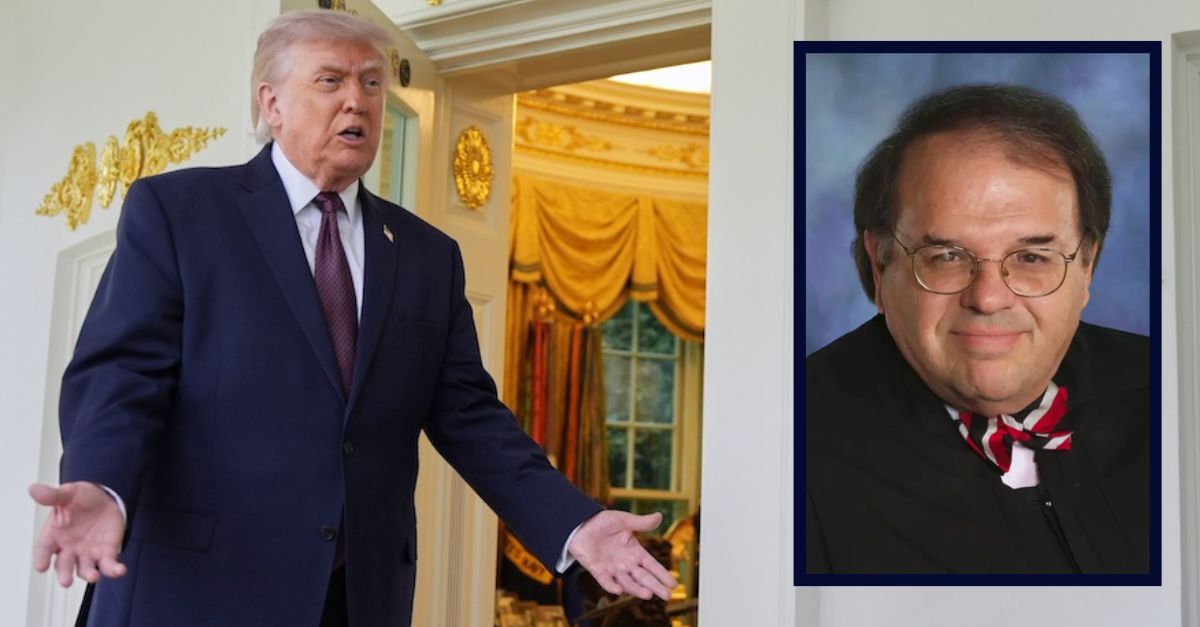

Main: President Donald Trump speaks to the press outside the Oval Office of the White House, Monday, April 13, 2026, in Washington (AP Photo/Alex Brandon). Right inset: Judge Richard Leon (U.S. District Court).
The Department of Justice moved quickly to appeal after a federal judge halted the construction of Donald Trump’s highly anticipated $400 million East Wing ballroom. In response, a panel from the U.S. Court of Appeals for the District of Columbia Circuit has requested clarification from the judge regarding an accommodation included in the injunction that paused the ballroom’s development.
U.S. Circuit Judges Patricia Millett and Bradley Garcia, appointed by Presidents Obama and Biden, respectively, cited discrepancies in the Trump administration’s court presentations as the reason for the confusion. In a 2-1 decision, the judges have sent the case back to U.S. District Judge Richard Leon, asking for clarity on whether the ballroom’s construction and the security enhancements beneath it can proceed independently.
The appeals court wants Judge Leon to assess if the injunction sufficiently considers the government’s concerns about national security and presidential safety.
The panel highlighted that the National Trust for Historic Preservation had already filed a lawsuit to prevent the construction before Judge Leon issued his injunction in late March. Leon, known for his emphatic rulings, used exclamation points liberally in this decision, similar to his previous judgments against the administration’s actions involving Sen. Mark Kelly and an executive order concerning Robert Mueller’s former law firm.
In his ruling, Judge Leon, appointed by George W. Bush, emphasized the importance of taking national security concerns seriously but criticized the government’s unsubstantiated claims. He dismissed several DOJ arguments passionately, exemplified by his repeated use of “Please!” while stating that the government’s legal oversights should not be shielded from judicial scrutiny.
Judge Leon remarked on the situation, pointing out that the issue of a “large hole” near the White House was a consequence of the President’s own actions.
Relevantly, the judge’s injunction still permitted “actions strictly necessary to ensure the safety and security of the White House and its grounds, including the ballroom construction site, and provide for the personal safety of the President and his staff.”
After the plaintiff National Trust for Historic Preservation in the United States won the first round, the DOJ appealed to the D.C. Circuit, but on Friday the panel only extended the stay Leon self-imposed on his order until April 17 — believing that more information was needed to determine if the government will be harmed absent a stay pending appeal it sought. After all, the Trump administration’s story has already changed, the judges said.
“To start, much of Defendants’ discussion of national-security risks concerns security fixtures that are, or will be, installed beneath the planned ballroom. But the district court’s injunction runs only against the ‘physical development of the proposed ballroom,’” the order said. “And Defendants have repeatedly represented to the district court that any below-ground work was distinct from construction of the ballroom itself and could proceed independently.”
“Yet Defendants now seem to suggest that below-ground ‘national security upgrades are inseparable from the rest of the Project,’” the majority went on. “As a result, it remains unclear whether and to what extent the development of certain aspects of the proposed ballroom is necessary to ensure the safety and security of those below-ground national security upgrades or otherwise to ensure the safety of the White House and its occupants while the appeal proceeds.”
Without downplaying the “importance of ensuring the safety of the White House, the President, staff, and visitors,” and supporting Leon’s treatment of those claims, the panel wanted to hear more.
“We cannot fairly determine, on this hurried record, whether and to what extent the district court’s ‘necessary for safety and security’ exception addresses Defendants’ claims of irreparable harm, insofar as it may accommodate the Defendants’ asserted safety and security need for the ballroom itself or other temporary measures to secure the safety and security of the White House, the President, staff, and visitors while this appeal proceeds. We thus remand these cases to the district court with instructions to promptly address the pending motion to clarify how the injunction and its exception will ensure safety and security pending litigation,” the court said.
U.S. Circuit Judge Neomi Rao, a Trump appointee, penned the lone dissent to say she would have granted the stay and “allow[ed] construction of the ballroom and related security facilities to continue during the pendency of an appeal.” Rao took aim at how Leon found the plaintiff had standing, based on the declaration of one member complaining of monthly “aesthetic harm” of having to look at an eyesore.
“[T]he Trust identifies no member with standing to sue. The declaration of the Trust’s sole identified member, Alison Hoagland, relies on the claim that she will suffer aesthetic harm if the East Wing project is completed. Aesthetic harm to a plaintiff’s recreational activities may qualify as injury in fact, but ‘mere incidental viewership’ of an unpleasant sight does not,” the dissent said. “[Alison] Hoagland’s declaration claims that ‘[a]s a resident of Washington D.C.’ she will walk by and ‘be impressed’ with the White House (but displeased with the new ballroom) ‘about once a month.’”
“Such vague and infrequent viewing supports ‘nothing more than [a] generalized grievance[],’ which is insufficient for Article III standing,” Rao concluded, calling the government’s evidence “credible” and of “clearly a weightier interest than the generalized aesthetic harms identified by a single member of the Trust.”