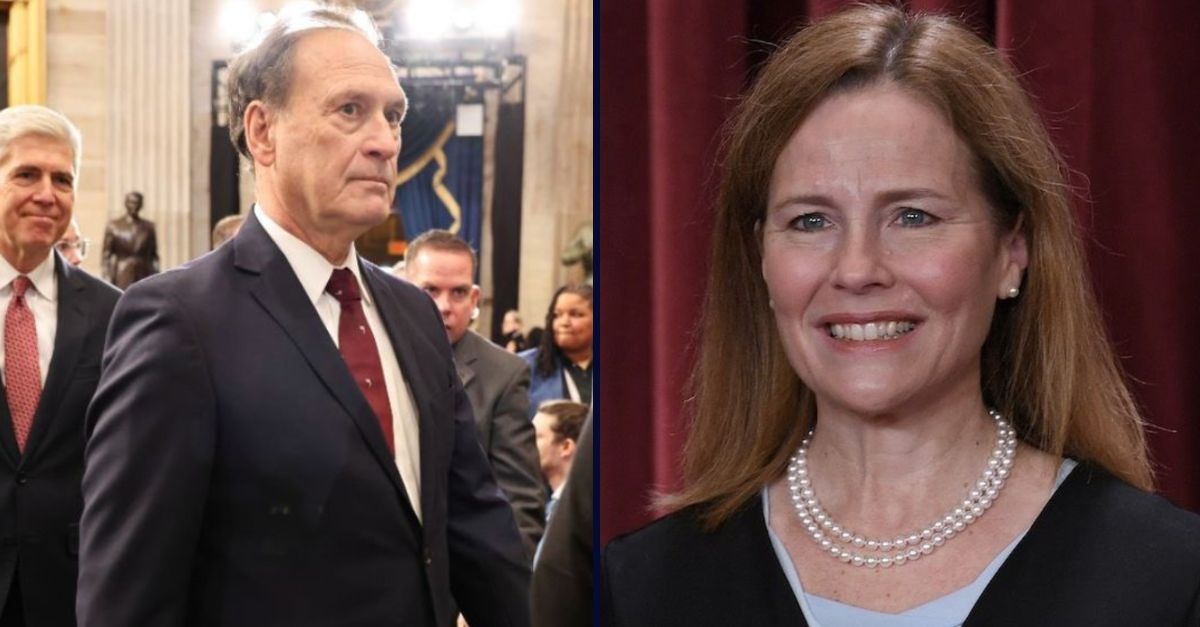

Left: U.S. Associate Supreme Court Justice Samuel Alito Jr. attends inauguration ceremonies inside the Rotunda of the U.S. Capitol on Jan. 20, 2025, in Washington, DC (Chip Somodevilla/picture-alliance/dpa/AP Images). Right: Associate U.S. Supreme Court Justice Amy Coney Barrett sits for the official Supreme Court photo in Washington, DC, on Oct. 7, 2022. (Photo by OLIVIER DOULIERY/AFP via Getty Images).
In a closely divided ruling Monday, Justice Amy Coney Barrett wrote for a 5-4 Supreme Court majority that Mississippi may count absentee ballots that are “postmarked by election day but received up to five days thereafter.” The court concluded that “nothing in the federal election-day statutes requires ballots to be received by election day.”
Barrett was joined by the court’s three liberal justices and Chief Justice John Roberts in rejecting the position advanced by the Republican National Committee and the Mississippi Republican Party. The GOP plaintiffs had argued that absentee ballots must physically arrive by Election Day in order to be counted.
Writing for the majority, Barrett acknowledged that “[e]lection fraud and its appearance are serious issues.” Even so, she said states retain authority to determine the deadline by which ballots must be received.
Justice Samuel Alito dissented, joined in full by Justices Clarence Thomas and Neil Gorsuch, and in part by Justice Brett Kavanaugh. Alito noted that both mail-in voting and early voting have become “popular” features of modern elections, and he did not dispute their legality.
“[R]espondents do not dispute the lawfulness of these modern practices. Nor do I,” Alito wrote, before drawing the line at the timing of the final electoral choice. “But acceptance of these practices cannot change the fact that under federal law, the electorate’s collective choice must still be authoritatively expressed on election day.”
Alito warned that, by “incorrectly remov[ing] this safeguard from federal law,” the majority could encourage “bad actors […] to stuff ballot boxes when early election results suggest a tight race.” He said the ruling “create[d] a serious risk of further undermining public confidence in our elections and our system of self-government.”
Barrett, however, pushed back by pointing to the Uniformed and Overseas Citizens Absentee Voting Act, suggesting that Alito’s concerns were better directed there.
“The defining element of an ‘election’—the term used in all three federal statutes—has always been the electorate’s choice of candidate. And a related federal statute, the Uniformed and Overseas Citizens Absentee Voting Act (UOCAVA), confirms that while federal law dictates when ballots must be cast, state law dictates when they must be received,” Barrett wrote.
In a footnote, Barrett then turned the tables on the dissent for apparently cherry-picking which “short-lived” statutes from a century or two ago to embrace and which to ignore.
“Things started to change during the Civil War, when some States allowed soldiers to vote from afar by absentee ballot. Access to absentee voting expanded throughout the 20th century, and today, every State lets at least some residents vote absentee,” Barrett explained first. “In fact, federal law requires States to permit absentee voting in certain circumstances.”
Then she noted that states “began counting absentee ballots received after election day” during World War I.
“The dissent brushes off these World War I statutes as ‘short-lived outlier[s],’ but relies heavily on Civil War mail-in voting statutes that were themselves ‘short-lived outlier[s],'” the footnote sharply observed.
If there is to be a “national solution,” Barrett concluded, that’s up to Congress.
“The election-day statutes say nothing about ballot receipt, and we cannot add to the words Congress chose,” she said.


