
Share this @internewscast.com
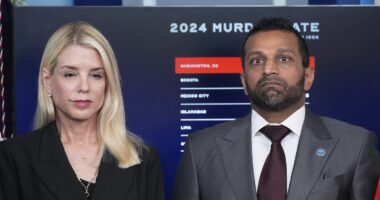
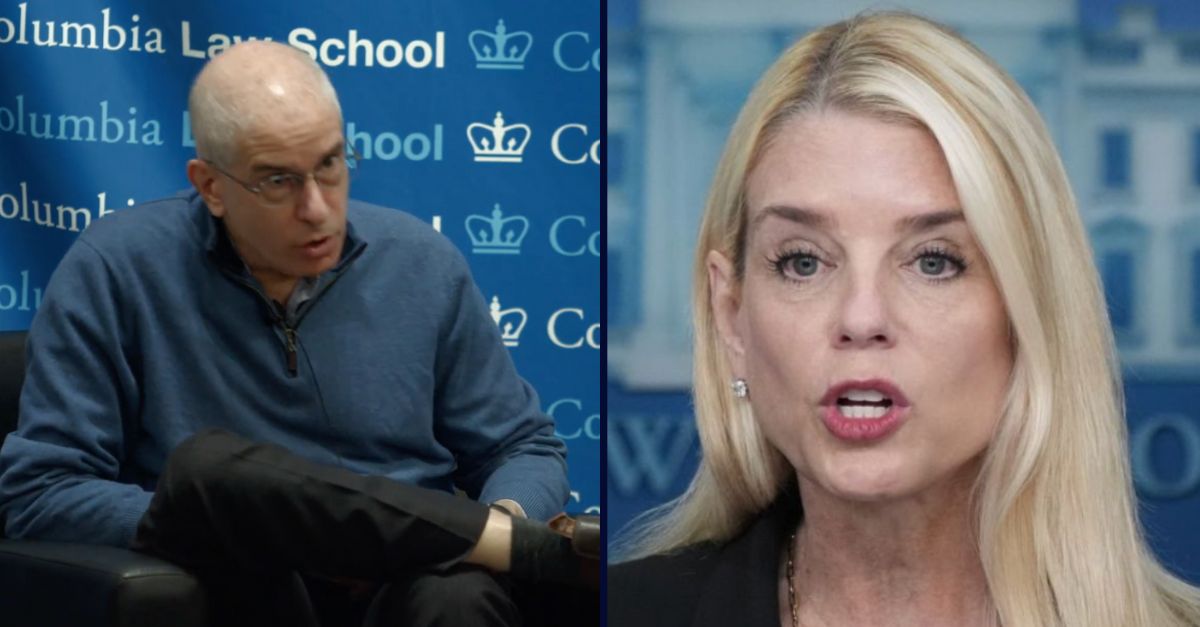
Left: Daniel Richman at Columbia Law School on Feb. 5, 2020 (Columbia Law School/YouTube). Right: Attorney General Pam Bondi speaks during a news conference with President Donald Trump in the James Brady Press Briefing Room at the White House, Monday, Aug. 11, 2025, in Washington (AP Photo/Alex Brandon).
On Tuesday, a deputy to U.S. Attorney General Pam Bondi, along with the “unlawfully appointed” lead prosecutor in the initial Department of Justice (DOJ) case against James Comey, accused a federal judge of obstructing the government’s efforts to bring new charges. This accusation follows the judge’s preliminary alignment with Comey’s former attorney and law professor friend.
The DOJ’s 20-page opposition document, penned by Deputy Attorney General Todd Blanche and Lindsey Halligan, contends that Senior U.S. District Judge Colleen Kollar-Kotelly has “impermissibly” prevented further indictment attempts by isolating crucial evidence obtained from Daniel Richman in 2017.
Richman successfully persuaded the judge to impose a temporary restraining order over the weekend. He argued that his seized belongings—containing “a significant amount of privileged information involving various clients,” communications with federal judges, family medical records, and “detailed financial records”—were examined without a new warrant and used in the case against Comey, who faced obstruction and false statement charges in late September and the subsequent six weeks.
Judge Kollar-Kotelly determined on Saturday that Richman met the criteria for a narrow temporary restraining order and is “likely to succeed” in retrieving his property. However, the DOJ claims Richman’s true aim is not the return of these items but rather the “destruction” of their copies in the DOJ’s custody, a move intended to shield his friend as the Trump administration seeks another indictment.
The DOJ’s filing argues that “Petitioner Daniel Richman’s motion for a return of property is essentially a collateral effort to suppress evidence, thwarting the government from utilizing it in a separate criminal case in another district.” It further states Richman’s request for preliminary relief essentially asks the Court to prevent the Government from conducting an ongoing criminal investigation and potential prosecution, which it deems “legally inappropriate.”
The DOJ characterizes Richman’s motion as a “strategic maneuver to obstruct the investigation and potential prosecution” of Comey, accusing the judge of having “effectively halted the government from probing and potentially prosecuting” the former FBI director. They note it was no coincidence that Richman promptly filed a lawsuit following the dismissal of the criminal case against Comey.
“The close connection to the Comey prosecution is also demonstrated by the timing of Richman’s motion,” the DOJ said, noting that the suit was filed roughly a week after the dismissal of the case.
“Approximately a week later, Richman sought a temporary restraining order enjoining the Government from ‘searching, using, or relying in any way’ on the materials that were seized pursuant to the warrants, ‘as well as any copies thereof or any materials obtained, extracted, or derived therefrom,’” the filing said, describing the suit as a “collateral (and premature) motion to suppress evidence in another criminal proceeding, masquerading as a motion for return of property[.]”
For that reason, and because the DOJ claimed that Kollar-Kotelly’s TRO amounts to an “impermissible” block on a “criminal investigation and potential prosecution in another district,” the government demanded that Richman’s motion be denied and the TRO dissolved.
“Given that Richman has all but conceded that he seeks a suppression remedy directed at a future prosecution (if Comey is reindicted), it would be unreasonable for the Court to allow Richman to collaterally secure that result,” the filing went on, denying that Richman’s Fourth Amendment rights were violated.
As Law&Crime reported last week, Richman asked Kollar-Kotelly to block the government from indefinitely searching his files, which were seized in 2017 as part of the Arctic Haze FBI media leaks probe that led to no charges against him. Despite that outcome, Richman said in his demand for the return of his property, the Trump administration, eight years later, went on to haphazardly use these personal computer files in the since-dismissed prosecution of Comey.
Recall the DOJ alleged that Comey lied to Sen. Ted Cruz on Sept. 30, 2020, when he denied under questioning that he had “‘authorized someone else at the FBI to be an anonymous source in news reports’ regarding an FBI investigation concerning Person 1,” namely Hillary Clinton, because he “knew, he in fact had authorized Person 3” — that would be Richman — “to serve as an anonymous source in news reports regarding an FBI investigation concerning [Clinton].”
Before the Comey case was tossed, a U.S. magistrate judge said the DOJ displayed a “cavalier attitude towards a basic tenet of the Fourth Amendment” by searching Richman’s files without a new warrant, in the apparent hope the findings would make the Comey case stick.
“The Arctic Haze investigation was closed in September 2021, with no charges filed. The Richman materials sat dormant with the FBI until the summer of 2025, when the Bureau chose to rummage through them again,” Magistrate William Fitzpatrick wrote, noting that the government “[i]nexplicably […] elected not to seek a new warrant for the 2025 search, even though the 2025 investigation was focused on a different person” — namely, Comey.
The magistrate said this while issuing a rare order for the government to hand over all grand jury materials to Comey’s defense.
Once the Richman lawsuit was before Kollar-Kotelly, the judge found he was “likely to succeed on the merits of his claim that the Government has violated his Fourth Amendment right against unreasonable searches and seizures by retaining a complete copy of all files on his personal computer (an ‘image’ of the computer) and searching that image without a warrant.”
As a result, Bondi and the DOJ were ordered to “identify, segregate, and secure the image” of Richman’s computer, his “Columbia University email accounts, and his iCloud account,” and any copies. Additionally, the judge said, the DOJ and Bondi could not “access the covered materials” or share them “without first seeking and obtaining leave of this Court.”
When Kollar-Kotelly’s TRO was issued, she said the property return issue would be resolved on an “expedited” basis, and that her order would “remain in effect until 11:59 p.m. ET on Friday, December 12, 2025, or until dissolved by further order of this Court, whichever comes first.”