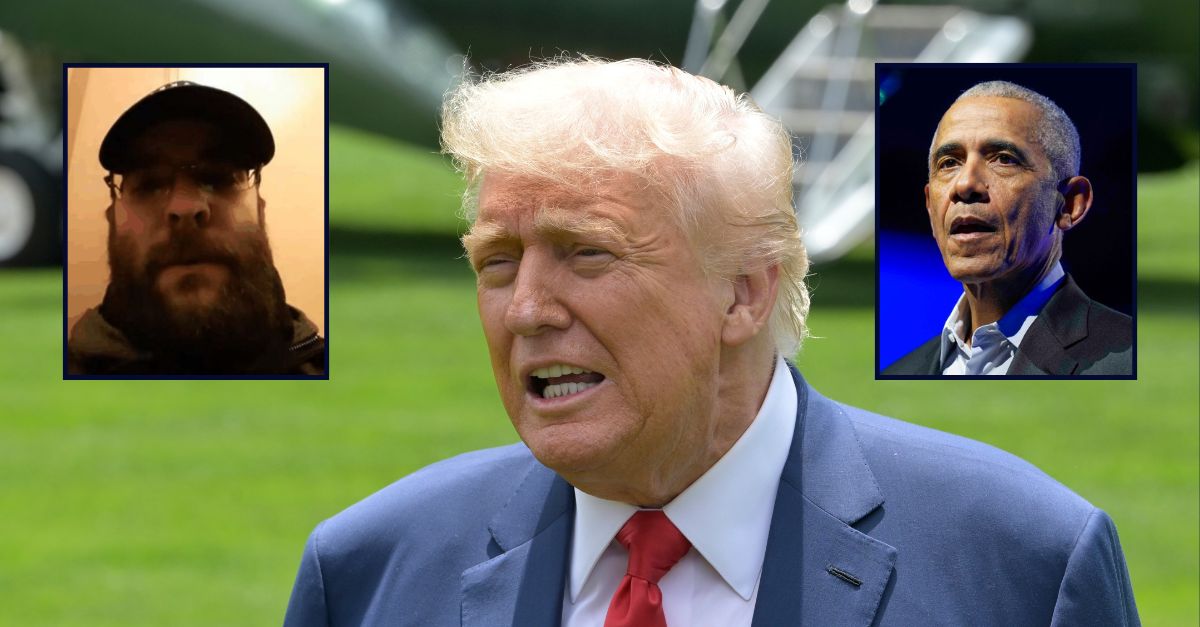
Inset left: Taylor Taranto in a photo he posted to Facebook while inside the Capitol on Jan. 6, 2021 (Department of Justice). Inset right: Former President Barack Obama speaks at the Obama Foundation Democracy Forum, Dec. 5, 2024, in Chicago (AP Photo/Erin Hooley, File). Background: US President Donald Trump talks with reporters at the White House on June 9, 2025, in Washington, D.C. (Photo by Lenin Nolly/NurPhoto via AP).
In the ever-changing landscape of the Department of Justice under the second Trump administration, it seems the number three holds particular significance.
This past Wednesday, the DOJ discreetly placed two prosecutors on administrative leave after they submitted a sentencing memorandum describing the January 6, 2021, attack on the U.S. Capitol as executed by “thousands of people comprising a mob of rioters.”
That same afternoon, the original sentencing memo was removed from the court docket, as shown by the Public Access to Court Electronic Records (PACER) website. By Wednesday evening, a revised memo, omitting any mention of January 6, was filed.
Within hours, Assistant U.S. Attorneys Carlos Valdivia and Samuel White were reportedly locked out of their government-issued devices and were informed that administrative leave was imminent. This information was reported by ABC News, citing unnamed sources. Concurrently, the 14-page legal document they prepared was inexplicably retracted, according to court records.
As of late Wednesday, no documents have been filed to officially explain the removal of these three items.
In response, the DOJ promptly submitted two official notices introducing two new prosecutors to the case. These newly assigned Assistant U.S. Attorneys are Travis Wolf, licensed in New York, and Jonathan R. Hornok, a member of the Texas State Bar.
Notably, U.S. Attorney Jeanine Pirro, who leads the district-based office, was also listed as an attorney on the undone memo. Pirro has declined to comment directly on the matter, according to Politico.
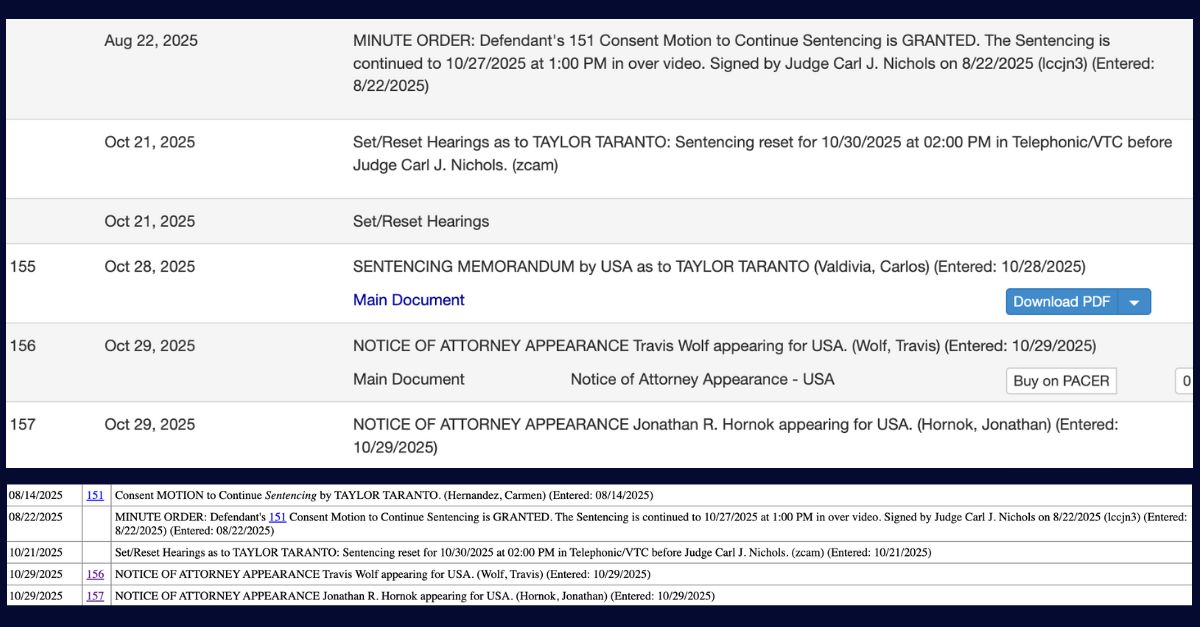
Top: The CourtListener archive showing the prior existence of the Taranto sentencing memo (Free Law Project). Bottom: The formal federal public docket showing the removal of the Taranto sentencing memo (PACER).
The case itself concerns Taylor Taranto, 39, a Washington state man and purported drifter pardoned by President Donald Trump for his role in the riot at the national legislative seat of government.
In May, Taranto was found guilty on charges – unrelated to Jan. 6 – following a bench trial in front of U.S. District Judge Carl J. Nichols, a Trump appointee.
Taranto was convicted on charges of illegally carrying firearms without a license, unlawfully possessing ammunition, and false information and hoaxes. That case stemmed from a June 2023 incident where Taranto traveled to Barack Obama”s Washington, D.C., home bearing guns and supplies for an explosive device.
In a sharp break from other attempts by the government to have Jan. 6 defendants benefit from Trump’s mass pardon in non-Jan. 6 cases, the DOJ moved to keep the charges against Taranto intact. Last week, Nichols set the defendant’s sentencing hearing for Oct. 30.
Tuesday’s memo argued in favor of putting Taranto in prison for two years – and mentioned his involvement in the Capitol attack.
“On January 6, 2021, thousands of people comprising a mob of rioters attacked the U.S. Capitol while a joint session of Congress met to certify the results of the 2020 presidential election,” the since-deleted memo reads. “Taranto was accused of participating in the riot in Washington, D.C., by entering the U.S. Capitol Building. After the riot, Taranto returned to his home in the State of Washington, where he promoted conspiracy theories about the events of January 6, 2021.”
The now-gone memo contains one additional mention of Jan. 6 – in a passage where Taranto explains that he visited a school in Maryland because of Rep. Jamie Raskin, a Democrat from Maryland.
The passage reads:
The reason probably we were picking that location was because its, you know, [U.S. Congressman Jamie] Raskin, Raskin, he lives over there and he’s one of the guys that hates January 6 people or more like Trump supporters and it’s kinda like sending a shockwave through him because I did nothing wrong. And he’s probably freaking out, and saying sh*t like, “Well, he’s stalking me!” Like AP there. Even though I didn’t go to his house or anything. I didn’t tell anyone where he is. Because I want him all to myself.
“Taranto’s menacing rhetoric harms public discourse and encourages others to use threats and violence to advance their views or silence their perceived political opponents,” the erstwhile memo goes on. “Accordingly, a substantial term of incarceration is necessary to ‘reflect the seriousness of the offense,’ ‘promote respect for the law,’ and ‘provide just punishment for the offense.’”
Thursday sentencing memo clocks in at 12 pages – a full two pages shorter than the excised Valdivia-White memo.
Gone are the prosecutors’ own mentions of Jan. 6 – while the Raskin reference in that context remains. The DOJ also saw fit to remove a reference to Trump himself in the replacement memo.
The original memo reads, in relevant part:
The next day, on June 29, 2023, then-former President Donald Trump published on a social media platform the purported address of former President Barack Obama. Taranto re-posted the address on the same platform and thereafter started livestreaming from his van on his YouTube channel. Taranto broadcast footage of himself as he drove through the Kalorama neighborhood in Washington, D.C., claiming he was searching for “tunnels” he believed would provide him access to the private residences of certain high-profile individuals, including former President Obama…
The non-verboten memo reads, instead:
The next day, on June 29, 2023, Taranto broadcasted footage of himself as he drove through the Kalorama neighborhood in Washington, D.C., claiming he was searching for “tunnels” he believed would provide him access to the private residences of certain high-profile individuals, including former President Barack Obama.
Law&Crime reached out to the new AUSAs assigned to Taranto’s case for comment and further details on this story, but no responses were immediately forthcoming at the time of publication.
A public archive of the later-altered docket is available here.