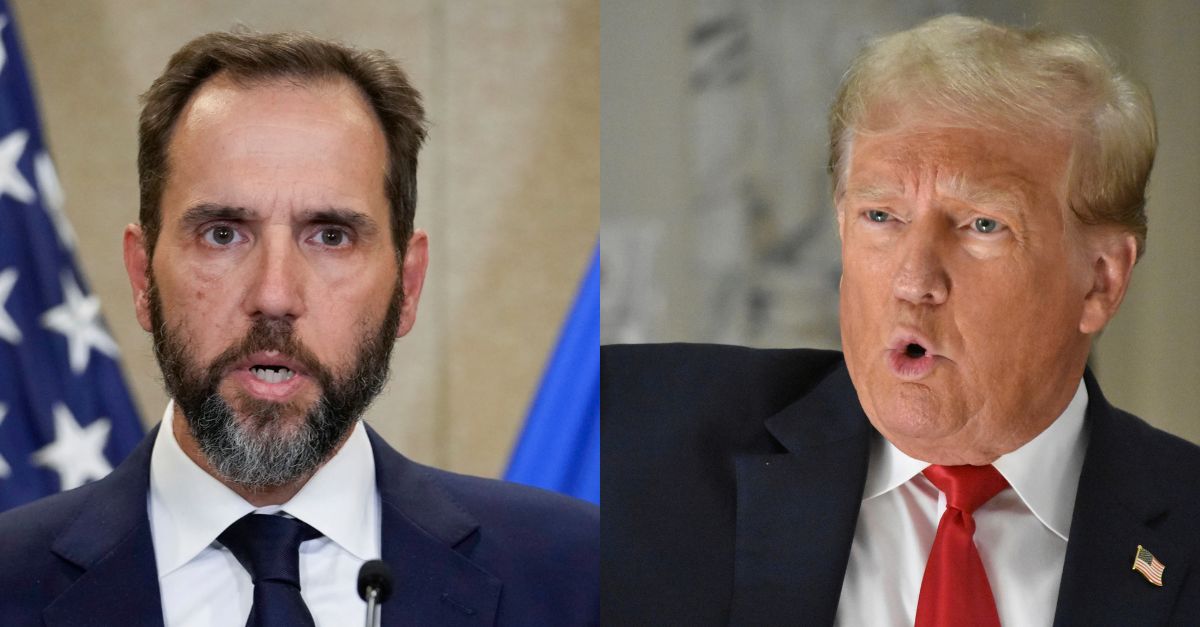
Special counsel Jack Smith speaks to the media about an indictment of former President Donald Trump, Tuesday, Aug. 1, 2023 (AP Photo/J. Scott Applewhite), Trump appears in the hallway of the Manhattan courthouse to speak to the press on October 4, 2023 (Photo by Kyle Mazza/NurPhoto via AP)
In a flurry of filings later Thursday, special counsel Jack Smith attacked various arguments that Donald Trump’s defense lawyers have advanced in bids to dismiss his Espionage Act indictment, including assertions about the Presidential Records Act (PRA).
The PRA, a subject that former Trump White House senior advisor Stephen Miller recently chimed in on through his legal group, does not actually do what the former president wants it to, Smith began.
“Trump’s reliance on the PRA as a basis for dismissing the indictment is wrong. The PRA does not exempt Trump from the criminal law, entitle him to unilaterally declare highly classified presidential records to be personal records, or shield him from criminal investigations—let alone allow him to obstruct a federal investigation with impunity,” the filing said, only getting sharper from there.
Likening Trump to an alchemist purporting to transform materials subject to the PRA into “personal” records appropriate for storage in a Mar-a-Lago bathroom and shower, Smith pointed out that executive order 13526 — “in force throughout Trump’s Presidency and through the allegations in the Superseding Indictment” — states that classified materials “can be accessed only by a person who an appropriate United States official determines is eligible for such access; who has signed an approved non-disclosure agreement; and who has a ‘need to know’ the classified information.”
“Under the provisions of EO 13526, the Superseding Indictment alleges, once Trump left office, he no longer had authorization to possess classified information, he never received a waiver entitling him, as a former President, to possess it, and he stored documents at a location that was not an authorized location for the storage, possession, review, display, or discussion of classified documents,” the special counsel said.
More Law&Crime coverage: Mar-a-Lago judge will consider legal arguments from Stephen Miller legal group and Federalist Society co-founder
From here, Smith responded to the “wrong” Trump argument that the PRA lets a president “make unilateral, unreviewable, and perpetually binding decisions to remove presidential records from the White House in a manner that thwarts the operation of the PRA,” again pointing to executive order 13526.
“The PRA provides no specific exception to EO 13526 that would authorize Trump to keep classified government records at Mar-a-Lago,” Smith wrote, before adding a footnote saying that even the Hur Report on President Joe Biden agrees:
The Hur Report reached the same conclusion: “We therefore decline to adopt the argument that compliance with the [PRA] authorizes former presidents and vice presidents to retain national defense information in unsecured and unapproved locations.”
Former President Ronald Reagan’s diaries and former President Bill Clinton’s memoirs don’t bear any “resemblance” to the issues at play here either, as Trump is accused of willfully retaining national defense information he played no role in creating and “do not reflect his personal thoughts,” Smith continued:
Trump alludes to DOJ’s inaction over former President Reagan’s diaries, which he retained after leaving office and which contained classified information. ECF No. 327 at 7. But DOJ’s decisions decades ago with respect to a former President’s diaries establish no legal precedent for the interaction of the PRA and Executive Orders governing classified documents. This case involves classified records created by intelligence and military officials for highly sensitive Presidential briefings. Trump did not create them, they do not reflect his personal thoughts, they came into his possession only through his official duties, and (except for one charged document) bear classification markings. They have no resemblance to diaries. See 44 U.S.C. § 2201(3)(A) (defining “personal records” to include “diaries, journals or other notes serving as the functional equivalent of a diary or journal which are not prepared or utilized for, or circulated or communicated in the course of, transacting Government business”). In any event, the Reagan example does not override EO 13526, and that text does not authorize Trump’s possession and storage of classified documents. Nothing in the PRA calls into question the Section 793(e) counts.
[…]
To reach a contrary conclusion, Trump relies on a statement made during oral argument before the district court in Judicial Watch, Inc. v. NARA, 845 F. Supp. 2d 288 (D.D.C. 2012). That case stemmed from a decision made by President Clinton to “enlist[] historian Taylor Branch to assist him in creating ‘an oral history of his eight years in office.”” Id. at 290 (quoting complaint). President Clinton “planned to make first use of [the taped conversations] for his memoirs, then eventually to release the transcripts at his presidential library.” Taylor Branch, The Clinton Tapes: Wrestling History with the President 13 (Simon & Schuster 2009).
After Branch published his book, a non-profit organization, Judicial Watch, sent a FOIA request to the Clinton Library for access to the tapes. Judicial Watch, 845 F. Supp. 2d at 292. The Supervisory Archivist for the Clinton Library responded that “the requested tapes ‘are not [P]residential records and therefore are not subject to request under the PRA and FOIA.’” Id. (quoting complaint). When Judicial Watch appealed to NARA, the Deputy Archivist noted that NARA had never had custody over the tapes. Id. at 292-93. The Deputy Archivist added that, to the extent that the appeal asked NARA to “make a further determination that the materials in question ought to be considered ‘presidential records’ within the meaning of the PRA, we decline to do so.” Id. at 293 (quoting the letter). The Deputy Archivist “‘consider[ed] the nature of the audio tapes, if they were created with the intent of their use as government materials, and whether or not they were circulated within the Administration or relied on as policy documents.’” Id. Based on the available facts, the Deputy Archivist did “‘not believe the materials in question fall within the ambit of the PRA,’” and she was instead “‘of the opinion that the audio tapes created by Taylor Branch are personal records of President Clinton as defined by the PRA.’”
Arguing that Trump’s “reliance” on the PRA in an attempt to dismiss the case wasn’t supported by the statute and wasn’t based on “any real-world facts,” Smith then quickly disposed of Stephen Miller-backed arguments for jettisoning the prosecution.
Smith said the Trump-Miller claims that the National Archives’ (NARA) allegedly improper criminal referral to the DOJ should make the prosecution go away was “fundamentally wrong”:
Finally, Trump contends that NARA made an improper referral to DOJ on February 9, 2022, and that the FBI therefore had no basis to “predicate” an investigation of his unauthorized possession of classified government documents. He claims that, as a result, the obstruction and false-statement allegations in Counts 33-42 must be dismissed. Each aspect of that argument is fundamentally wrong. Nothing in the PRA preempts the application of federal criminal law or divests the Government of criminal investigative authorities, and in any event, an individual’s claim that the Government lacked authority to investigate provides no defense to charges for obstructing its investigation.
Why? Even if Trump has a valid PRA argument, which he doesn’t, that didn’t give him “license” to obstruct a grand jury probe, the special counsel continued.
“Trump does not get a free pass for his alleged obstruction offenses based on his legal claim that those entities lacked authority to investigate,” Smith stated.
More Law&Crime coverage: Special counsel torches Trump with his own words in response to claims of selective prosecution and comparison to Hillary Clinton
“Indeed, given that (1) the Government’s redactions to its three Oppositions are truly minimal, representing portions of only 13 pages out of 268 pages of briefing, and (2) the articulation of threats that witnesses have already faced in this case and the potential for threats if names and identifying information are disclosed […] the Government has demonstrated that the limited sealing or redaction proposed here meets not only the good cause standard, but also the higher standard of being ‘necessitated by a compelling governmental interest and [ ] narrowly tailored to serve that interest,’” Smith said.
Read the filing as to the PRA here.


