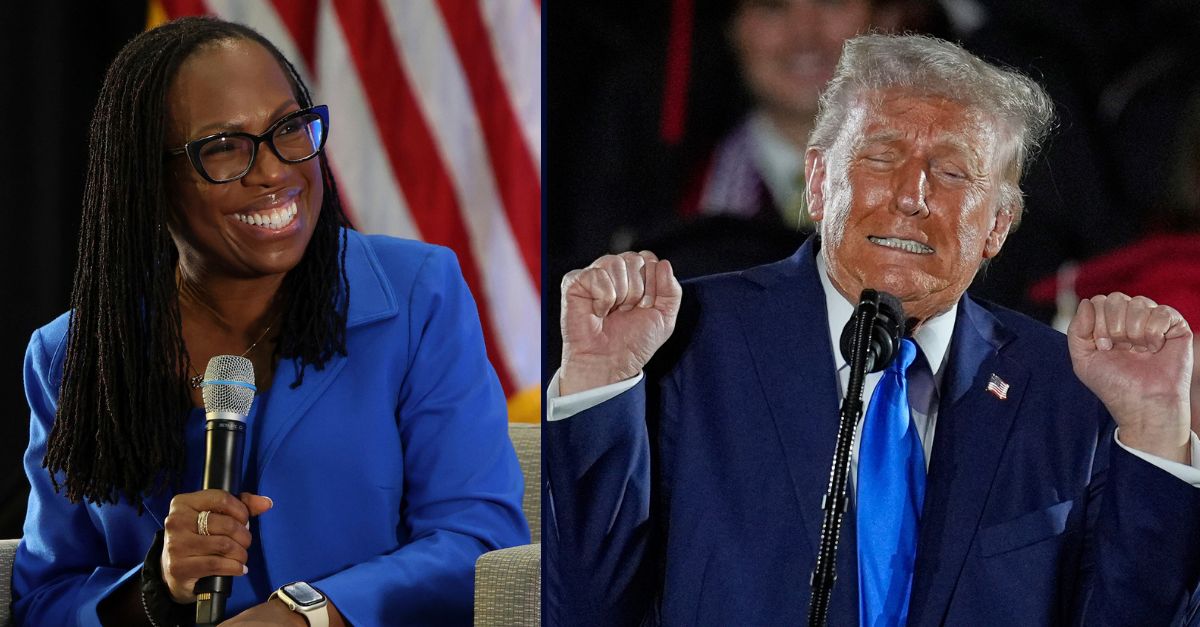
Left: MIAMI, FL-MARCH 10: U.S. Supreme Court Justice Ketanji Brown Jackson appears during an event called Evening with Ketanji Brown Jackson at Chapman Conference Center at MDC Wolfson Campus on March 10, 2025, in Miami, Fla. (Photo by Alberto E. Tamargo/Sipa USA)(Sipa via AP Images). Right: President Donald Trump discusses transgender weightlifters while delivering a commencement speech at the University of Alabama on Thursday, May 1, 2025, in Tuscaloosa, Ala. (AP Photo/Mike Stewart).
On Friday, the U.S. Supreme Court approved the Trump administration’s proposal to provide the Department of Government Efficiency (DOGE) with access to sensitive Social Security Administration (SSA) data.
In response to a stay application, a majority of the justices decided to overturn an injunction placed in mid-April by U.S. District Judge Ellen Hollander in Baltimore, who was appointed by Barack Obama. The injunction had previously prevented DOGE from accessing the non-anonymous personal data at the heart of the case.
The district court previously issued a temporary restraining order barring DOGE staffers from accessing the data as well as demanding they “disgorge and delete” any personally identifying data in their possession and remove any software or code the group may have installed or altered on SSA computer systems. A long series of failed attempts to overturn the blocks raised by Hollander ensued.
In late April, the Fourth Circuit Court of Appeals denied a stay and agreed to hear the appeal en banc – before the full appellate court. Sitting en banc, the court denied the government’s stay request but scheduled additional briefing on the matter slated for July.
Love true crime? Sign up for our newsletter, The Law&Crime Docket, to get the latest real-life crime stories delivered right to your inbox.
Now, the government can turn over the SSA data to DOGE until the litigation fully plays out at the lower court level.
Writing in dissent, Justice Ketanji Brown Jackson, joined by Justice Sonia Sotomayor, took the government to task for what she sees as the lack of an “emergency” in the government’s request.
“The Government wants to give DOGE unfettered access to this personal, non-anonymized information right now—before the courts have time to assess whether DOGE’s access is lawful,” the dissent reads. “In essence, the ‘urgency’ underlying the Government’s stay application is the mere fact that it cannot be bothered to wait for the litigation process to play out before proceeding as it wishes.”
The dissent also makes sure to implicate her colleagues for the sudden rush to grant the Trump administration its requested relief.
“That sentiment has traditionally been insufficient to justify the kind of extraordinary intervention the Government seeks,” Jackson continues. “But, once again, this Court dons its emergency-responder gear, rushes to the scene, and uses its equitable power to fan the flames rather than extinguish them.”
The dissent expends considerable energy on arguing the Trump administration failed to show “irreparable harm” – a term of art which means a problem that cannot be solved by money alone, either at the time or down the line – a factor necessarily considered by courts when deciding whether to stay injunctive relief.
Here, Jackson says, the government has failed.
From the dissent, at length:
Stepping back to take a birds-eye view of the stay request before us, the Government’s failure to demonstrate harm should mean that the general equity balance tips decisively against granting a stay. On the one hand, there is a repository of millions of Americans’ legally protected, highly sensitive information that—if improperly handled or disseminated—risks causing significant harm, as Congress has already recognized. On the other, there is the Government’s desire to ditch the usual protocols for accessing that data, before the courts have even determined whether DOGE’s access is lawful. In the first bucket, there is also the state of federal law, which enshrines privacy protections, and the President’s constitutional obligation to faithfully execute the laws Congress has passed. This makes it not at all clear that it is in the public’s interest for the SSA to give DOGE staffers unfettered access to all Americans’ non-anonymized data before its entitlement to such access has been established, especially when the SSA’s own employees have long been subject to restrictions meant to protect the American people.
And, Jackson insists, the government never made the case for why they needed to expeditiously access the personal SSA data.
“Throughout the lower courts’ thorough evaluations, the Government never deigned to substantiate its purported need for unfettered access, much less demonstrate why it must have that degree of access now. And it produces nothing more on that score with respect to the ’emergency’ application this Court considers today,” the dissent goes on. “The lower courts repeatedly placed the Government on notice of its harm-related failures, yet the Government still offers us next to nothing to satisfy its burden.”
To hear the government tell it, however, the injunction did harm them.
“This emergency application presents a now-familiar theme: a district court has issued sweeping injunctive relief without legal authority to do so, in ways that inflict ongoing, irreparable harm on urgent federal priorities and stymie the Executive Branch’s functions,” the stay application argues.
But Jackson was unmoved.
“In its reply brief, the Government glibly contends that it is harmed by the injunction’s effect on the Government’s work,” the dissent rages in a footnote. “Those kinds of generalized complaints are mere descriptors of what it means to be constrained by law. As such, they are manifestly insufficient to demonstrate concrete harm.”
The justice, for her part, sees the latest victory for the Trump administration as a signal from the court to the public – and to the Trump administration – that standards are not really standard.
Again the dissent, at length:
In my view, granting the Government a stay on this plainly deficient showing of harm is also systemically corrosive. We have told everyone that it is “critical” that an applicant justify its request for a stay from this Court by showing that it “will be irreparably injured absent a stay.” So the idea that the Government actually need not satisfy the irreparable harm burdens that other stay applicants have, nor wait for the courts to decide the merits of challenges to its allegedly unlawful conduct—as other litigants must—is not costless.
To accept this line of argument sends a troubling message: that this Court will allow departures from our stated legal standards and the basic norms of our judicial system (such as respect for lower court rulings and equal justice under law) for certain litigants. It says, in essence, that although other stay applicants must point to more than the annoyance of compliance with lower court orders they don’t like, the Government can approach the courtroom bar with nothing more than that and obtain relief from this Court nevertheless.
Justice Elena Kagan also voted to deny the stay – but did not join the dissent.


