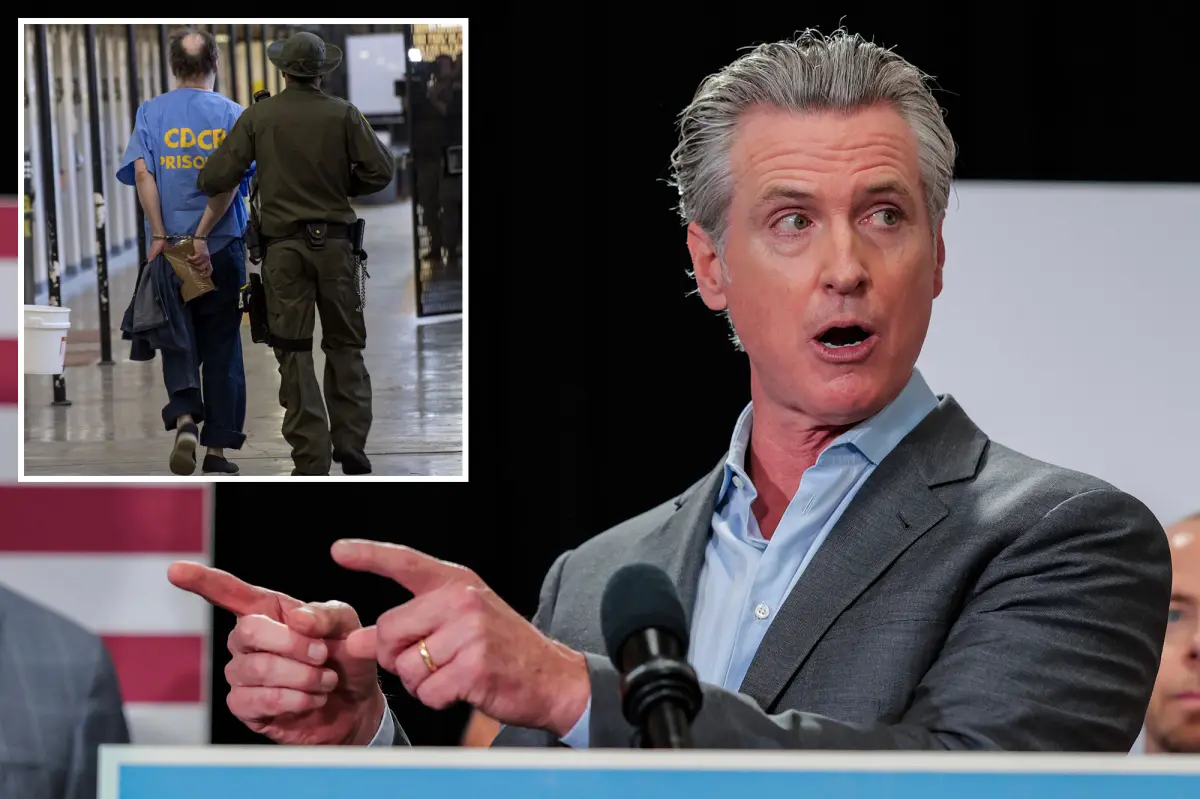

Gov. Gavin Newsom has disclosed the pivotal conversation that helped persuade him to commute the death sentences of all 548 inmates on California’s death row.
The decision has drawn fierce criticism from prosecutors and victims’ relatives. Newsom said, however, that an unexpected meeting with the sisters of murder victim Polly Klaas played a central role in his decision to spare the condemned prisoners.
“It was really, to me, one of the most profound and outsize meetings that I’ve had. Not just on this topic,” Newsom told the San Francisco Chronicle.
Newsom said he encountered Jess and Annie Nichol at a film festival held at San Quentin State Prison in Marin County in late October. The sisters were related to Klaas, who was 12 when she was kidnapped and murdered in 1993 by Richard Allen Davis.
The three gathered inside a converted death-row cell, where the sisters told Newsom that not every victim’s family believes capital punishment is the right path forward.
Davis was convicted of capital murder and sentenced to death in 1996. But Klaas’ sisters told the governor they did not believe executing him would resolve their grief or bring meaningful closure.
Annie Nichol, who was 6 years old when Klaas was murdered, said it was “heartbreaking” to watch the case contribute to a wave of tough-on-crime policies, including California’s “Three Strikes” law.
“There’s a relief in knowing the state is stepping away from another death in Polly’s name,” Annie told the Chronicle.
Jess Nichol said Newsom appeared visibly surprised during much of the discussion.
The governor had previously spoken with Polly’s father, Marc Klaas, when he issued a 2019 executive order halting executions in California. Marc opposed that moratorium and has since criticized Newsom’s decision to commute the sentences.
Newsom told the sisters that he remembered his earlier conversation with their father.
“And then one of the daughters looked at me, she looked me in the eye, and she said, ‘Then don’t ever forget what we just said to you, and that sticks with you as long as his comments stuck with you,’” Newsom told the Chronicle.
RELATED: Pope Leo XIV Says He Voted in U.S. Election, Proud to Be American
“That moment, for me, I was almost freed. It was spiritual,” he said. “It stuck with me.”
Following Newsom’s mass commutation, Marc Klaas sharply criticized the governor in an interview with the California Post.
“He’s putting these people closer and closer and closer to freedom, and these are absolutely the worst, most disgusting people that have ever lived,” he said.
“The whole idea that my daughter’s killer is getting this gift of life that was denied to all of the victims of these characters” is deeply offensive to him.
On Friday, Los Angeles County District Attorney Nathan Hochman warned that Newsom’s action could eventually open the door for convicted killers to seek release, including more than 100 inmates sentenced in Los Angeles County.
Hochman cited the Menendez brothers as an example of how a sentence of life without parole does not always ensure that a person will remain behind bars for life.
Newsom’s controversial move could also shape voters’ views of him as he considers a potential 2028 presidential campaign. The governor did not say how the commutations might affect his political future.
Several victims’ relatives noted that Newsom announced the mass commutations soon after Democrats scored sweeping victories in midterm elections across the country.
“It’s a moral moment. I think Tuesday was a moral moment,” Newsom told the Chronicle while discussing the election results. “That’s not politics. That’s just meaning. That’s mission. That’s purpose. That’s life. And I think this country needs a little of that.”
The legal status of Davis, Klaas’ killer, is not yet settled.
Because he has multiple felony convictions, his death sentence cannot be commuted without a recommendation and approval from the California Supreme Court.