Share this @internewscast.com
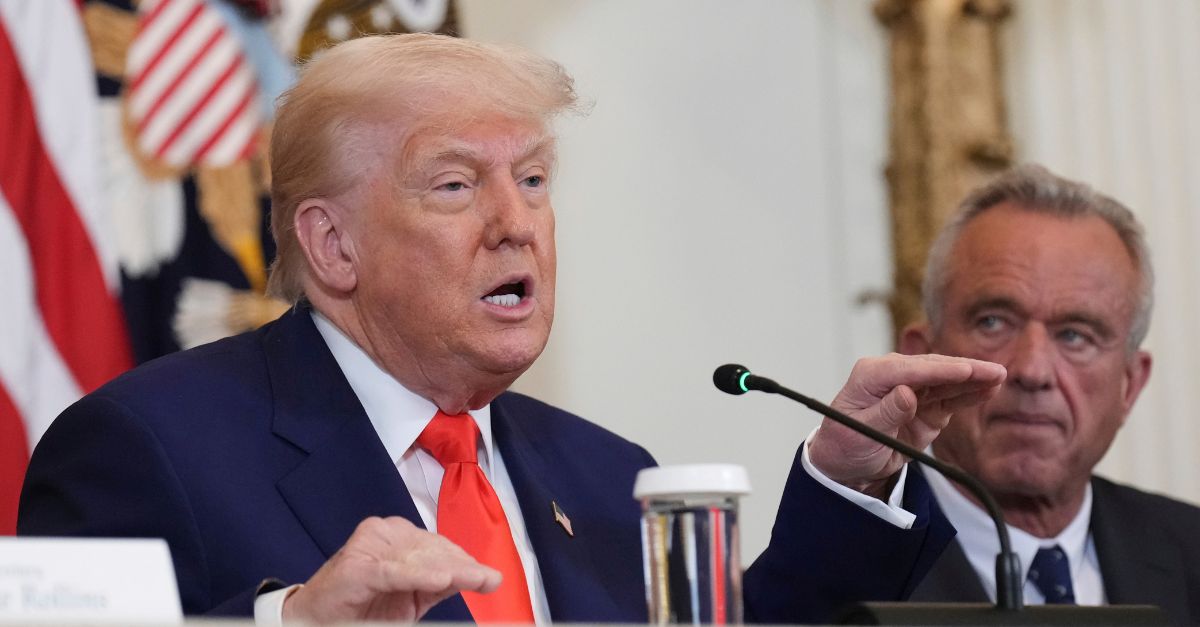
President Donald Trump, left, speaks as Health and Human Services Secretary Robert F. Kennedy Jr. listens during a Make America Healthy Again (MAHA) Commission Event in the East Room of the White House, Thursday, May 22, 2025, in Washington. (AP Photo/Jacquelyn Martin)
A federal judge issued a stern rebuke to the Trump administration on Thursday, blocking its attempt to strip approximately $600 million in public health grants from four states. The judge criticized the administration’s justification for the funding cuts as “contrived” and lacking merit.
The case, spearheaded by Illinois, involves a coalition including California, Colorado, and Minnesota. These states challenged the administration’s recent initiative to withdraw funding from states with policies it opposes, as outlined in a 26-page lawsuit filed in early February.
Immediately after the lawsuit was filed, a hearing was promptly scheduled and conducted. On the same day, U.S. District Judge Manish S. Shah, appointed by President Barack Obama, issued a temporary restraining order. He deemed the funding cuts “likely unlawful” and accused the administration of leveraging grants as a tool to push a policy agenda unrelated to public health funding.
On March 6, the plaintiff states sought a preliminary injunction to ensure the continuation of federal funding during the legal proceedings at the district court level.
Judge Shah has now unequivocally sided with the plaintiff states, asserting that the defunding effort was not about public health but rather aimed at penalizing the states for their stance on federal immigration policies.
In his seven-page order, Judge Shah pointed out that while there are “stated explanations for grant terminations,” the government has failed to clarify the criteria used to target these specific states for funding cuts.
The plaintiffs, however, have an explanation: They were targeted because they are so-called “sanctuary” jurisdictions.
The court ran through the series of events in detail.
Crucial to the case was President Donald Trump’s announcement in early January that “states having sanctuary cities” would stop receiving any federal funding starting in February.
That threat, of course, did not pan out. But the court believes the Office of Management and Budget (OMB) tried to realize the defunding plan in league with the Department of Health and Human Services (HHS) in the days that followed.
The judge notes that “[t]hree days” after Trump’s announcement, OMB “discussed something with HHS that led to OMB asking for a list and acknowledging the effort to support the President’s priorities.”
Then, one particular sub-agency got to work, the court noted
“Between January 22 and 23, the Centers for Disease Control (CDC) put together a list of active awards to Colorado, California, Minnesota, and Illinois,” the order goes on. “There is no explanation in the record for why those four states were treated as a group for data collection. But the chronology suggests that this scramble was tied to the January 13, 2026 announcement.”
On Feb. 1, the cuts were announced.
On Feb. 5, back-filling an explanation, the Trump administration “used an artificial intelligence model to generate language supporting grant terminations based on misalignment with agency priorities,” the judge explained.
Days later, the lawsuit was filed – largely based on alleged violations of the Administrative Procedure Act (APA), particularly a section which requires an agency to make reasoned decisions.
Such decisions likely did not occur here, Shah said.
“[W]here an explanation appears contrived or incongruent with what the record reveals about the process, then the agency violated the reasoned explanation requirement of administrative law,” the judge mused. “That is likely the case here, where there is a disconnect between the government’s expressed hostility to the plaintiffs as states with certain immigration-related policies…and later grant-specific explanations.”
Shah believed the “machine-generate[d]” explanation was a post hoc effort to explain the cuts. And though the plaintiffs have not produced a so-called “targeting directive,” the timeline, including the lack of affirmative denials by OMB, suggested the states were targeted.
“What remains, then, is a matter of inference,” the order goes on. “The sequence of events does not suggest mere inconsequential coordination. Instead, the reasonable inference is that the Office of Management and Budget directed HHS to cut funding for plaintiffs by February because plaintiffs were on a list of states with sanctuary jurisdictions.”
The court goes on like this, at length:
There was an OMB “project” to be implemented. Both OMB and HHS missed the target date by a few days, but the most plausible inference is that OMB drove HHS’s decision. Coordination and influence are not surprising, and it is not improper to work with other agencies to substantiate the legal basis for a preferred policy. But this looks instead like a final decision by OMB with a different motive than what HHS used to explain its grant-termination decision.
“Plaintiffs are likely to succeed on their claim that OMB’s targeting of them for HHS cuts must be set aside under the Administrative Procedure Act,” the order continues. “The Act requires courts to set aside agency action that is arbitrary, capricious, contrary to constitutional right, or in excess of statutory authority or limitations.”
While the court enjoined HHS from moving forward with the $600 million in public health cuts, the injunction stopped short of the full relief requested by the plaintiffs. The judge said the idea of a targeting directive operative at all federal agencies, at least at this stage (and without the relevant discovery), is akin to a “programmatic challenge,” which is beyond the court’s jurisdiction under the APA.