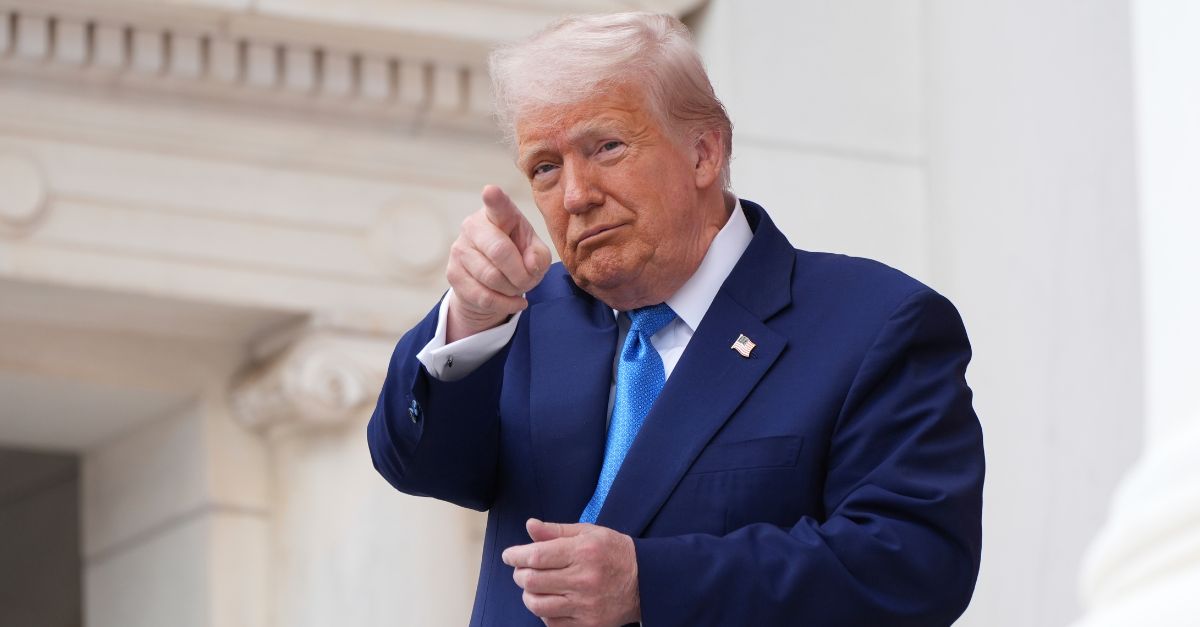

President Donald Trump takes part in the 157th National Memorial Day Observance at Arlington National Cemetery on Monday, May 26, 2025, in Arlington, Virginia (AP Photo/Jacquelyn Martin).
The Trump administration achieved a significant success on Friday when a Washington, D.C., court permitted the government to give the U.S. Department of Government Efficiency (DOGE) access to sensitive data across various departments and government agencies.
In a 28-page memorandum opinion and order, U.S. District Judge John Bates, appointed by George W. Bush, refused the plaintiffs’ request for a preliminary injunction that would have prevented such access.
In February, the AFL-CIO, other unions, and an economic think tank accused DOGE of violating “multiple laws” and sued to limit access to nonpublic information within the Department of Labor and elsewhere.
Results in the case have been mixed for the parties.
The plaintiffs repeatedly pushed for – and were repeatedly denied – a temporary restraining order. Then, in late February, the Trump administration suffered a substantial setback when Bates ordered four members of what he termed the “opaque” cost-cutting group to sit for depositions on a series of “properly-scoped topics” totaling eight hours. Meanwhile, the judge instructed the AFL-CIO to move for a preliminary injunction – which they did in late April.
Love true crime? Sign up for our newsletter, The Law&Crime Docket, to get the latest real-life crime stories delivered right to your inbox.
Now, after following the court”s request – and after having their case buoyed by the favorable discovery order – the plaintiffs simply still have not marshaled enough evidence in their favor, the judge said.
“The Court, however, still cannot step in,” Bates opined. “The only harm plaintiffs allege their members face is that their information has been or will be viewed by unauthorized government personnel. Absent evidence those personnel will imminently misuse or publicly disclose that information, the Court cannot say that irreparable harm will clearly occur before the Court can make a final determination on the merits.”
In their latest reply in support of their preliminary injunction, the plaintiffs argued that such access alone was enough to prove harm.
“HHS and DOL have granted DOGE Affiliates broad and sweeping access to sensitive systems containing highly sensitive personal information of a broad swath of Americans, including that of Plaintiffs’ members,” the motion reads. “[C]ourts in this district have not consistently held that Plaintiffs are required to show that DOGE personnel have or will further disseminate this private information to the public writ large.”
Moreover, the unions argued, the government did not even contest that access to the information in question had been supplied to DOGE.
“Defendants effectively concede that they have not undertaken and do not undertake any particularized analysis before granting DOGE access to sensitive systems,” the reply goes on. “That concession is enough to confirm violations of the Privacy Act and APA violations.”
The judge said this just was not enough to prove irreparable harm.
“Here, plaintiffs fall short of the high irreparable-harm bar—even assuming they are right that the DOGE Policies violate the Privacy Act,” the opinion reads. “On this basis, the Court will deny their motion.”
Bates explains his reasoning, at length:
Plaintiffs’ one and only alleged irreparable harm is the same harm they assert for standing: the privacy harm that results from DOGE Affiliates viewing their records in violation of the Privacy Act. Plaintiffs emphasize that these records contain some of the most sensitive and private information the government can hold on a person. That is indisputable. Even looking at only the two previously mentioned systems, the records to which DOGE Affiliates have access include employment and financial histories, and—even more concerning—a conglomerate of detailed medical information, from diagnoses all the way down to discrete medical notes. And the agencies have granted DOGE Affiliates access to 25 other sensitive systems.
Yet, no matter how sensitive the information being accessed or how concerned the Court is about that access, establishing irreparable harm requires more. But plaintiffs put forward nothing that shows the harm their members face is “certain and great” or “beyond remediation.”
To hear the court tell it: “not all alleged invasions of privacy invariably result in irreparable harm.”
Bates goes on to muse about the records at stake – and admits that “not all alleged invasions of privacy invariably result in irreparable harm.” But, the court reasons, there is just no proof the data is being released into the wild.
“Regardless of the type of information disclosed, however, the disclosure might not cause irreparable harm if it won’t travel far,” the opinion continues. “Thus, if the information is disclosed only to a narrow group—in particular, if the disclosure is within the government but not beyond it—it is significantly less likely to amount to irreparable harm…Here, the records disclosed to DOGE Affiliates no doubt contain sensitive information. But plaintiffs demonstrate no risk that the information will be further shared or improperly used before the Court can make a final determination on the merits.”
The court does hold out some hope for the plaintiffs by reiterating earlier-issued misgivings about the secretive nature of DOGE and stressing that, on the merits of the case itself, the lawsuit, with more, might very well succeed.
“This conclusion does not mean the harm the members face is insubstantial or that the Court harbors no concerns that DOGE Affiliates have their hands on some of the most personal information individuals entrust to the government,” Bates opines. “To the contrary, the Court’s concerns are as grave as ever, and it stands ready to remedy plaintiffs’ harm should they ultimately succeed on the merits. At this time, however, the extraordinary remedy of a preliminary injunction is not warranted.”