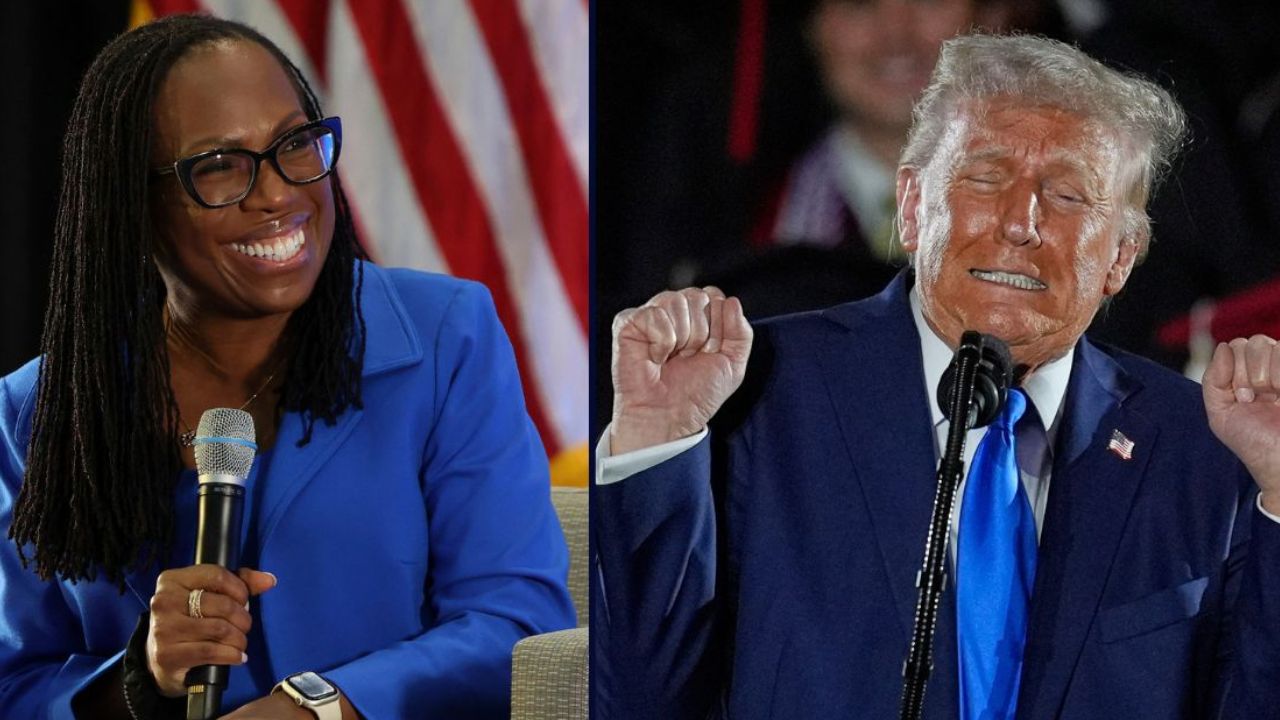

Left: MIAMI, FL: U.S. Supreme Court Justice Ketanji Brown Jackson appears during “An Evening with Ketanji Brown Jackson” at the Chapman Conference Center on the Wolfson Campus of Miami Dade College on March 10, 2025, in Miami, Fla. (Photo by Alberto E. Tamargo/Sipa USA)(Sipa via AP Images). Right: President Donald Trump discusses transgender weightlifters while delivering a commencement address at the University of Alabama on Thursday, May 1, 2025, in Tuscaloosa, Ala. (AP Photo/Mike Stewart).
The U.S. Supreme Court on Friday night temporarily authorized the Trump administration to proceed with a revised voter-verification system targeting questions about noncitizens, issuing the decision through the court’s controversial “shadow docket” and drawing a forceful dissent.
In response to a motion for a stay, most of the justices agreed to suspend an earlier ruling by U.S. District Judge Sparkle L. Sooknanan, a Joe Biden appointee. That decision had blocked the administration from using a newly altered version of the Systematic Alien Verification for Entitlements, or SAVE, database.
The dispute was brought by the League of Women Voters. Both the district court and the U.S. Court of Appeals for the District of Columbia Circuit had rejected the government’s attempt to use SAVE to help prevent noncitizens from voting.
In June, Judge Sooknanan issued a 75-page opinion describing the case as a conflict involving two basic interests: privacy and the right to vote.
Sooknanan concluded that the revised SAVE system was likely unlawful under the Administrative Procedure Act. She also criticized the government’s effort to build what she called a “centralized federal database” containing Americans’ Social Security numbers, citizenship information and other highly personal data.
Earlier this month, the D.C. Circuit allowed the summary judgment ruling to stand and refused to issue a stay while the appeal continued. The appeals court said the administration had “forfeited arguments” that it later asked the judges to accept.
The Supreme Court’s unsigned decision, issued without oral arguments or the full briefing normally associated with a major case, hands the Trump administration a significant win on an issue expected to feature prominently in the 2026 midterm elections.
The majority’s reasoning rests on the conclusion that federal law permits the changes the administration made to SAVE in spring 2025.
“The plaintiff organizations claim that the federal defendants violated the Social Security Act, Privacy Act, and APA,” the order states. But Congress, the justices wrote, separately gave the Department of Homeland Security authority in 1996 to seek citizenship and immigration information from other agencies, including the Social Security Administration, through the Illegal Immigration Reform and Immigrant Responsibility Act.
The majority also pointed to language in another federal statute declaring that no person or agency may block or limit the government from sending citizenship information to DHS—or from requesting and receiving that information from the department.
Taken together, the justices said, those laws prevent other agencies from obstructing the release of citizenship data to DHS.
YOU MAY ALSO READ: Pennsylvania Doctor Idris Evans Stabbed to Death by Elijah Hemingway
“Congress necessarily authorized DHS to request and receive that information,” the per curiam ruling says. Without that authority, the court reasoned, government officials could be placed in an untenable position.
According to the majority, officials would otherwise have to choose between complying with privacy protections and following the immigration statute.
The court said Congress likely did not intend to create such a conflict when it enacted IIRIRA, adding that the statute therefore probably overrides disclosure limits found elsewhere in federal law.
The ruling describes the revised SAVE system as “an important federal program” and indicates that the Supreme Court is likely to ultimately reject the lower court’s finding that the administration violated the Social Security Act, the Privacy Act and the Administrative Procedure Act.
The federal government, the order says, has a legal duty to answer requests from state and local election officials seeking to confirm voters’ citizenship. The lower court’s injunction, the justices added, prevents the administration from using the system it considers most effective for that purpose.
The immediate effect of the decision is limited by a federal voting-rights provision that bars large-scale voter-roll removals during the 90 days before an election. Even during that period, however, the Supreme Court said the government may carry out individual eligibility checks allowed under federal law.
Justice Ketanji Brown Jackson sharply objected to the ruling, joined in dissent by Justices Sonia Sotomayor and Elena Kagan. She criticized both the substance of the majority’s decision and the way it was issued.
Echoing broader concerns about the Supreme Court’s shadow docket, the dissent noted that the justices acted without full briefing or oral argument. Jackson also questioned the decision to issue a provisional ruling on two statutory provisions the court has never previously interpreted.
“The Court also focuses only on the harms the Government will purportedly suffer absent a stay, disregarding the harms that the modified SAVE system has caused, and will likely continue to cause, to lawful voters,” the dissent continues. “The Court thus misuses its equitable powers.”
On the merits, the dissent goes on to fault the majority for its “back-of-the-napkin assessment” that “two IIRIRA provisions that we have never before interpreted” override a whole suite of privacy laws.
Jackson also argues that “the harm caused by burdening or disenfranchising even a few lawful voters outweighs the nonexistent harm that the Government experiences when it is prevented from taking an action that it likely lacks the authority to take.”
The post ‘Back-of-the-napkin assessment’: Justice Ketanji Brown Jackson faults SCOTUS majority for ‘disenfranchising’ voters ‘without full briefing or oral argument’ first appeared on Law & Crime.


