
Almost half of France’s Muslim population would consider leaving the country if Marine Le Pen wins next year’s presidential election, according to a new survey.
Le Pen, leader of the hard-Right National Rally party, is currently ahead in polling for the 2027 presidential contest.
The Ifop poll found that 46 per cent of Muslim respondents would contemplate emigrating under a Le Pen presidency. One in five, or 20 per cent, said they would “certainly” leave France.
The survey also highlighted deep concern over the potential consequences of a Le Pen victory. Some 81 per cent of Muslim respondents believed it would result in greater aggression and discrimination against Muslims.
According to local news outlet Marianne, more than a quarter of those surveyed—27 per cent—said they might even hide their religious identity.
Le Pen has faced strong criticism over proposals aimed at tackling what she describes as “Islamist ideologies” in France if she becomes president.
Among those proposals is a fine for wearing a hijab in public, which Le Pen refers to as the “Islamist veil”.
“I will submit to the French people, by referendum, a bill to combat Islamist ideologies with numerous powerful measures, including the banning of the Islamist headscarf in public places,” the candidate wrote on X last month.

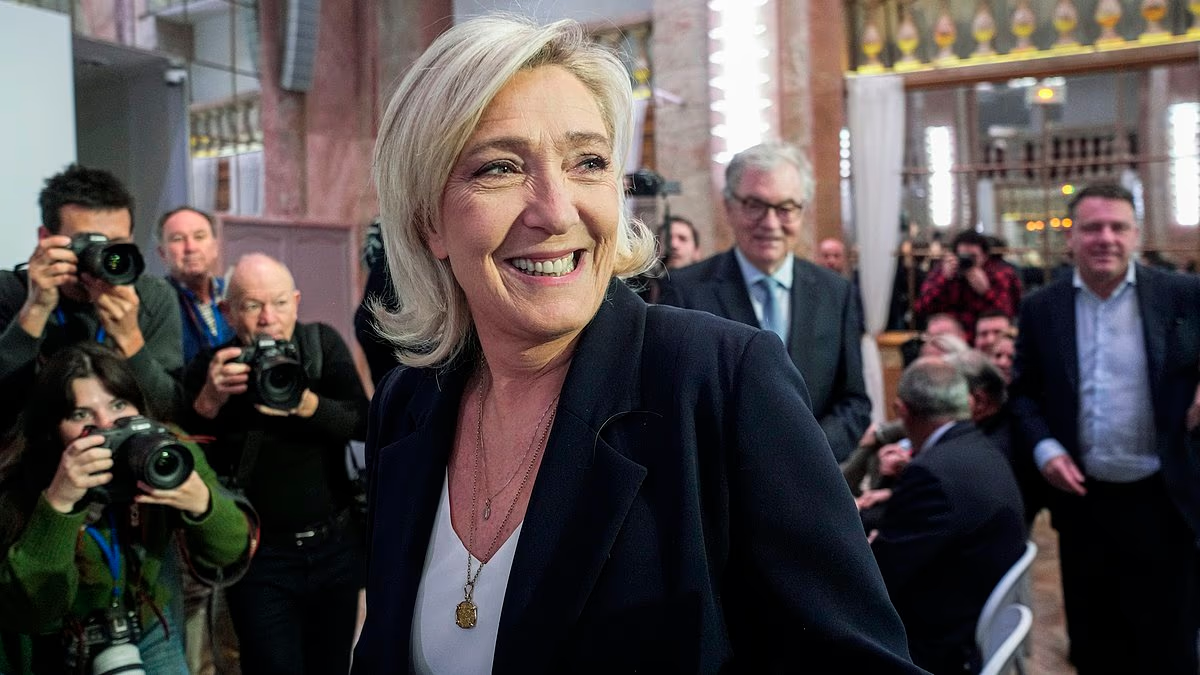
National Rally leader Marine Le Pen arrives for the party’s New Year’s address to the media in Paris in January 2024
Le Pen, 58, has backed a ban on Muslim women wearing head coverings in public since 2012, when she began her first of three unsuccessful presidential campaigns.
However, she shelved the proposal in 2022 as she sought to soften her hard-Right image while challenging the current president, Emmanuel Macron.
France became the first European country to prohibit full-face coverings in public spaces in 2011. Those who violate the law can face a fine or be required to attend civic education classes.
The French government said face coverings made it difficult to identify people, created potential security risks and hindered social interaction.
Several other European countries later introduced similar measures, including Portugal, which banned or restricted burqas and other full-face veils in public last month.
The report suggested that Le Pen’s position broadly reflects public opinion in France.
IN CASE YOU MISSED IT: Trump Slams Ukraine’s New Russian Refinery Attacks as ‘Disgrace’
The study surveyed 9,689 adults and found that a substantial majority supported restrictions on Islamic clothing and other religious symbols in public spaces.
About 53 per cent said they opposed women wearing the hijab in the street, while 75 per cent supported banning the abaya in state secondary schools.

A woman wearing a headscarf in public in Nantes
The abaya, a long dress worn by some Muslim women, was banned for girls in state schools in 2023 after authorities argued that it breached France’s principle of secularism.
The measure received strong support from Macron and sparked a political dispute over France’s secularism laws, including questions about whether they discriminate against the country’s Muslim minority, which accounts for around 10 per cent of the population.
Meanwhile, the study found 72 per cent of those surveyed supported a ban on conspicuous religious symbols at sporting events.
François Kraus, director of the Politics and Current Affairs unit at Ifop, said that Ms Le Pen’s victory ‘risks generating significant blockages and produces high levels of fear and a sense of insecurity’.
Ms Le Pen has consistently led first-round voting intention surveys for the election on April 18, 2027, typically polling between 30 and 35 per cent.
Jean-Luc Mélenchon of La France Insoumise and former prime minister Édouard Philippe have alternated in second place, polling between 14 and 19 per cent.
Ms Le Pen recently stirred tension after accusing Europe of waging a war over energy with Russia and vowed to stop funding Ukraine should she win the presidency.
She pledged to stop financial aid for Kyiv within six months, saying France can no longer afford it.
And claimed the ‘honest thing’ the EU should do would be to tell Ukrainian President Volodymyr Zelensky it ‘can’t manage’ to financially support his cause any more.
The Eurosceptic party leader has long opposed Ukraine’s membership of the EU and has criticised EU sanctions against Russia, claiming it has allowed an ‘energy war’ to form between the two powers.
Ms Le Pen accused the EU of idiocy over its stance against the Kremlin, telling the Financial Times: ‘We the EU have led an energy war against Russia, when we haven’t got any energy. It is not very smart.’
READ MORE: Marine Le Pen says she would stop aid to Ukraine within six months of being elected and criticises Europe’s ‘energy war’ with Putin as polls put her ahead in French presidential race