
Share this @internewscast.com
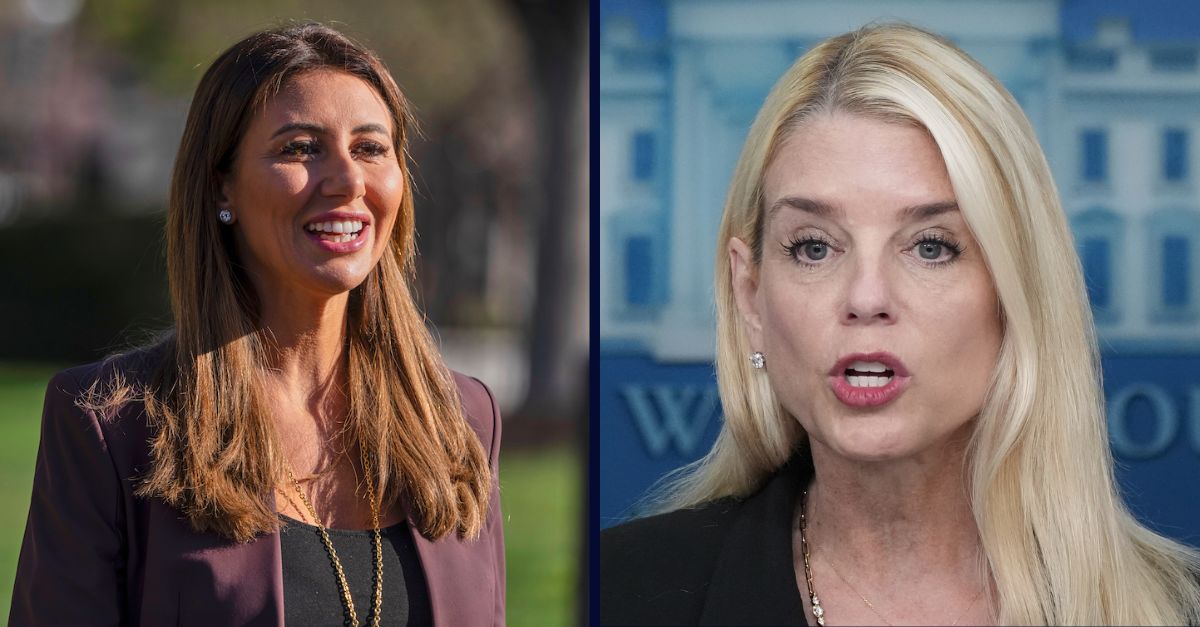
Left: Alina Habba, President Donald Trump”s pick to be the interim U.S. Attorney for New Jersey, arrives to speak with reporters outside the White House, March 26, 2025, in Washington (AP Photo/Mark Schiefelbein, File). Right: Attorney General Pam Bondi, speaks during a news conference with President Donald Trump in the James Brady Press Briefing Room at the White House, Monday, Aug. 11, 2025, in Washington (AP Photo/Alex Brandon).
A trio of judges has rejected U.S. Attorney General Pam Bondi’s effort to maintain a staunch Trump supporter as the leading federal prosecutor in New Jersey. The panel determined on Monday that Alina Habba was properly removed from cases against her challengers.
The 3rd U.S. Circuit Court of Appeals, in a unanimous decision authored by Senior U.S. Circuit Judge D. Michael Fisher, emphasized the Trump administration’s desire to appoint favored individuals to U.S. attorneys’ positions. This decision, however, underscored the necessity for “clarity and stability” for both New Jersey residents and federal employees regarding Habba’s legitimacy, bypassing customary Senate confirmations and constitutional procedures.
Fisher stated, “The appointment of a U.S. Attorney is a significant role that demands Senate confirmation. When a vacancy occurs, Congress generally prefers that the acting officer have extensive experience to lead effectively. The current administration’s attempts to secure its appointees have encountered various legal and political hurdles, as demonstrated by its efforts to appoint Alina Habba as Acting U.S. Attorney for the District of New Jersey. Yet, stability and clarity are owed to New Jersey citizens and dedicated staff in the U.S. Attorney’s Office.”
The court ultimately concluded that Habba was ineligible to serve as the acting U.S. Attorney since she was not the first assistant at the time of the vacancy. Her nomination was withdrawn by President Trump, and her dual title as a special attorney, granted by Bondi, did not permit her to carry out the U.S. Attorney’s functions.
The court elaborated, “The Government claims Habba serves as Acting U.S. Attorney for New Jersey under the FVRA due to her designation as First Assistant U.S. Attorney. We need to determine: (1) whether only the first assistant present at a PAS officer’s resignation automatically assumes acting duties under § 3345(a)(1), and (2) whether the nomination bar in § 3345(b)(1) prevents someone from assuming acting duties even if their nomination is no longer pending in the Senate. We affirm both questions.”
Moreover, the panel dismissed Habba’s special attorney title as being “prohibited by the FVRA’s exclusivity provision.”
Senior U.S. Circuit Judge D. Brooks Smith, a George W. Bush appointee like Fisher, and U.S. Circuit Judge L. Felipe Restrepo, a Barack Obama appointee, joined the opinion.
Habba was first named interim U.S. attorney in March as Trump nominated her to the permanent position. When the 120-day interim stint neared its end, the New Jersey federal district court declined to extend her stay under 28 U.S.C. § 546, leading Bondi to lash out against so-called “rogue judges” in late July.
The district court had instead appointed Habba’s then-first assistant Desiree Grace — the second in command at the U.S. attorney’s office — to fill the vacancy upon the expiration of Habba’s interim stint. But before the interim term ended, Bondi claimed “politically minded” judges had interfered with Trump’s “core Article II powers,” and Grace was fired.
After Trump pulled Habba’s nomination as permanent U.S. attorney, Habba resigned as interim U.S. attorney and was appointed simultaneously to the ousted first assistant’s position under the Federal Vacancies Reform Act (FVRA) — elevating her to acting U.S. attorney by default. At the same time, Bondi named Habba a special attorney under 28 U.S. Code § 515, delegating to Habba the power to act as a U.S. attorney through another means as the office’s supervisor.
Chief U.S. District Judge for the Middle District of Pennsylvania Matthew Brann, sitting by designation, ruled in August that Habba was disqualified from the cases of Cesar Pina, Julien Giraud Jr., and Julien Giraud III because Bondi’s method of keeping Habba in place after her 120-day interim stint ended was not lawful.
During oral arguments in October, the circuit judges did not jump at the chance to tip their hands in the DOJ’s favor, with Smith openly challenging Bondi’s counselor Henry Whitaker at the tail end of the proceeding to “come up with an example of any time” a non-Senate confirmed temporary U.S. attorney was installed as Habba was.
“Well, I guess I cannot,” Whitaker answered, still claiming that there had been analogous situations.
On Monday, the panel provided specifics on its views as to why Bondi’s gambit could not succeed, leaving the DOJ with an opportunity to seek an en banc rehearing at the 3rd Circuit or to petition the U.S. Supreme Court to step in.
The appellate judges were unpersuaded by the DOJ’s arguments that a lone district judge had threatened to “cripple the functioning of government” by ruling against a “past practice” for filling temporary vacancies.
“The Government finally argues that past practice by various administrations indicates its reading of the statute aligns with Congress’s intent. This argument is unpersuasive. First, just because a practice previously went unchallenged does not mean it complies with the FVRA,” the panel noted.
Separately, the 3rd Circuit said, Congress’ efforts to shore up its own “advice-and-consent power” through the legislation like the FVRA is far from new.
“The final statute was a compromise: Congress granted the Executive additional flexibility by lengthening the limitations period and expanding ‘the pool of individuals the President could appoint as acting officers,’” the opinion said. “But while it granted this added flexibility, Congress—as it has done on many occasions since George Washington’s first Presidential term—acted in response to the ‘interbranch conflict’ and ‘tensions’ arising from the Executive branch’s continued attempts to contravene the Senate’s advice-and-consent power.”
To accept the DOJ’s arguments here, the panel continued, would be to render statutory limitations on the executive “mostly superfluous.”
“On the contrary, allowing rejected (and withdrawn) nominees to serve as later-appointed acting officers during that vacancy would significantly undercut Congress’s solution to its separation-of-powers concerns,” the court summed up.
Nor did Bondi’s delegation to Habba of the “full panoply of powers of a U.S. Attorney” through a special attorney title stand up to scrutiny.
“Under the Government’s delegation theory, Habba may avoid the gauntlet of presidential appointment and Senate confirmation and serve as the de facto U.S. Attorney indefinitely. This view is so broad that it bypasses the constitutional PAS process entirely,” the opinion concluded. “It also essentially eliminates the requirements of the FVRA and the U.S. Attorney-specific statute, § 546. The Government’s arguments to the contrary are unavailing.”
That the DOJ embraced a loophole which would “effectively permit[] anyone to fill the U.S. Attorney role indefinitely,” the court said, “should raise a red flag, given the careful time limitations included in both the FVRA and the U.S. Attorney-specific statute.”
“As it stands, Habba alone is exercising all the powers of a U.S. Attorney, making her an Acting U.S. Attorney whose appointment is not FVRA-compliant,” the panel added, upholding Brann’s disqualification order.
Read the full opinion here.