

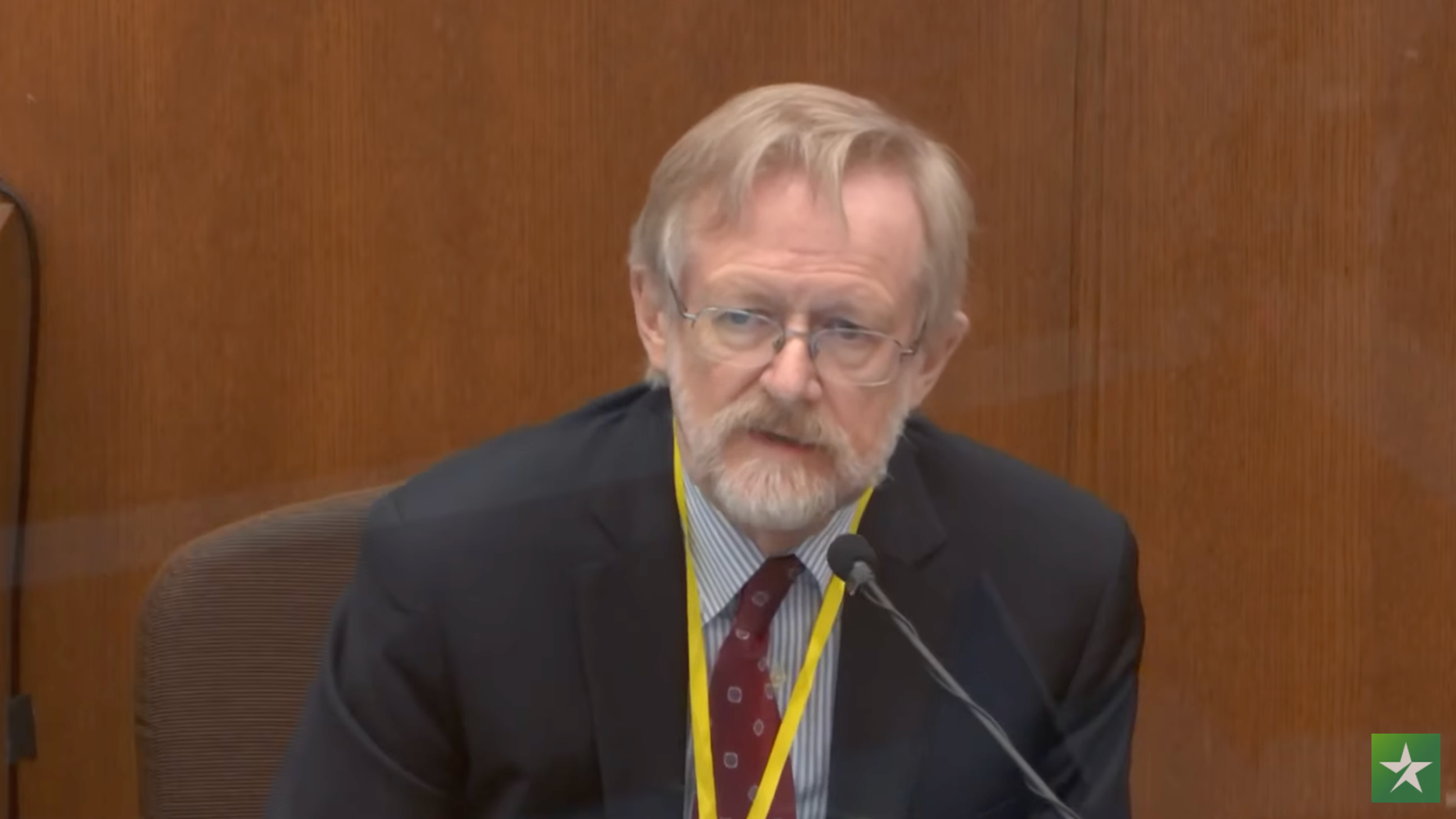
A doctor specializing in respiratory medicine testified in court Thursday that George Floyd died of asphyxia as a result of being handcuffed facedown on the street with former Minneapolis police officer Derek Chauvin kneeling on him.
Dr. Martin Tobin, who works in the intensive care unit at Hines VA Hospital in Illinois and has studied respiratory physiology for 40 years, said Floyd died of a “low level of oxygen,” also known as asphyxia or hypoxia.
“This caused damage to his brain,” Tobin testified, “and it also caused a [pulseless electrical activity] arrhythmia that caused his heart to stop.”
Floyd’s low oxygen level was caused by “shallow breathing” due to his being handcuffed in the prone position against the pavement as Chauvin knelt on Floyd’s neck as well as his back and side, according to Tobin.
Floyd was being “squashed” between the hard ground and the officers as they pushed his handcuffs high into his back, Tobin says. Such actions would “totally interfere with central features of how we breathe,” he added.
“It’s like the left side is in a vise,” Tobin testified. “It’s totally been pushed in, squeezed in from each side, from the street at the bottom and from the way that the handcuffs are manipulated.”
“It’s as if a surgeon has gone in and removed the lung ― not quite, but along those lines,” Tobin added. “Very little opportunity for him to be able to get any air to move into the left side of his chest.”
Tobin gave his assessment to the court on the ninth day of witness testimony in Chauvin’s trial. Chauvin has been charged with second- and third-degree murder as well as manslaughter in Floyd’s death. He has pleaded not guilty to all charges.
Tobin testified Thursday that Chauvin kneeling on Floyd’s neck prevented air from getting through the hypopharynx, a hollow tube that passes food, water and air through the bottom of the throat. Floyd’s placement in the prone position also narrowed the hypopharynx, Tobin said.
“When you have to breathe through a narrow passageway, it’s like breathing through a drinking straw, but it’s much worse than that,” Tobin said.
Tobin’s testimony undercut the defense’s argument that drug use ― not Chauvin’s actions ― played a major role in Floyd’s death.
The Hennepin County Medical Examiner’s Office’s autopsy report, released in June last year, classified Floyd’s death as a homicide and said it was caused by “cardiopulmonary arrest complicating law enforcement subdual, restraint and neck compression.”
The report also stated that Floyd tested positive for COVID-19 in April 2020 and that he had fentanyl and methamphetamine in his system when he died — but didn’t draw a causal link between the drugs and his death.
Fentanyl typically causes a person’s respiratory rate to slow, Tobin testified Thursday. Floyd’s respiratory rate was a normal 22 breaths per minute just before he lost consciousness. If fentanyl were impacting Floyd’s breathing, his respiratory rate likely would have been about 10 breaths per minute at that point, according to Tobin.
The defense has argued that Floyd’s high carbon dioxide level recorded at the hospital the night of his death was caused by fentanyl use. But Tobin said that phenomenon is “solely” explained by Floyd’s lack of breathing.
Any “healthy person” subjected to what Floyd was subjected to during his arrest “would have died,” Tobin said.
Later Thursday, Dr. Bill Smock, the police surgeon for the Louisville Metro Police Department, testified that he believed Floyd died of “positional asphyxia,” which Smock described as “a fancy way of saying he died because he had no oxygen left in his body.”
Like Tobin, Smock said Floyd could be seen during his arrest suffering an anoxic seizure, which occurs when there’s a fatal injury to the brain from a lack of oxygen.
“You can hear the handcuffs shake, and you’ll see the body camera shake when he has an anoxic seizure,” Smock testified.
Smock also dismissed suggestions that Floyd might have died of a drug overdose, noting that his methamphetamine level was “very low” and he didn’t exhibit certain symptoms of fentanyl overdose, such as constricted pupils. He also said there was “absolutely” no evidence that Floyd died of a heart attack.
The doctor who treated Floyd the night he died in May 2020 testified on Monday. He said that, given the information he had at the time of Floyd’s death, he believed Floyd “likely” died of asphyxia.
Videos recorded by bystanders and the officers’ body-worn cameras showed Chauvin kneeling on Floyd’s neck for 9 minutes and 29 seconds as Floyd stated multiple times that he couldn’t breathe. Chauvin remained in this position for several minutes even after Floyd ceased moving and breathing.
Calling all HuffPost superfans!
Sign up for membership to become a founding member and help shape HuffPost’s next chapter
Source: huffpost


