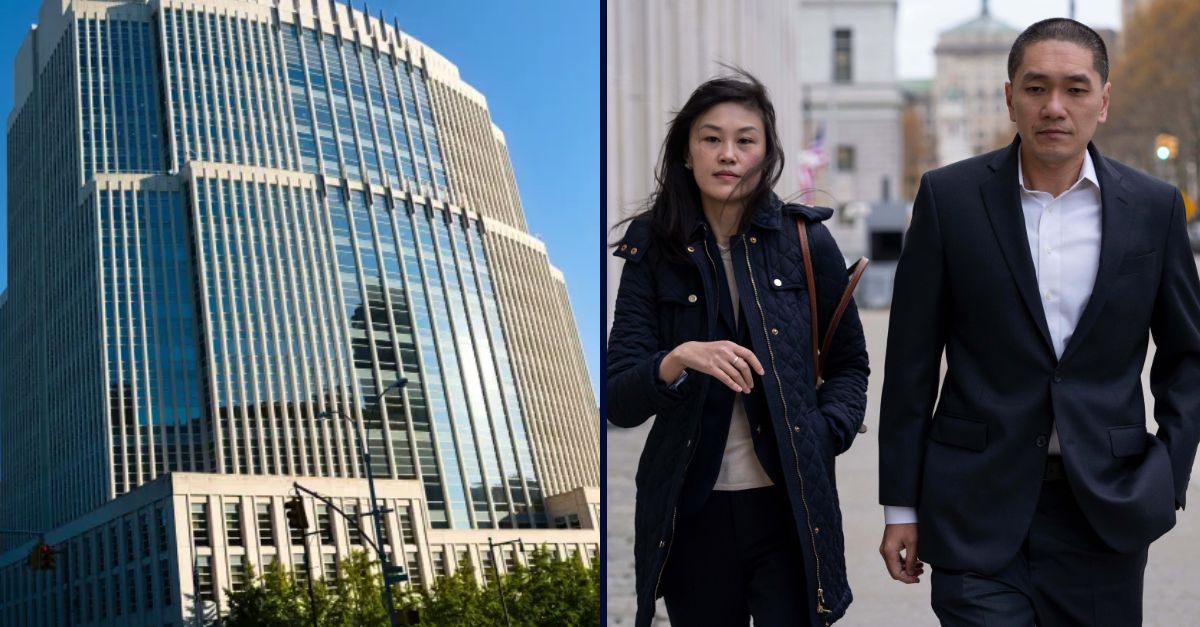

Right: Former New York Governor Kathy Hochul aide Linda Sun and her husband, Christopher Hu, arrives at Brooklyn federal court, Nov. 13, 2025, in New York (AP Photo/Yuki Iwamura).
In a high-profile political corruption trial in Brooklyn’s federal court, the jury found itself unable to reach a unanimous decision after nearly a month of deliberations. The case involved Linda Sun, a former aide to Governors Andrew Cuomo and Kathy Hochul, and her husband, who faced accusations of selling influence to the Chinese government.
U.S. District Judge Brian M. Cogan, known for his respect for the jury system, declared a mistrial and expressed gratitude to the jury for their service. He remarked, “You [juries] almost always get it right, even when you’re deadlocked. It shows how tough the case is, that’s something we all need to know.” This comment suggests that even the judge found it challenging to reach a conclusion on the Sun case, and it served to reassure the jurors that their efforts were valued, despite the lack of a verdict.
Despite the deadlock, prosecutors demonstrated confidence in their case and announced plans to retry the case at the earliest opportunity. A hung jury, however, does not signify a complete loss. The outcome may prompt prosecutors to consider dismissing the case or offering a more favorable plea deal to the defendants, thereby avoiding the expense and uncertainty of another trial.
As a co-instructor of a law school course on judging, I have observed that guest judges frequently affirm their agreement with jury verdicts, especially in high-profile cases. They typically express confidence in the jury’s decisions.
This raises an interesting question: what would happen if judges disagreed with jury verdicts but lacked the legal power to overturn them? While a judge can set aside a conviction if the evidence is deemed insufficient, they generally cannot overturn a verdict based on their personal assessment of a witness’s credibility, which the jury may have found convincing enough to convict.
I often wonder about that. What, indeed, would it mean if the judges disagreed with the jurors but, as is the case in most circumstances, simply lack the legal authority to overturn the jury’s verdict? After all, while a judge can legally overturn a jury’s conviction if the evidence of guilt is in her view insufficient, she basically cannot if she simply finds untruthful the star witness whom the jury obviously accepted as truthful in having voted to convict.
If Cogan is right that jurors almost always “get it right” — actually meaning, seeing it the same way as the presiding judge would — why is it that criminal lawyers almost never counsel their clients to proceed without a jury? This even though in New York State court, for example, the decision to “go nonjury” is entirely in the defendant’s hands. And in federal court, while a criminal nonjury trial technically requires the government’s consent too, the government will almost always consent to a defendant’s decision to waive a jury, in part lest their refusal be deemed disrespectful to the judge. To the layman, the defendant’s typical insistence on a jury trial may seem somewhat surprising, inasmuch as a nonjury trial is far cheaper, far faster, far less stressful for the defense and seemingly less likely to face potentially hard-nosed and unforgiving jurors out for blood.
Put simply, a jury simply provides for a far greater chance of “victory” for a defendant. And a victory can simply mean a deadlocked or so-called “hung jury.” That is, one single juror — maybe even an “I will never go along with the others” knee-jerk contrarian who somehow managed to get seated on the jury — standing up to the 11 other “ready-to-convict” jurors. And no criminal lawyer wants to forfeit the possibility of persuading that lone contrarian who can singularly, even maybe irrationally, defeat defeat! Or even, as in the instance of the famous film “Twelve Angry Men,” give up on the potential of a totally rational Henry Fonda figure turning around the entire jury to vote for acquittal.
Criminal lawyers don’t have to be soothsayers to uniformly “believe in” the jury system and virtually always persuade their clients to demand a jury trial! Again, everyone in the system would quickly agree that a hung jury is generally a defendant’s win, even if the defense gains only one juror’s vote.
Given the value of a hung jury — assuming, as I say here, that hung juries indeed constitute defense victories — it’s noteworthy that judges can’t “hang,” although there was an instance many years ago in Brooklyn Supreme Court in which a judge openly announced in court that he couldn’t reach a verdict and declared himself “hung” — an unusual thing for a judge to have said so aloud, and he probably should have simply acquitted under those circumstances. And so, along with the inability to seat a contrarian fact finder in a nonjury trial, it is that unlikelihood for a judge to declare that he or she is “hung” or deadlocked that causes criminal lawyers to fervently counsel their clients to almost always demand a jury trial.
“Almost” always? Yes, it does happen that an attorney may conclude that the potential defense is so technical, notwithstanding horrendous conduct by the defendant, that it is far more likely that a judge would be better able to put aside his strong negative feelings about the defendant and accept the technical defense than pretty much any jury sitting in that jurisdiction.
And maybe most important, juries – although, frankly, a few judges too — can’t be counted on to be bias-free. In the case of many juries, the defendant’s religion, race or ethnicity may be a great hindrance to the defendant getting a fair shake. Proceeding to trial in a venue where “his kind” isn’t easily accepted by the venue’s general population (and accordingly the jury’s likely makeup) may argue that a nonjury trial is a much wiser choice. Put differently, trial lawyers simply can’t necessarily rely on the honesty of jurors who reflexively claim during voir dire a ready ability – and willingness – to put aside their personal biases.
Interestingly, in recent months a New York City police sergeant, Erik Duran, leading an undercover operation, was charged in the Bronx for killing an escaping suspect in a drug operation by having thrown a filled cooler at him while he was driving a motorbike, which led to a collision in which he died. Perhaps because the case was venued in the Bronx where juries are notoriously known to be anti-police, Duran waived a jury trial. The judge, however, did find Duran guilty. What a jury would have done we’ll never know. Obviously, though, Duran’s lawyers believed a jury result would likely have been negative to him and asking the trial judge to sit as the factfinder might have led to a possible acquittal.
Returning to the Sun case, Cogan may be absolutely right — jurors almost always get it right because, as he sees it, they reach the same conclusions as do the presiding judges. And because the Sun jury was hung, maybe Cogan too was hung — although respecting him, as I do, there’s not a prayer in the world that he would ever say anything like that aloud.
When, however, jurors see it differently from the judge — maybe, using his right/wrong phraseology, they would get it “wrong” — or just one single juror dissents from the majority for whatever (perhaps ill-conceived) reason, the defendant wins the day. Who, in their right mind, would want to give up that possibility?
And therein lies the answer to the question posed by this essay’s title.
Joel Cohen, a former state and federal prosecutor, practices white collar criminal defense law Of Counsel to Ruskin Moscou & Faltischek PC. He is the author of “Blindfolds Off: Judges on How They Decide” (ABA Publishing, 2014) and is an adjunct professor at both Fordham and Cardozo Law Schools.


