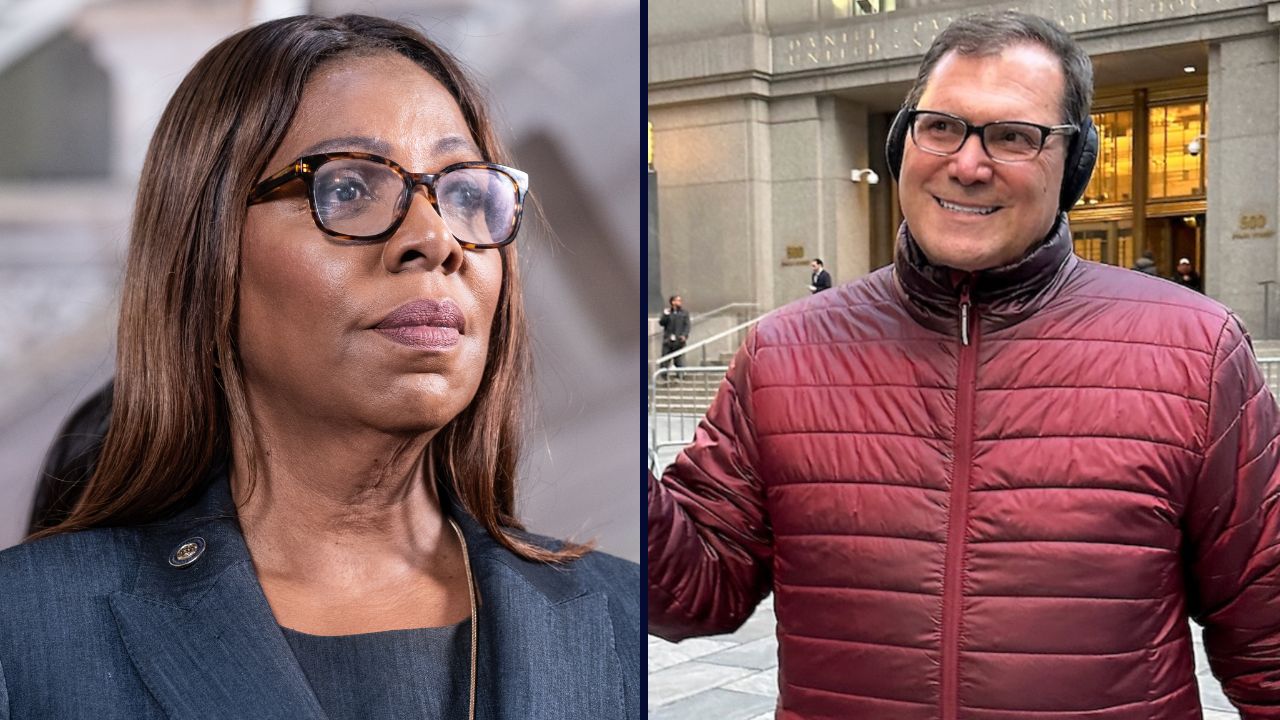

Left: New York Attorney General Letitia James appears with elected officials at a Sept. 14, 2026, City Hall event in New York, where they announced plans to join the Public Rights Project in suing over the federal government’s revised public charge rule. (Photo by Lev Radin/Sipa USA)(Sipa via AP Images). Right: John Sarcone, acting U.S. attorney for Northern New York, exits Manhattan federal court on Thursday, Dec. 4, 2025, in New York. (AP Photo/Larry Neumeister).
The Trump administration asked the U.S. Supreme Court on Tuesday to revive subpoenas aimed at New York Attorney General Letitia James’ office—on the same day the Justice Department sought to revive its bank fraud case against James in a federal appeals court.
The dispute centers on whether John Sarcone, who was disqualified as an acting U.S. attorney, can take part in a grand jury investigation involving officials who examined President Donald Trump and his family business during a New York civil fraud case.
In August, the 2nd U.S. Circuit Court of Appeals upheld, in a 2-1 decision, a lower court ruling that threw out the subpoenas and barred Sarcone from “any further involvement in prosecuting or supervising the instant investigations, regardless of his title.”
The appellate majority agreed with Senior U.S. District Judge Lorna Schofield that Sarcone had neither “validly” served as acting U.S. attorney nor “lawfully” performed the responsibilities of that office.
Sarcone was first installed as an interim U.S. attorney in the Northern District of New York, a position limited to 120 days. After that period expired, a court appointed Donald Kinsella to replace him. Kinsella was promptly dismissed, and the Justice Department argued that Sarcone could resume leadership under the titles of special attorney and first assistant U.S. attorney.
Federal courts, however, have repeatedly rejected that interpretation. The 2nd Circuit’s ruling followed other decisions criticizing former U.S. Attorney General Pam Bondi’s temporary, non-Senate-confirmed acting or interim U.S. attorney appointments in districts covered by the 3rd, 4th and 9th Circuits.
Shortly before the Sarcone decision, the 9th Circuit unanimously concluded that Sigal Chattah was “not lawfully serving” as Nevada’s acting U.S. attorney under the Federal Vacancies Reform Act. The court therefore upheld her removal from supervision of indictments against criminal defendants who challenged her authority, ruling that the law allows automatic succession only by a first assistant who was already in place when the vacancy occurred.
The Justice Department is asking the Supreme Court to review both cases. The Sarcone petition was added to the court’s docket Tuesday.
“The recent court-of-appeals decisions are incorrect,” the DOJ told the justices. The department argued that nothing in the Federal Vacancies Reform Act restricts acting service to the person who held the first-assistant role before a vacancy. Instead, it said, the statute refers to the current “first assistant to the office of such officer” and requires that person to perform the office’s duties. The government also maintained that the attorney general can assign broad law-enforcement powers to any DOJ official, accusing the lower courts of disrupting “two longstanding executive-branch practices for addressing vacancies” in Senate-confirmed positions.
The department directed the Supreme Court to the Chattah litigation, citing the petition filed a week earlier. According to the DOJ, that case presents the Federal Vacancies Reform Act questions more directly and offers “a better vehicle than this [Sarcone] case” because it does not involve the controversial subpoenas.
Even so, the Justice Department asked the Supreme Court to overturn rulings from three federal appeals courts. It warned that those decisions could create major complications during the next presidential transition, when outgoing officials and their first assistants often leave at the same time, potentially depriving a new administration of viable temporary leaders while permanent nominees await confirmation.
The Chattah petition also cautioned that the ruling could immediately create uncertainty across five U.S. attorney’s offices in the 9th Circuit. Together, those offices oversee more than 8,000 civil and criminal matters each year, the government said, making swift Supreme Court review necessary.
The investigation involving James’ office has not been halted. The government remains free to issue the subpoenas again, provided they come from officials with lawful authority to do so.
The post Trump DOJ asks SCOTUS to revive subpoenas after Letitia James investigation stalls, while pointing to a “better vehicle” in a related case, first appeared on Law & Crime.