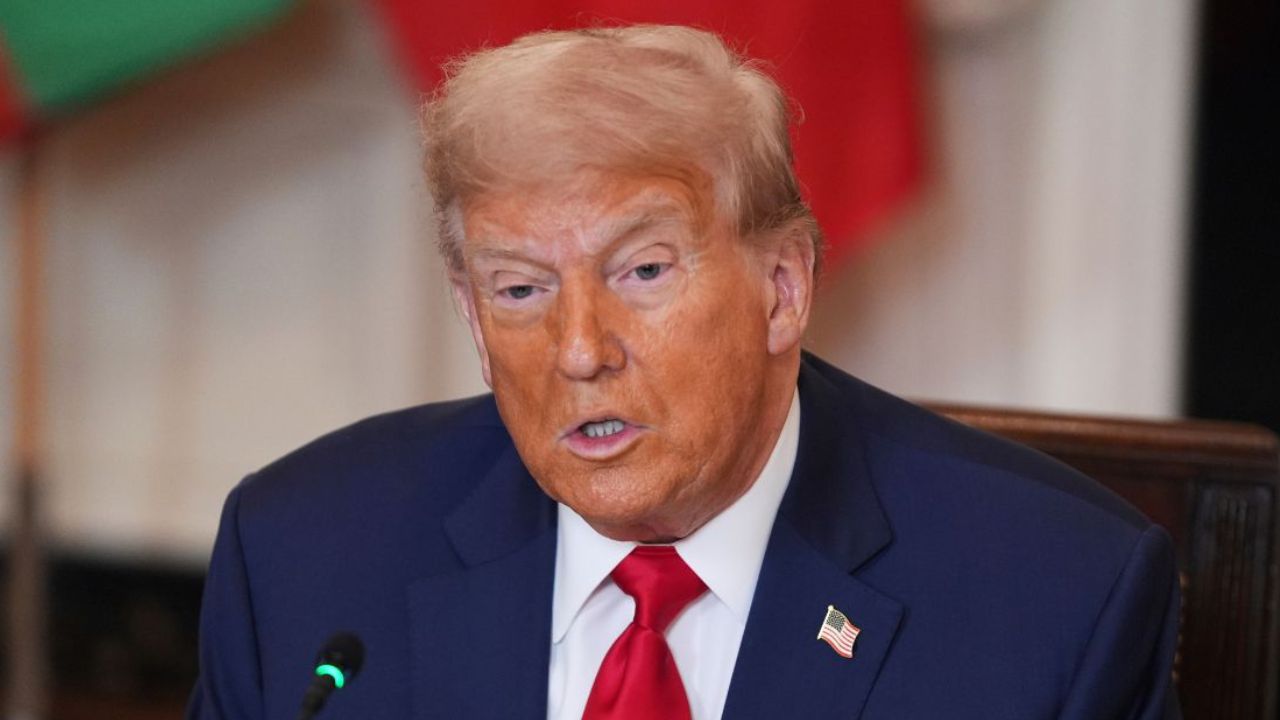

President Donald Trump addresses African leaders during a lunch in the State Dining Room at the White House on Wednesday, July 9, 2025, in Washington (AP Photo/Evan Vucci).
Hundreds of thousands of Americans living abroad — including “military personnel and their family members” — could be at risk of losing their ability to vote under a Trump administration policy, a group of former national security officials warned in a court filing Tuesday.
The warning came in a 38-page amicus brief from National Security Leaders for America (NSLA), which argues that the Postal Service’s proposed new rule for mailing ballots is broadly “unlawful” and violates “protections Congress guaranteed” for members of the uniformed services and other eligible voters overseas.
“[A]llowing USPS to implement the Final Rule would create an imminent risk that military personnel and their families serving away from their legal residences and diplomats and other eligible voters living abroad will be effectively disenfranchised,” the brief states.
The dispute traces back to March, when the administration began moving to carry out President Donald Trump’s executive order directing USPS to sharply limit mail-in voting procedures by bringing ballot envelopes under a federalized system.
States and advocacy groups have challenged the policy in multiple lawsuits, seeking to keep it blocked. They have succeeded to varying degrees, at least with respect to the coming midterm elections. But the legal landscape shifted in late August, when USPS formally adopted the policy as an internal rule, effectively restarting the pending litigation. With Election Day approaching, the flurry of motions, rulings and appeals has accelerated rapidly.
Last week, U.S. District Judge Indira Talwani, an appointee of President Barack Obama, issued her latest ruling on the matter, dissolving a temporary restraining order and replacing it with a preliminary injunction. The Trump administration quickly responded with a notice of appeal to the U.S. Court of Appeals for the 1st Circuit, even as it was already pursuing a stay pending appeal of the earlier temporary order.
The former national security officials now argue that the administration has downplayed the real-world consequences of the new USPS rule and has not been candid about how it would affect voters overseas.
“Although the Final Rule nominally purports to exempt [overseas] ballots from its implementation of [the rule’s] unlawful requirements, the exclusion is neither developed nor workable,” the filing goes on.
To hear the 1,500-plus members of NSLA tell it, the “new barcode-and-enrollment regime for ballot mail” required by the USPS rule is set to be “implemented on a compressed election-year timeline” and will directly “interfere” with the federal law protecting military voters.
The amicus brief points to the absence of any reference to that law in the government’s filed efforts to overturn Talwani’s injunctions.
“Confirming that the Final Rule’s exclusion for [overseas] ballots is fictional, the Government’s Motion omits any mention of it,” the filing continues. “The Government thus leaves the admitted conflict between [the overseas ballot law] and the Postal Service’s ballot-blocking policy entirely unaddressed.”
The national security group goes on to say the rule “is ultra vires and cannot be lawfully implemented because it would impose envelope formatting requirements” on the states that the overseas ballot law “expressly prohibits.”
That is, the group says the “barcode-and-enrollment policy” contains “no plausibly effective procedures” to ensure ballots mailed by overseas voters will pass muster under the rule at a basic level.
The group also says the circumstances of the upcoming election render the rule unworkable in the near term.
The filing elaborates:
[I]mplementation of the Final Rule would inject confusion and operational disruption into military and diplomatic and other overseas voting at the very time when State officials, under express requirements of the statute, must distribute, receive, and count [overseas] ballots. The processes prescribed to protect [overseas] voters preclude any realistic conclusion that there will be adequate time to resolve the conflicts and uncertainties associated with the Final Rule’s ballot procedures before the November 3, 2026, general election.
And the problems would only snowball at this point for military voters and others similarly situated, the group argues. While those problems are likely to affect voters writ large, they pose particular problems to overseas voters, the amicus brief alleges.
“A domestic voter whose mail ballot is rejected retains some recourse; she may vote in person, seek a provisional ballot, or return to her local election office to resolve a registration problem before Election Day,” the filing goes on. “[An overseas] voter may have none of these options. She cannot appear at a polling place thousands of miles away, and once her ballot is transmitted under the schedule [the overseas ballot law] requires, the calendar ordinarily leaves no time to receive a rejection notice, obtain a compliant envelope or enrollment, and return a replacement ballot before its deadline.”
The post Trump’s mail-in ballot rule could cost ‘military personnel and their family members’ their vote, ex-national security leaders warn first appeared on Law & Crime.