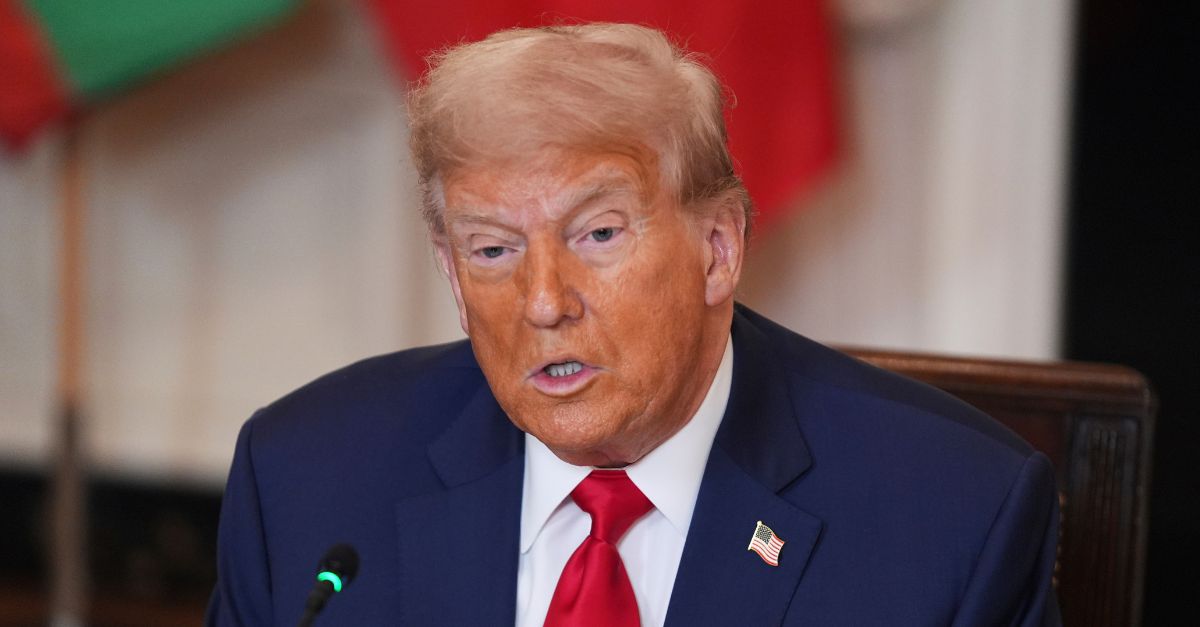

President Donald Trump speaks during a lunch with African leaders in the State Dining Room of the White House, Wednesday, July 9, 2025, in Washington (AP Photo/Evan Vucci).
President Donald Trump has suffered a significant loss in a federal court of appeals over his power to impose unilateral tariffs.
On Friday, the U.S. Court of Appeals for the Federal Circuit delivered a 127-page decision, stating the president does not possess the authority to impose tariffs under the International Emergency Economic Powers Act (IEEPA).
“In each statute granting tariff power to the President, Congress has set specific limitations and procedural guidelines for imposing such tariffs,” the majority opinion states. “It is unlikely that Congress intended to diverge from its usual practice by providing the President with unrestricted tariff authority under IEEPA. The statute neither addresses tariffs nor includes procedural safeguards with clear limits on the President’s tariff-imposing powers.”
But the 45th and 47th president quickly vowed to appeal the loss to the perhaps friendlier terrain of the U.S. Supreme Court.
“Today a Highly Partisan Appeals Court incorrectly stated that our Tariffs should be lifted, but they know the United States will ultimately prevail,” Trump declared in a Truth Social post on Friday evening. “Removing these Tariffs would be disastrous for the Country. It would weaken us financially, and we must remain strong. The U.S. will not accept large Trade Deficits and unfair Trade Barriers imposed by other Countries that undermine our economy. If left unchallenged, this Decision would destroy the United States.”
In mid-April, V.O.S. Selections, an alcohol importer, along with other businesses, filed a lawsuit against the tariff regime—citing issues with pricing, shipping, product selection, inventory, reduced cash flow, and fewer purchase orders. In late April, a coalition of 12 Democratic-led states filed a similar challenge to Trump’s tariffs. These cases were later consolidated.
By late May, the consolidated plaintiffs succeeded, with a unanimous three-judge panel on the Court of International Trade blocking the tariffs. However, that ruling was promptly stayed by a 10-judge panel in the appellate court.
Now, the panel, made up of 11 judges and almost the court’s entirety – except for U.S. Circuit Judge Pauline Newman who is disallowed from serving in her duties due to allegations of severe cognitive decline – has vindicated the lower court’s decision.
But, again, in real terms, the tariffs regime moves forward because the appellate court stayed application of its own ruling until Oct. 14.
This concomitant pause will allow both the Trump administration to immediately appeal – as well as give the New York City-based trade court an opportunity to consider, on remand, whether or not its “universal injunction comports with the standards outlined” in the high court’s landmark decision on the reach of district court injunctions.
Earlier this year, a majority of justices voted to narrow down the pathways to nationwide, or universal, injunctions.
But the appellate court left little room for the lower court.
“[V]acatur of the universal injunction is warranted based on the Supreme Court’s intervening decision in Trump v. CASA, Inc.,” the opinion goes on. “In CASA, the Supreme Court considered the Government’s challenge to three universal injunctions issued by different district courts prohibiting enforcement of the President’s policy with respect to birthright citizenship.”
In the present case, the 7-4 majority on the panel agreed with the legal reasoning and conclusions reached by the trade court.
“We are not addressing whether the President’s actions should have been taken as a matter of policy,” the opinion continues. “Nor are we deciding whether IEEPA authorizes any tariffs at all. Rather, the only issue we resolve on appeal is whether the Trafficking Tariffs and Reciprocal Tariffs imposed by the Challenged Executive Orders are authorized by IEEPA. We conclude they are not.”
To hear the appellate court tell it, the text of the statute at issue strongly advises against the government’s interpretation.
“The statute bestows significant authority on the President to undertake a number of actions in response to a declared national emergency, but none of these actions explicitly include the power to impose tariffs, duties, or the like, or the power to tax,” the opinion reads. “The Government locates that authority within the term ‘regulate . . . importation,’ but it is far from plain that ‘regulate . . . importation,’ in this context, includes the power to impose the tariffs at issue in this case.”
The appeals panel did not stop with the statute’s interpretation at the basic level. The panel further explored the government’s arguments about the power the president claimed – and found those arguments particularly lacking in the constitutional sense.
From the opinion, at length:
The Government’s interpretation of IEEPA would render it an unconstitutional delegation. Because taxation authority constitutionally rests with Congress, any delegation of that authority to the President must at least set out an intelligible principle that includes “both ‘the general policy'” that the President “must pursue and ‘the boundaries of [its] delegated authority.'” Similarly, Congress must “provide sufficient standards to enable both ‘the courts and the public [to] ascertain'” whether the President “has followed the law.” Because this is undoubtedly a case that “affect[s] the entire national economy,” the “‘guidance’ needed is greater . . . than when [Congress] addresses a narrow, technical issue.” For taxes, both “quantitative” and “qualitative limits on how much money” the President can raise are permissible, but it would “pose a constitutional problem” if the “statute gives the [executive branch] power, all on its own, to raise [a] hypothetical $5 trillion” with no “ceiling.”
The Government’s interpretation of IEEPA would be a functionally limitless delegation of Congressional taxation authority.