Share this @internewscast.com
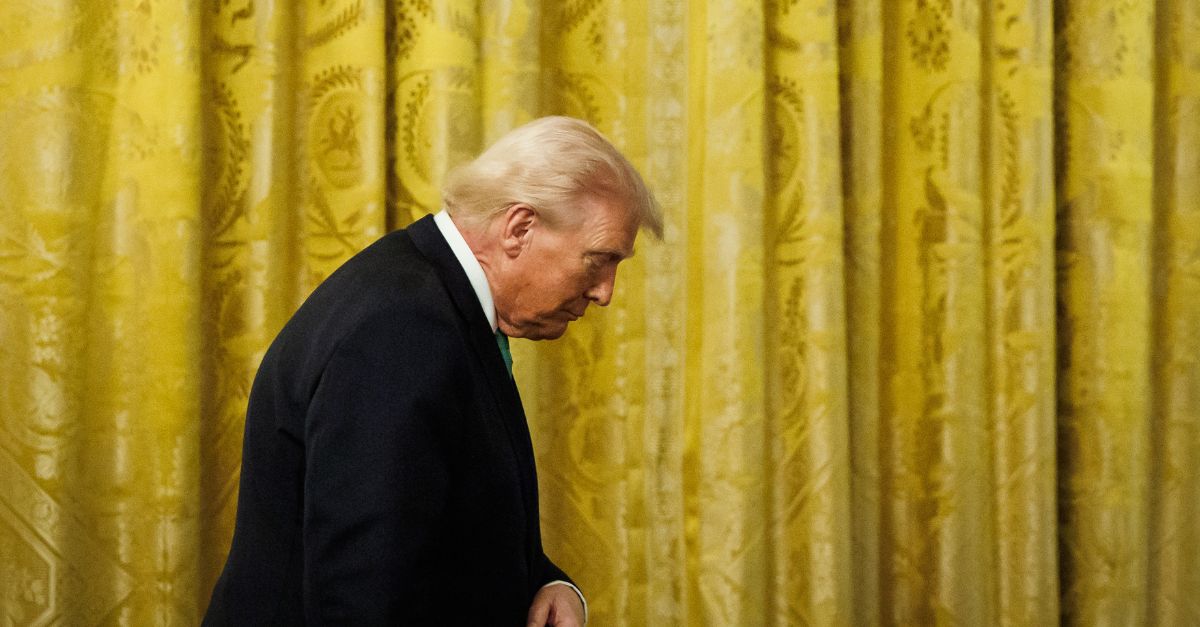
U.S. President Donald Trump leaves a St. Patrick”s Day event in the East Room of the White House on March 17, 2026 in Washington, D.C. (Photo by Samuel Corum/Sipa USA/via AP Images).
The Trump administration is being accused of waging a “campaign of retaliation” against Colorado, as claimed in a lawsuit recently submitted to federal court. This legal action centers on allegations that the administration is specifically targeting a long-established research institution located in the state.
Signs of this purported campaign emerged in the spring of 2025. During that time, President Donald Trump began to publicly refer to Tina Peters—a former Mesa County clerk convicted and imprisoned for election-related crimes—as a “hostage” allegedly punished due to political motivations.
Following these statements, the administration is accused of issuing a series of threats against Colorado. The plaintiffs argue these threats were meant to pressure the state into ending its mail-in voting system, a demand that coincided with calls for Peters’ release.
The situation escalated in September 2025 when the administration’s alleged campaign took a more formal shape. It was then that President Trump announced plans to relocate the U.S. Space Force headquarters out of Colorado, a move the lawsuit describes as part of an effort to secure Peters’ freedom, including an attempted presidential pardon, which the plaintiffs assert had “no legal effect.”
Further developments unfolded in December 2025. On a single day, the National Center for Atmospheric Research (NCAR) in Boulder faced significant cuts alongside a withdrawal of $109 million in transportation funding.
The lawsuit, detailed in a 47-page original petition filed on Monday, contends that the federal government failed to provide a rational explanation for singling out Colorado in its decision to terminate funding.
Instead, a White House spokesperson “directly tied” the funding rescission and NCAR closure threat “to Governor Polis’s refusal to cooperate with President Trump’s demands,” the lawsuit claims.
The plaintiffs, University Corporation for Atmospheric Research (UCAR), a nonprofit consortium of over 100 colleges and universities which provides research and training in atmospheric and related sciences, say the federal government’s actions are manifestly “unlawful.”
“This case arises from unlawful retaliation by federal administrative agencies that are violating long-established procedural limitations on agency action, exceeding the bounds of their statutory authority, and eroding the principles of federalism at the core of our constitutional structure,” the lawsuit begins.
Despite this constitutional framing, the five-count complaint is almost entirely a creature of the Administrative Procedure Act (APA), the federal statute governing the behavior of administrative agencies.
The heart of the lawsuit is the notion that the 45th and 47th president first lashed out over the Peters situation, then piled on complaints about Colorado’s voting system and, finally, had agency heads violate multiple laws in an effort to exact “retribution” when Trump’s increasingly ratcheted-up threats did not result in obedience.
“Federal agencies and officials therein are waging a campaign of retaliation against the State of Colorado and institutions within it,” the lawsuit goes on. “Because Colorado refuses to relinquish to the federal government powers reserved to it by the Constitution, the Agencies have undertaken a series of retributive actions designed to coerce and punish Colorado.”
Showcasing Trump’s disdain for Colorado, the lawsuit also notes that the first time the president used his veto during his second term was to veto a bill funding a clean water project in the state on Dec. 31, 2025. That same day, Trump posted on social media that he hoped the state’s governor and the district attorney who prosecuted Peters “rot in Hell.”
The filing says “UCAR and NCAR are collateral damage” in the federal government’s campaign to encroach upon how Colorado runs its elections and “for the exercise of its constitutionally conferred power to administer and enforce its criminal code.”
The research institute employs nearly 1,400 people in the Boulder area, generates millions of dollars in annual economic activity, and has been a fixture in the state since 1960, the lawsuit notes.
Since Office of Management and Budget (OMB) Director Russ Vought announced the government was “breaking up” NCAR, the Trump administration has engaged in a “cascading series of retaliatory measures,” the lawsuit claims.
Among those additional punitive measures are divesting the institute of its stewardship over a supercomputer that was built by NCAR, terminating a “multi-million-dollar cooperative agreement” with the National Oceanic and Atmospheric Administration (NOAA), weaponizing “disparate and undue reporting requirements” to “saddle UCAR and NCAR with pointless bureaucratic burdens” and using gag orders to “unconstitutionally restrain the speech” of scientists, according to the lawsuit.
The filing holds out particular umbrage for the novel reporting requirements imposed on NCAR staff in light of the breakup plan.
“These disparate and undue reporting obligations and enhanced approval requirements with no precedent are not intended to serve legitimate purposes—they are solely intended to punish UCAR and NCAR as part of the retaliatory campaign against Colorado,” the lawsuit continues. “The reporting and approval demands that deviate from past practice are arbitrary, capricious, and unconstitutional.”
The plaintiffs also level constitutional claims at the gag orders.
“While prior restraints on speech imposed by the government are always inherently harmful, striking at the heart of civil liberties, the gag order in this case has worked particularly acute prejudices,” the lawsuit goes on. “When threatened with restructuring and change as a result of the Agencies’ campaign of retaliation, it is especially vital that UCAR and NCAR be permitted to speak freely without fear of repercussion. NSF is preventing UCAR and NCAR from exercising these fundamental rights.”
The litigation seeks APA-sourced relief in the form of a finding that the campaign against UCAR and NCAR be found unlawful and set aside. The lawsuit also seeks declaratory and injunctive relief as well as an end to the gag orders and restoration of two specific funding awards.