
Share this @internewscast.com
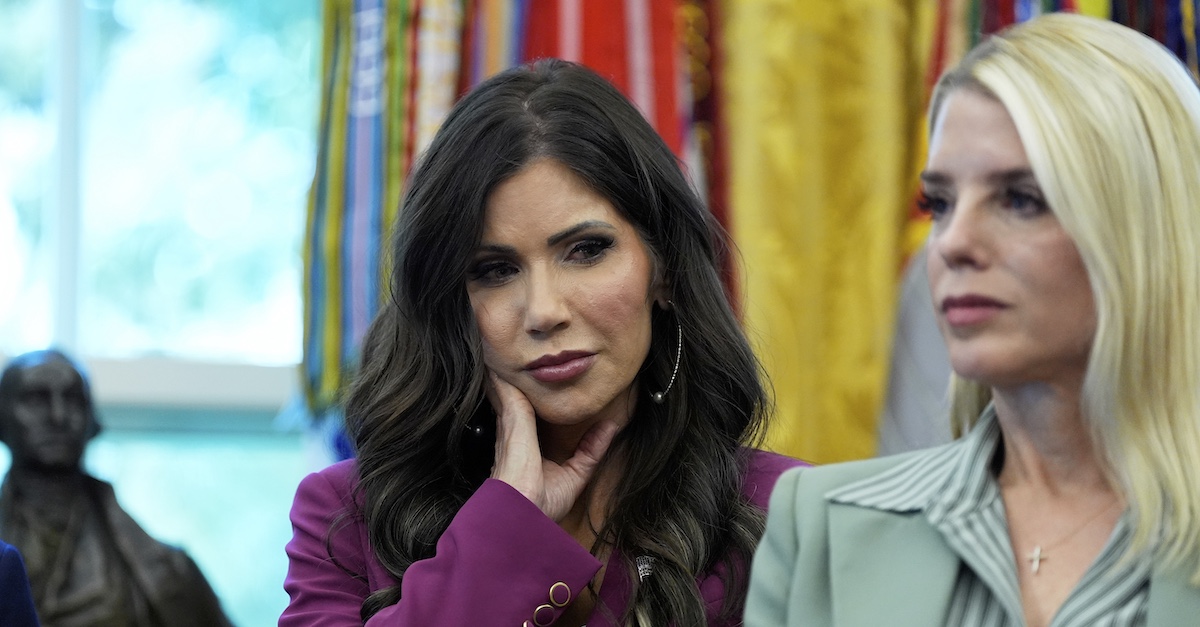
Homeland Security Secretary Kristi Noem, left, and Attorney General Pam Bondi listen as President Donald Trump speaks in the Oval Office of the White House, Monday, Sept. 15, 2025, in Washington (AP Photo/Alex Brandon).
The Trump administration faced a setback after its attempt to sue an entire district court and its judges ended in defeat. Undeterred, they swiftly moved to appeal the decision. However, by 2026, the Department of Justice (DOJ) attempted to retreat from the situation while still asserting a semblance of victory. This week, an appeals court firmly rejected their efforts.
On Tuesday, the 4th U.S. Circuit Court of Appeals delivered a succinct order denying the DOJ’s motion to dismiss its appeal on grounds of mootness. The court also refused the department’s request to nullify the lower court’s ruling against them.
“The case is not moot,” the 4th Circuit declared, opting to reinstate the briefing schedule rather than aligning with the DOJ’s preferences.
Earlier in the summer, the DOJ and the Department of Homeland Security took the unusual step of suing the entire U.S. District Court for the District of Maryland. The lawsuit challenged automatic two-day stays in habeas corpus cases, which the government argued were part of Chief U.S. District Judge George Russell III’s “standing orders” that signified “judicial overreach.” The administration claimed these orders hampered President Donald Trump’s executive authority and his 2024 electoral mandate to expedite deportations.
However, these arguments were met with strong opposition in August when U.S. District Judge Thomas T. Cullen, a Trump appointee, dismantled the case. He criticized the administration’s cabinet members for labeling the judiciary as “rogue” and “activists.”
Judge Cullen, having indicated his stance during a hearing, ultimately sought to reduce tensions between the executive and judicial branches by dismissing the case, which he described as a “constitutional free-for-all.”
“Dismissal of the Executive’s suit is appropriate because it has not pointed to a cause of action that permits this court to entertain a lawsuit between two coordinate branches of government, and this court will not be the first to create one,” he wrote, noting that the “irreconcilable defects” of the suit “mandate dismissal” — without even reaching the merits of whether court-created two-day administrative stays “are a proper exercise of judicial power.”
The DOJ promptly filed a notice of appeal, appearing to commit to seeing a lawsuit against 15 federal judges and a court to its end.
In January, that stance changed. The DOJ asserted that the case was moot because the district court modified the challenged standing orders, meaning the orders the government sued over “are no longer in effect.”
The Trump administration claimed that in a situation like this one, it’s the “customary practice” of the 4th Circuit to then vacate the district court’s opinion, wiping the loss away.
Unsurprisingly, the judges’ lawyers were not interested in that outcome.
Former U.S. Solicitor General Paul Clement wrote that his clients didn’t “object to dismissal of this appeal” but that Cullen’s word on the matter should stand because the “Executive has expressly reserved the right to sue all over again.”
“Defendants have no interest in prolonging this litigation, which never should have been brought. But while the Executive has decided to dismiss this appeal in light of the issuance of the Second Amended Standing Order, it has expressly reserved the right to challenge that order facially via affirmative litigation (rather than as-applied in an individual case)—even though any such effort would plainly be barred several times over by the decision below,” the judges’ attorneys countered. “The parties’ dispute accordingly remains very much live.”
Clement said the DOJ shouldn’t be rewarded for abandoning its appeal, as that would “effectively give the Executive the relief it would obtain if it prevailed[.]”
“The Executive’s actions amount to ‘voluntarily abandon[ing appellate] review’ in hopes of ’employ[ing] the secondary remedy of vacatur as a refined form of collateral attack on the judgment,’” a filing said.
On Tuesday, the 4th Circuit rejected the DOJ, ensuring its judges will hear more from the Trump administration. The court set March 23 as the date to file an opening brief.