
The best and worst NHS hospitals for giving birth in England have been revealed in a Daily Mail analysis of official ratings from the healthcare watchdog.
The investigation found that only five of the 196 maternity services assessed by the Care Quality Commission (CQC) achieved its highest rating of ‘outstanding’.
By contrast, eight services were rated ‘inadequate’ and 84 were judged to ‘require improvement’. The remaining 99 received a ‘good’ rating.
That means almost half of the maternity units assessed fell below the standard expected by the independent regulator.
The analysis comes as NHS maternity care remains under intense scrutiny following a series of high-profile scandals and inquiries into failings affecting mothers and babies.
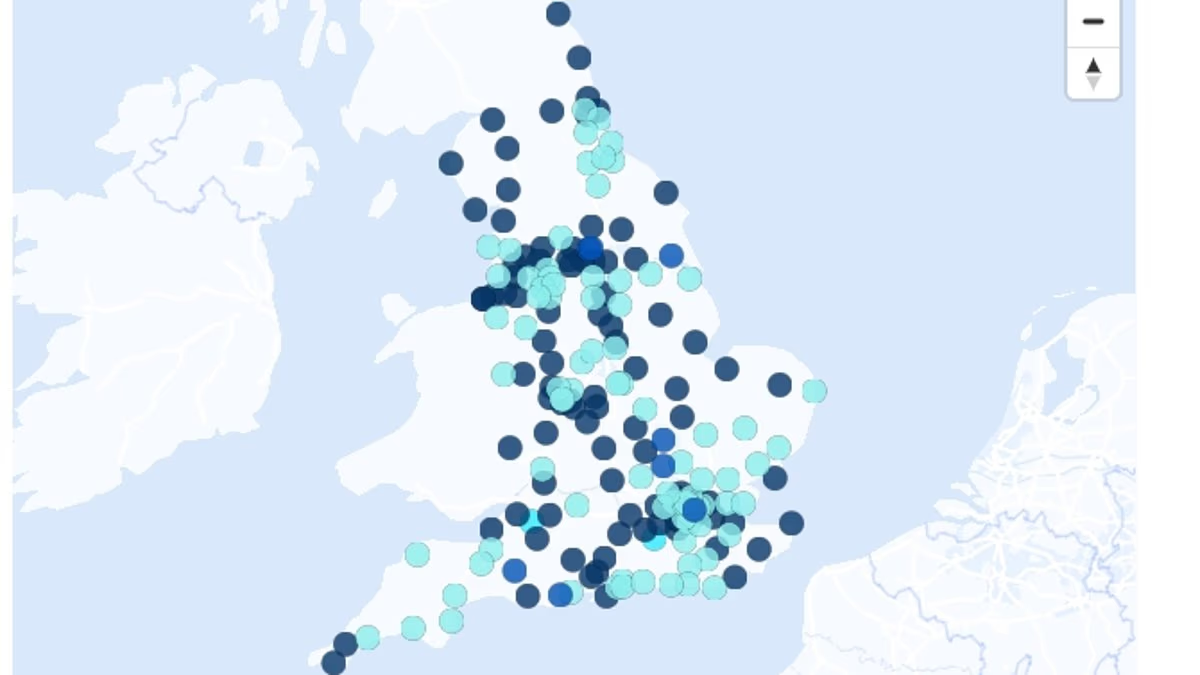
The Daily Mail’s interactive map allows readers to compare their local maternity service with units elsewhere in England.
Readers can search all 196 locations included in the analysis to find out whether their nearest hospital or birth centre is among the country’s highest- or lowest-rated services.
The CQC data, updated earlier this month, covers NHS maternity hospitals and birth centres across England.
Some of the ratings were issued several years ago and may not fully reflect changes introduced since the most recent inspection.
In a small number of cases, services may also have changed, moved location or suspended some elements of their maternity provision.
CQC inspectors assess maternity services in five areas: safety, effectiveness, care, responsiveness and leadership.
Each service is then rated as outstanding, good, requires improvement or inadequate.
The five services awarded an outstanding rating included two west London hospitals operated by Imperial College Healthcare NHS Trust: Queen Charlotte’s and Chelsea Hospital and St Mary’s Hospital.
Both hospitals received the rating in July 2023, following inspections carried out in March of that year.
Queen Charlotte’s and Chelsea Hospital, a specialist centre for maternity, women’s and neonatal care, was praised for its robust safety procedures and effective leadership.
The hospital is where former Countryfile presenter Julia Bradbury gave birth to her three children, including twin daughters in 2015.
Inspectors also highlighted the hospital’s efforts to address staff shortages and strengthen recruitment, as well as its thorough investigation of safety incidents.

Former Countryfile presenter Julia Bradbury gave birth to all three of her children at Queen Charlotte’s and Chelsea Hospital
St Mary’s is perhaps best known for its private Lindo Wing, where Princess Diana gave birth to Princes William and Harry and where the Princess of Wales later welcomed all three of her children.
However, the hospital’s NHS maternity service also received the highest rating, with inspectors praising its skilled workforce, effective approach to managing risk and commitment to improving care.
Hospital leaders were commended for tackling staffing pressures, while maternity teams were praised for adapting care to the individual needs of mothers and babies.
The other three outstanding-rated services were Royal Surrey County Hospital, Royal United Hospital Bath and West Middlesex University Hospital.
Royal Surrey County Hospital received the rating in February 2024, approximately five months after its inspection.
Inspectors said staff were well trained and found a strong safety culture across the maternity unit.
They reported that 98 per cent of women received one-to-one support during active labour.
At Royal United Hospital Bath, which was rated outstanding in March 2024, inspectors said staff collaborated effectively, responded to risks and learned from incidents.
They did, however, raise concerns about staff shortages and gaps in emergency training.
West Middlesex University Hospital, which received its outstanding rating in May 2023, was praised for its strong infection prevention measures.
Inspectors also noted effective teamwork and efforts to ensure women received care without delay.

St Mary’s is best known for its private Lindo Wing, where Princess Diana gave birth to Princes William and Harry
Four of the eight maternity services rated inadequate are run by just two NHS trusts: Bedfordshire Hospitals NHS Foundation Trust and Leeds Teaching Hospitals NHS Trust.
They are Bedford Hospital, Luton and Dunstable Hospital, Leeds General Infirmary and St James’s University Hospital.
At Bedford Hospital, inspectors found persistent staffing shortages, delays in care and failures to learn from safety incidents.
More than one in five calls to the maternity triage service were either unanswered or abandoned.
Staff shortages delayed births at Luton and Dunstable Hospital, inspectors said, while more than 1,000 safety incidents were still awaiting investigation or closure.
Leeds General Infirmary was found to have too few midwives, unsafe staffing levels, poor infection control and inadequate assessments of risks to mothers and babies.
At St James’s University Hospital, inspectors identified unsafe staffing levels, infection-control problems and a failure to learn from previous incidents.
Some women also said they had been treated unkindly by staff.
The other services in the inadequate category were Hull Royal Infirmary, Poole Hospital, The Barkantine Centre and Yeovil District Hospital.
At Hull Royal Infirmary, inspectors described the maternity triage service as ‘chaotic’, citing long waits, inadequate risk assessments and concerns about safeguarding and staff training.
Inspectors at The Barkantine Centre said there was not always ‘adequate equipment to respond to a maternal collapse’. A later inspection found improvements, but the centre retained its inadequate rating. It no longer provides births.
At Poole Hospital, inspectors found unsafe triage arrangements, staff shortages and faulty emergency call systems.
Birth services have since moved to Royal Bournemouth Hospital.
At Yeovil District Hospital, inspectors identified shortages of medical staff, insufficient emergency equipment for babies and poor infection control.
Earlier this year, the cross-party Health and Social Care Committee of MPs described England’s maternity services as being in a ‘state of crisis’.
A major CQC review found that serious problems were widespread across England, rather than limited to a small number of notorious scandals.
The committee warned that poor care had become normalised in some services and that too many mothers and babies were not receiving the standard of care they deserved.
Reviews of high-profile scandals in recent years have concluded that deaths and life-changing injuries involving mothers and babies could have been prevented through better care.
An NHS England spokesman said: ‘While the majority of services are rated as Good or Outstanding by the CQC, it is clear that further improvement is needed to reduce variation across the country and ensure every woman and baby receives safe, high-quality care.
‘The recent independent National Maternity and Neonatal Investigation highlighted the scale of the challenge facing services, and the NHS is working closely with trusts to address the concerns identified and understand where further support is needed.’