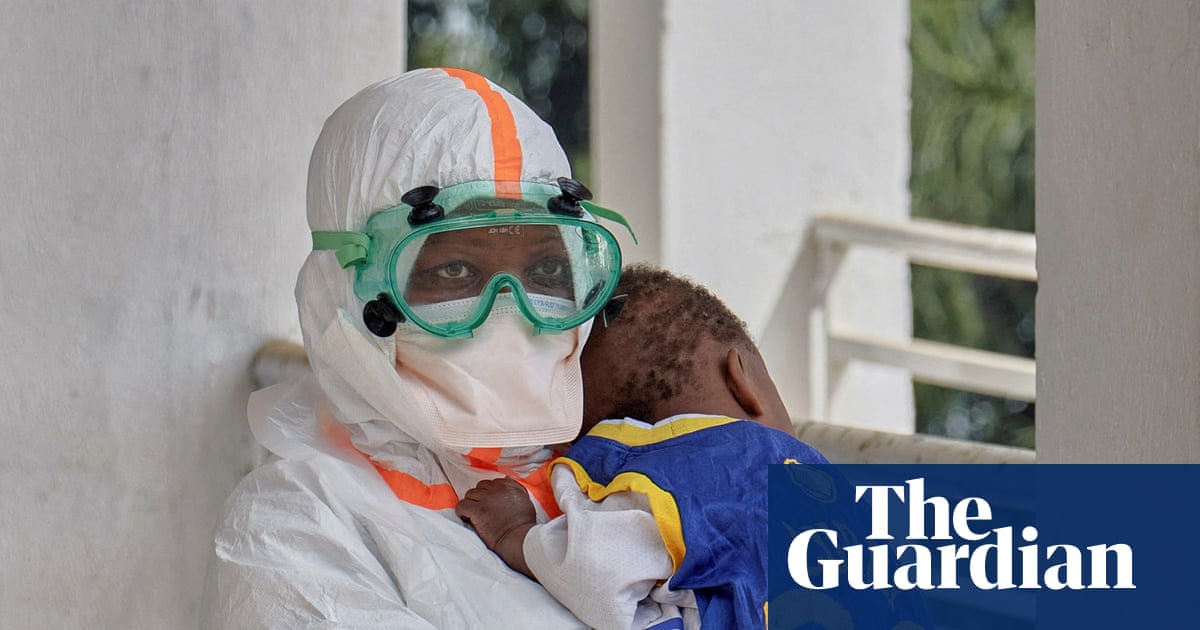

When a newborn boy was taken into an orphanage in Bunia after his mother died of Ebola, the nuns caring for him believed they were offering him a chance to survive. The infant lived for just two more weeks. Since then, four of the nuns who looked after him have also become ill with the virus.
The episode captures the human toll of an outbreak that, according to the World Health Organization, is expanding at an alarming pace, with the number of victims roughly doubling each week.
“It’s really, really devastating,” said Dr Babou Rukengeza, Save the Children’s Ebola response lead in the Democratic Republic of the Congo. He said all children and staff at the orphanage are now being closely monitored for symptoms.
One month after the latest Ebola outbreak, caused by the Bundibugyo strain, was first detected in the DRC, the most recent UN figures show 676 confirmed cases and 136 deaths. Nearly all have been recorded in Ituri province in the country’s east.
Health workers on the front lines say they are still struggling with shortages of critical supplies, including personal protective equipment and vehicles needed to transport bodies. They say testing capacity has improved, but results must come more quickly and services need to be brought closer to patients.
In neighbouring Uganda, which has reported 19 cases and two deaths, intensive tracing of contacts means the outbreak is under control, health officials say.
Despite the global risk remaining low, 22 countries, including the US, have imposed travel restrictions on people coming from the DRC, Uganda or South Sudan, according to Africa CDC, the health agency of the African Union.
Those restrictions have been criticised as impeding health agencies’ response. What the DRC really needs from the international community, experts say, is flexible funding that it can use to get the situation under control.
There are reasons for hope: scientists are working rapidly to test and produce vaccines against Bundibugyo, and the latest research suggests existing antivirals are likely to be helpful.
In Ituri, the organisations involved in the response meet daily to coordinate plans, and African leaders will meet virtually on Tuesday to discuss the outbreak and make funding commitments.
But there are also strong headwinds that are slowing the response: conflict continues in the worst-hit areas and misinformation is rife, leading people to avoid hospitals and the care that could save their lives, and there have even been attacks on aid workers and treatment centres.
Gratien Iracan, the local MP for the provincial capital, Bunia, noted on social media last week: “Despite the millions of dollars announced by the international community to support the response to Ebola, these resources are not yet sufficiently visible on the ground in Ituri.”
In subsequent posts, he highlighted a doctor’s death from Ebola, saying the medic had sent messages from his hospital bed complaining of poor care in the clinic. The Guardian has not been able to verify those messages.
Iracan also described an incident in which a community had called the authorities to report a suspected case of Ebola but the promised support had not arrived, sparking “incomprehension, anger and concern”.
According to Africa CDC, community trust is “a critical challenge” – CNN video footage from Bunia’s central market shows people denying the virus exists and blaming Red Cross workers for spreading it.
In a statement, the continental health watchdog cited “reports of resistance to hygiene measures and decontamination in some communities, as well as incidents of mob violence”.
A key reason for this stems from people’s reluctance to allow their sick relatives to be cared for by strangers in healthcare isolation units – and the importance of funeral rites.
For some people, their fear of displeasing God over not performing an appropriate burial for a relative can be greater than their fear of contracting a virus. According to one study after the 2016 outbreak, exposure to body fluids during each “unsafe” funeral for Ebola victims created an average of 2.58 secondary cases.
Informing people about the symptoms and risks – using mass media such as radio and TV as well as face-to-face contact in the community – has become a key part of work on the ground, says Rukengeza.
“We are pushing and currently we are working with the leaders, community leaders, religious and other people here on the ground just to let them know that this is really Ebola virus, and they have to pay attention,” he says.
With about 600 confirmed cases in one area, health experts would expect to have about 24,000 contacts to monitor. On Thursday, Dr Jean Kaseya, director general of Africa CDC, says there are 4,955 listed – and 57% of those are being monitored.
“It means there is a huge risk of transmission [being] sustained in the community,” Kaseya says. “We still have some confirmed cases not admitted [to hospital]. They are somewhere in the community, elsewhere.”
A joint response plan drawn up by Africa CDC and the WHO estimates that $518m (£387m) will be needed over the next six months to bring the outbreak under control. Kaseya says some early financial pledges from around the world “were not real”, but he now thinks that about $212m, including support in kind, was “almost there”.
Many of those infected are healthcare workers. Ebola is spread via body fluids, and those caring for the sick are most likely to be exposed to them.
Speaking from Bunia on Thursday, Dr Salim Abdool Karim, an epidemiologist who chairs the Africa CDC emergency consultative group, says he visited a treatment centre that day: “There were 22 patients in that particular hospital, five of whom were healthcare workers, two doctors and an anaesthetist.”
Even before Ebola arrived, Ituri faced a humanitarian crisis, with tens of thousands of people displaced by years of conflict. WHO officials have registered more than 520 security incidents affecting their teams in the field so far.
Over the past month, the outbreak has been gradually moving up the grim league tables that rank Ebola epidemics by case numbers and death toll. It is now the third largest on record. Modelling by the US Centers for Disease Control and Prevention suggests this outbreak could grow to match the 2014-16 one in west Africa, which killed more than 11,000 people.
“We hope we can stop that,” says Kaseya, “and it won’t move from the third to the second, even the first one.”


