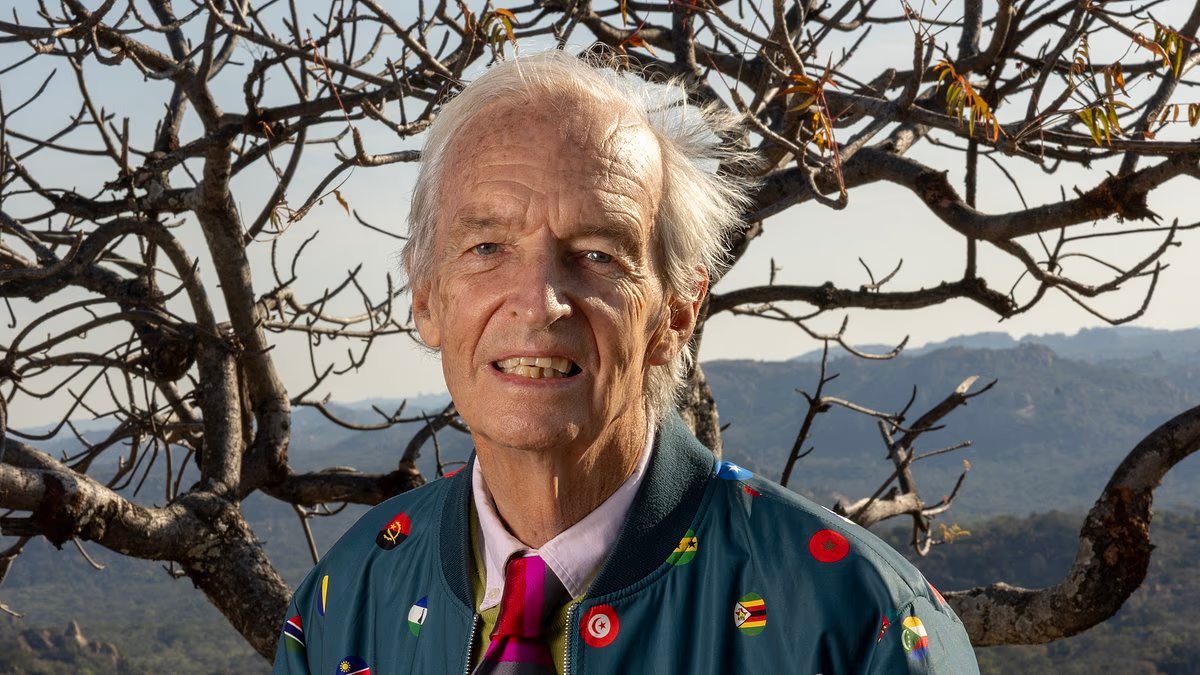

Veteran broadcaster Jon Snow has joined actors Sir Jonathan Pryce, Suranne Jones and Vicky McClure among 60,000 signatories backing a powerful call for “better for everyone affected by dementia”.
The letter, due to be handed in at Downing Street today, is urging ministers to commit to a “bold and ambitious” strategy for faster dementia diagnosis, as fresh research suggests many people are enduring waits of more than six months before getting answers.
Alzheimer’s Society, which organised the campaign and collected the signatures, is calling for a new national standard guaranteeing that anyone suspected of having dementia receives a clear and accurate diagnosis within 18 weeks of being referred by their GP, alongside a care plan and access to suitable treatment where available.
The charity argues that comparable ambitions already exist for other major health conditions, including cancer and heart disease.
In June, the Daily Mail disclosed that Snow had been diagnosed in 2023 with Alzheimer’s disease, the most common type of dementia.
The open letter presses the Government to set a clear goal for reducing dementia deaths, prepare strong plans for rolling out disease-modifying treatments as they emerge, improve dementia training across the social care workforce, and make sure every person can obtain an early, accurate diagnosis.
Without a firm national target, Alzheimer’s Society warns that dementia services risk being scaled back, leaving more families facing long delays while symptoms progress and opportunities for support are missed.
In some cases, campaigners fear patients could deteriorate beyond the point where they are eligible for new breakthrough dementia drugs, which are designed to be used in the earliest stages of the disease.

The Daily Mail revealed in June that Jon Snow (pictured with his wife Dr Precious Lunga) had been diagnosed with Alzheimer’s disease in 2023.

Everyone experiences dementia differently. Use this checklist to help you make a note of your symptoms before you talk to your GP.
The letter comes as its survey of over 1,000 UK carers of people with dementia found just under half (45 per cent) waited more than six months for a dementia diagnosis after first seeking help.
Among the 868 carers supporting someone who had received a formal dementia diagnosis, 46 per cent said the time taken to receive a diagnosis affected their work, just over a third (35 per cent) said it made it harder to plan for the future, and three in 10 felt ‘life was on hold’.
Michelle Dyson, chief executive at Alzheimer’s Society, said it would never be accepted for someone to be ‘left to work out the next steps on their own’ after being diagnosed with a disease such as cancer, but that this is ‘the reality for too many people affected by dementia’.
She said: ‘A dementia diagnosis can bring answers, understanding and access to the support, treatment and care that can make a real difference to people’s lives.
‘But we know things can be so much better.
‘Too many families spend months, and sometimes years, waiting for answers while their dementia progresses. It is like trying to plan a journey without knowing where you are going or when you will arrive. Behind every delayed diagnosis is a family living with uncertainty and trying to prepare for the future without the support they need.’
The Daily Mail and Alzheimer’s Society have partnered in a drive to defeat dementia, which claims 76,000 lives a year as Britain’s biggest killer.
The Defeating Dementia campaign aims to raise awareness of the disease, in an effort to increase early diagnosis, boost research and improve care.

Michelle Dyson, chief executive at Alzheimer’s Society, said too many people are left to work out the next steps on their own after receiving a dementia diagnosis.

Line of Duty actress and Alzheimer’s Society ambassador Vicky McClure is among the signatories to the letter.
Ms Dyson previously told the Daily Mail the government’s upcoming dementia plan will not be ‘worth the paper it is written on’ after the 18-week target was removed from a recent draft despite appearing in an earlier versions.
She also accused the NHS of treating dementia patients as ‘second-class citizens’ who are ‘cast aside’ and typically sent home with little more than a leaflet.
A Department of Health and Social Care spokesperson said: ‘This Government is determined to strengthen the support that is available both to individuals affected by dementia, and the family members who look after them.
‘We are bringing forward the timetable for Baroness Casey’s commission on reform of the social care system, and we are appointing a new dementia tsar to help lead our work in that area, as recommended by Baroness Casey.
‘We are also implementing a new action plan for unpaid carers to ensure that they receive the support and recognition they deserve for the selfless work they do.’


