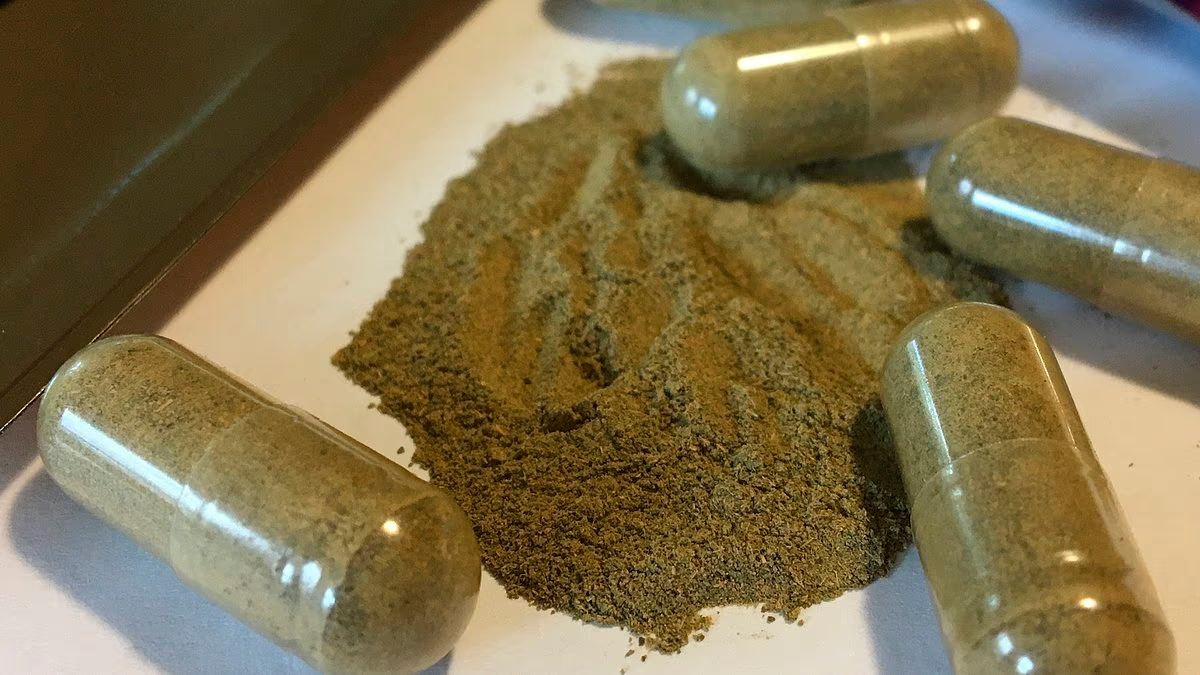

Concerns about the safety of unregulated kratom are intensifying after the supplement was found during investigations into the deaths of two college students.
Two unidentified University of Mississippi students died Tuesday on the school’s campus in Oxford, according to Vice Chancellor for Student Affairs Dr. Shawnboda Mead.
Authorities have not confirmed an official cause of death. However, the Lafayette County Metro Narcotics Unit said in a social media post that packaged kratom was found during both investigations.
Police said the substance had been sold by an unnamed retail store. The agency stressed that it remains unknown whether kratom or any other substance contributed to the students’ deaths.
Mead urged students and staff not to draw conclusions before the investigations are complete, saying: “We encourage our community not to speculate about the circumstances or repeat information that has not been officially confirmed.”
Kratom comes from the leaves of a tropical tree native to Southeast Asia. It is legally sold in much of the United States through smoke shops, convenience stores and online retailers, with products available as powders, capsules, liquids and tablets.
The American Kratom Association estimates that the industry has grown to approximately $1.5 billion in annual sales.
The supplement is often marketed as a natural option for pain relief, anxiety and depression, as well as a potential aid for people trying to overcome opioid addiction.

Two unidentified University of Mississippi students died Tuesday on the university’s campus in Oxford.
Health experts caution that kratom’s active ingredients interact with the same opioid receptors in the brain targeted by drugs such as oxycodone.
At smaller doses, kratom may cause increased alertness and energy. Larger amounts can bring pain relief, sedation and a calming effect, leading some critics to describe it as “gas station heroin.”
The potential dangers may be greater in concentrated products, particularly those containing 7-OH. The psychoactive compound occurs naturally in kratom, but only in trace amounts.
Critics say kratom’s popularity is also driven by the way it is promoted, with many products providing limited information about possible health risks.
Because kratom is marketed as an herbal supplement rather than a medicine, it does not undergo the same strict safety testing required for prescription drugs.
Kratom products are also not generally required to carry warning labels.
In July 2025, the Trump administration began the formal process of seeking a ban on 7-OH. It recommended that the Drug Enforcement Administration place the compound in Schedule I of the Controlled Substances Act, alongside heroin and MDMA.
No final decision has been issued.
Until federal rules change, individual states remain responsible for determining how kratom is regulated.

Kratom capsules are shown above. The substance is often promoted as a natural remedy for pain, anxiety and depression.
Several states, including Alabama, Arkansas, Indiana, Vermont and Louisiana, have effectively banned kratom by classifying its active ingredients as controlled substances.
Others have chosen regulation instead. Texas, Utah and Arizona, for example, limit the potency of kratom products. Florida and Kentucky have moved to ban concentrated 7-OH products altogether.
The result is a patchwork system in which products that are illegal in one state can still be bought over the counter in another.
A recent government report shows that poison center calls about kratom have skyrocketed in the US. Between 2015 and 2025, these reports jumped by about 1,200 percent, from 258 calls to over 3,400 in 2025 alone.
Many of these incidents are a consequence of kratom being mixed with alcohol or other drugs, as well as the emergence of newer, more concentrated products.
The brain and nervous system
The best-studied compounds in kratom are mitragynine and 7-hydroxymitragynine (7-OH).
In the brain, these two compounds interact with opioid receptors, producing both stimulant-like effects, including alertness and energy, and sedative-like effects, including relaxation, pain relief and confusion.
Potential serious side effects include confusion or altered mental status, loss of consciousness and seizures.
In people who repeatedly consume kratom, dependence can develop, meaning they may experience withdrawal symptoms if they stop taking it.

The above graph shows kratom-related poison center calls that led to serious medical outcomes, by single- vs multiple-substance exposure
Lungs and breathing
Because kratom produces opioid-like effects, it could cause respiratory depression – when breathing becomes dangerously slow or shallow.
When breathing is too slow or shallow it leads to a shortage of oxygen in organs throughout the body and a dangerous buildup of carbon dioxide in the blood.
Severe oxygen deprivation can damage the brain and other vital organs and can ultimately be fatal.
Heart and cardiovascular system
Kratom consumption can also impact heart rate.
Because it can produce stimulant-like effects, it may cause a rapid heart rate in users. Severe kratom poisonings have been associated with cardiac dysrhythmias – abnormal heart rhythms.
This abnormality interferes with the heart’s ability to pump blood effectively and can lead to cardiac arrest in severe cases.
Liver
Kratom has also been linked to liver injuries among users in published case reports.
Clinical reports have documented jaundice and acute liver injury among users, with the injury often showing a cholestatic pattern, meaning the normal flow of bile from the liver is impaired.
In rare cases, kratom-associated liver injury has progressed to acute liver failure, which can be fatal.


