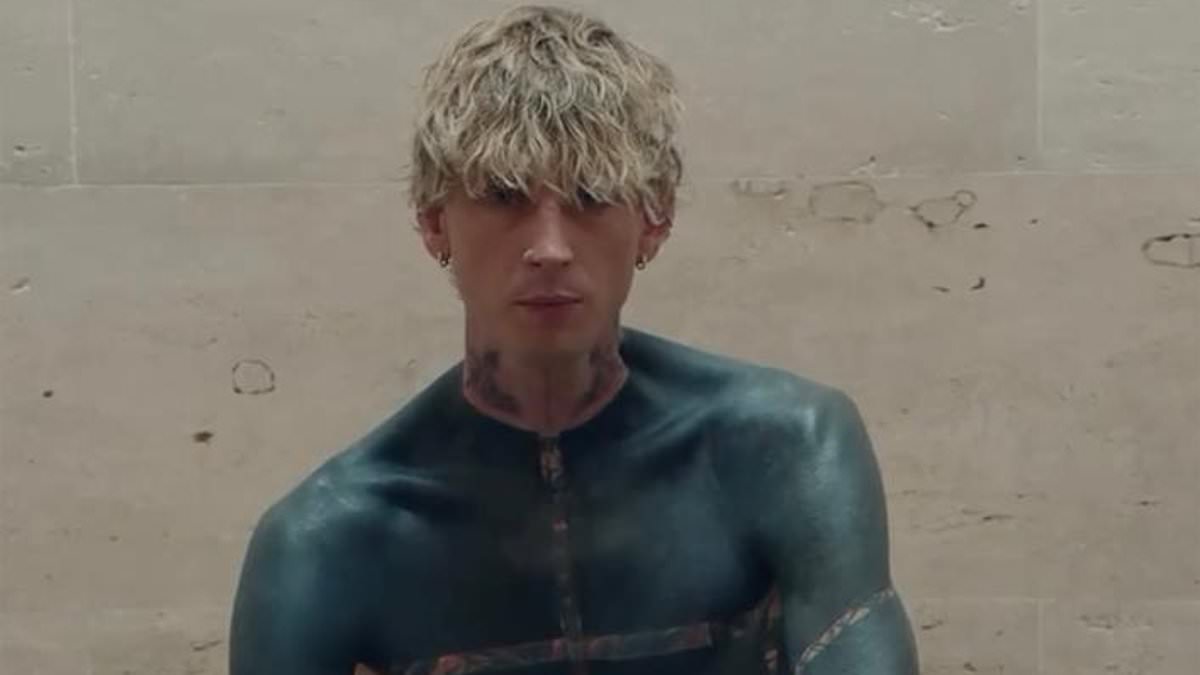

In 2024, Machine Gun Kelly, now 36, unveiled a bold transformation with his new ‘blackout’ tattoo. This extensive design covers his arms, chest, and torso, serving as a canvas to obscure his previous collection of ink. He described the tattoo as a manifestation of his “screaming bipolarity.”
Initially, tattoo artist ROXX estimated that completing this ambitious piece would take around two years. Defying expectations, the rapper and singer-songwriter managed to finish the process in just two months, all without the use of anesthesia.
Reflecting on the experience, Machine Gun Kelly acknowledged that it might have been a “big mistake.” A week after the intense sessions, he found himself unable to move certain parts of his upper body.
Despite the challenges, he maintains, “My morals still stand. I was looking for a change that wasn’t just a sound wave. It had to be something physical.”
As tattoos grow increasingly popular, recent studies have emerged, suggesting links between tattoo ink and potential health risks such as skin and blood cancers.
While tattoos continue to become ever more prevalent, recent years have brought a number of studies linking the ink with skin and blood cancers.
Today, most experts agree the link with cancer is far from conclusive, but there are a number of health risks, from blood poisoning to blindness, that people need to be aware of before going under the needle.
Surveys estimate up to a third of adults in the UK now have a tattoo.
In 2024, the rapper and dad-of-two debuted his new look ahead of the release of his mixtape, Blog Era Boyz
And whilst inking up has become more common, experts are concerned less attention has been paid to what’s in the inks being injected into people’s skin – the body’s largest organ.
Tattoo ink is designed to last permanently in the skin. But over time, pigments can break down and travel to the lymph nodes – which are used by the body to clear out toxins.
This seems to have been the case for the rapping singer-songwriter.
‘After the first week, we hit my lymph nodes around my armpits and shoulders, and I got really sick,’ he said.
‘My skin was turning yellow and I wasn’t able to sleep. I stopped being able to move certain parts of my upper body,’ the father-of-two told Billboard Canada.
Researchers have questioned for a long time whether the potentially toxic components in tattoo ink can cause harm if they gather in the lymph nodes.
The general consensus is that some colours may be more harmful than others, with black and red ink toxic to a type of white blood cell that lives in the lymph nodes – called macrophages – that plays a key role in activating an immune response.
In the long term, this low-grade inflammation can exhaust the immune system, increasing the likelihood of infection and some types of cancer.
![Machine Gun Kelly said that he no longer recognised himself with the tattoos he already had, saying he saw 'death and drugs' in the patterns he was 'literally writing on [his] body'](https://i.dailymail.com/1s/2026/06/10/16/109258169-15888817-Machine_Gun_Kelly_said_that_he_no_longer_recognised_himself_with-a-7_1781105464849.jpg)
Machine Gun Kelly said that he no longer recognised himself with the tattoos he already had, saying he saw ‘death and drugs’ in the patterns he was ‘literally writing on [his] body’
‘Tattoos cause damage to the skin that takes time to heal,’ Professor Adam Taylor, from the University of Lancaster, told the Daily Mail.
‘As the needles break the skin, this causes the body to automatically mount a response, resulting in swelling. The larger the tattoo, the more fluid accumulates in the area.
‘This is why larger tattoos are normally spread over a number of sessions to allow the body to heal and recover in-between.’
But the ink itself isn’t the only cause for concern.
While hitting a lymph node doesn’t necessarily explain why the rapper’s skin turned yellow, Prof Taylor cautioned that any procedure that punctures the skin carries a risk of causing a blood infection, like hepatitis which can lead to jaundice.
‘Substantial tattoos can also cause significant inflammation in tissues, which can manifest as bruising which can lead to yellowing of the skin,’ Prof Taylor added.
‘Tattoo needles are designed to deposit ink in the dermis which is close to surface, while lymph nodes are typically deeper into tissues than the length of a needle.’
Either way, the rapper’s striking transformation and his recent comments has sparked renewed interest in the long-suspected links between tattoos, cancer and the immune system – highlighting the need for further research.
‘The potential health effects and links to various conditions will continue to be of interest to researchers, but just like many things, tattoos carry risk and the people who make choices to get tattoos should know that they are not risk free,’ Prof Taylor concluded.
People with tattoos have double the risk of deadly cancers – the larger the tattoo, the greater the danger
Last year, a compelling study found that getting a tattoo could nearly triple the risk of skin cancer.
Danish and Finnish scientists analysed data from over 2,000 twins, comparing cancer rates in those who had tattoos versus those who didn’t.
They found that those with any tattoo were up to 62 per cent more likely to be diagnosed with skin cancer.
But for those with larger tattoos, the risk of skin cancer increased by 137 per cent and the risk of lymphoma – a type of blood cancer – soared to 173 per cent.
However experts agree more research is needed to explore the potential biological mechanisms, and how different types and colours of ink may interact with external exposures, like sunlight, over time.
Going under the needle can increase the risk of infection
Tattooing involves piercing the skin with a needle which – without good care by the technician and customer – can allow bacteria and other organisms to get into the body, increasing the risk of infection.
Infections can come from microorganisms living on the skin, or those introduced to the body through dirty needles – resulting in hepatitis, syphilis or even HIV.
This has resulted in calls for tattooing and piercing equipment to only be sold to people with a special license or registration documents to ensure that all organisations involved are taking their responsibilities seriously.
Permanent scarring and flare-ups
One of the most common yet overlooked complications seen after tattooing is permanent scarring.
It can cause a keloid to form, a raised scar that is left on the skin after a wound has healed. This type of scar usually appears a few weeks to years after you damage or injure your skin.
A keloid scar usually grows for months or years and becomes bigger than the original wound and tattoo itself.
Tattooing can also triggering or worsen existing skin conditions, through a process known as koebnerisation, where skin trauma sparks disease activity.
This means the skin modification may not be suitable for people who suffer from psoriasis, eczema and viral warts who are particularly prone to scarring.
Tattoo-related vision loss is on the rise
While it is well-known that injecting tattoo ink into the eye massively increases the risk of blindness, a small but increasing number of people are being diagnosed with a rare tattoo-related eye condition, known as uveitis.
This happens when the chemicals that make up tattoo ink trigger an immune response, and the body starts attacking the tattoo site. This can cause inflammation, not just of the tattooed skin but in other parts of the body too.
When these inflammatory cells breach the barrier designed to protect the inside of the eye, inflammation can spread to the uvea and the iris – resulting in light sensitivity, scarring and eventually blindness.
In most cases, the condition can be treated with steroids injected directly into the eye. However, treatment doesn’t always work, leaving around 75 per cent of patients with temporary vision loss and around 17 per cent with permanent visual loss.


