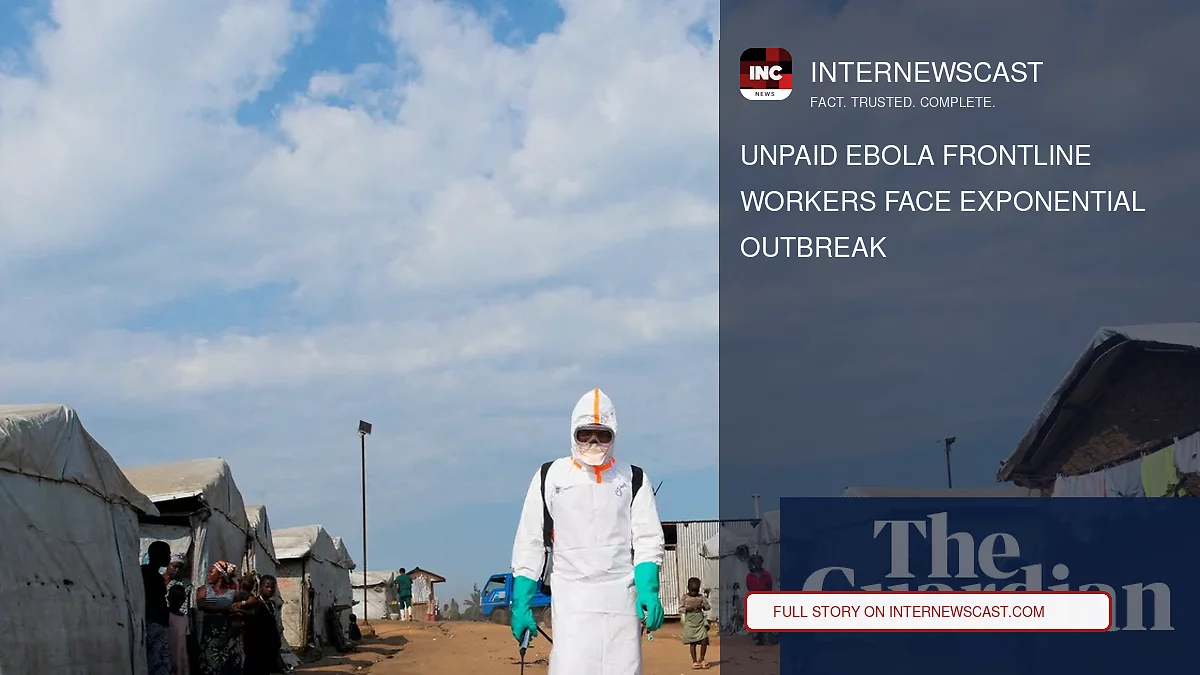

Each time Sophie Mwadawa Kabundo reports for duty as a nurse at an Ebola treatment centre in north-eastern Democratic Republic of the Congo, she carries the same fear: that she could become infected at work and unknowingly bring the virus home to the people she loves.
“More and more confirmed cases are being admitted here … Some of our colleagues have died,” Kabundo said. “We fear that, despite our vigilance, workplace accidents may occur and put us in ever greater danger … We go to sleep already worrying about the days ahead, as patients continue to pour in.”
At the Elikya treatment centre in Bunia, the capital of Ituri province, which has been hit hardest by the outbreak, her colleague Martin Bolombi is living with the same anxiety. “Personally, this outbreak is causing me a lot of stress,” he said. “But I have no choice but to pluck up my courage and ensure that the situation is brought under control first, before it can stabilise.”
Their determination is even more striking because both frontline health workers, serving in what has become the fastest-growing Ebola outbreak ever recorded, said they are doing the dangerous work without being properly paid.
“I have been working since May and have only been paid for June,” said Bolombi, a hygiene worker who joined roughly 100 others in a protest outside the Elikya treatment centre last month during a strike over unpaid bonuses.
Kabundo said she, too, is still waiting for money she is owed. “We are not being paid and we want the government to provide solutions as soon as possible,” she said. “We are under immense pressure … We are exposed to the risk of infection, and our families and other loved ones may contract the disease because of us.”
Unpaid salaries are adding to a broader set of challenges complicating the Ebola response in the DRC, one of the poorest nations in the world, where misinformation, distrust within communities and weak infrastructure have all slowed efforts to contain the deadly virus.
The outbreak has now killed more than 2,500 people and is expanding rapidly across a region larger than France, Julien Harneis, the UN’s senior Ebola coordinator, said on Friday. Speaking by video link from Bunia, Harneis appealed for additional international assistance, warning that current funding could be exhausted within weeks. He said 160 healthcare workers had contracted Ebola, including 43 who had died.
“The outbreak is growing faster and wider than the Ebola response,” he added. “And all of this is happening in an area that has had three decades of conflict and is generating huge humanitarian needs.”
The World Health Organization estimates that the outbreak is on course to exceed west Africa’s 2014-16 Ebola outbreak as the biggest ever globally. In the previous outbreak, more than 28,600 cases and 11,325 deaths were recorded across Guinea, Liberia and Sierra Leone, according to WHO data.
The infections in DRC are of the rare Bundibugyo species of the virus. There are no approved treatments or vaccines for the strain, but trials for both are under way.
Bolombi said he was working seven days a week, with barely any time to see his family, as the outbreak was getting worse. “Logistics have improved compared to the early days of the response, but this is still not enough, as needs are growing as the disease progresses,” he said.
Despite the enormous challenges and lack of renumeration, Kabundo expressed pride that there had been “a large number of recoveries” at the Elikya treatment centre. “This progress must be highlighted, but it is no excuse to rest on our laurels,” she said.
The Congolese health ministry did not immediately respond to a request for comment.
Ebola is transmitted to people from wild animals and then spreads between humans via direct contact with the organs, blood or other body fluids of infected people, including dead bodies. It can also be spread through contact with contaminated surfaces and materials, such as bedding or clothing.
Initial symptoms can include fever, fatigue, muscle pain, headaches and a sore throat. These progress to vomiting, diarrhoea, abdominal pain, rash and symptoms of impaired kidney and liver functions.
Widespread mistrust and misinformation have resulted in people with the virus not attending health centres for treatment until it is too late, as well as attacks on health facilities and ambulances.
Dr Eddy Kambale Kahandukya, a deputy medical coordinator for the charity Médicins Sans Frontières in the DRC, said: “The lack of community engagement remains a major challenge in breaking this chain of transmission … For example, patients who suspect they have symptoms and are awaiting laboratory results seek refuge within the community and end up creating new clusters that further fuel the spread of the epidemic.”
Fear was a big driver of the lack of trust in the authorities’ response to Ebola, said Manon Dumortier, an emergency coordinator in Bunia for the aid group Mercy Corps.
“It’s scary, right? … Suddenly there are so many people dying and you don’t know what it is about,” she said. “People are just disappearing, going to health centres and you cannot even see them before they are being buried. This is just raising a lot of speculation and rumours.”
The WHO declared the outbreak a public health emergency of international concern in May, but later said sequencing showed the outbreak had started months earlier in February.
The virus has spread to six of the DRC’s 26 provinces, concentrated in the country’s north-east. More than 4,200 of the confirmed cases are in Ituri, which borders Uganda and South Sudan.
Uganda reported 20 cases and two deaths, all in the capital, Kampala. The government declared the country Ebola-free on 28 July after the last Ebola patient, a Congolese national, was discharged on 16 July.


