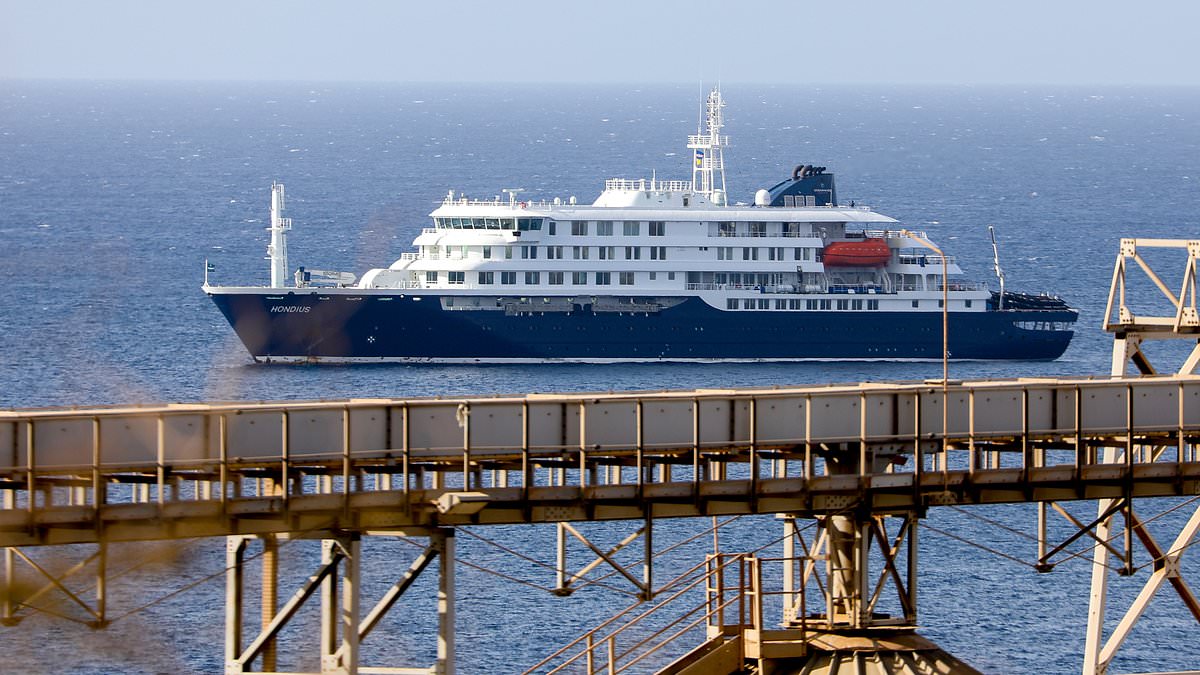

A potentially deadly rat-borne virus is believed to have claimed the lives of three individuals and sickened at least seven others aboard a cruise ship, with experts suggesting the virus may have spread among passengers—an unusual occurrence for this pathogen.
On Tuesday, the World Health Organization (WHO) raised concerns about possible human-to-human transmission of the hantavirus, noting that several of the infected had been in ‘very close contact’ with one another.
Dr. Maria Van Kerkhove, WHO’s Director for Epidemic Preparedness, stated, “We cannot entirely dismiss the possibility of human-to-human transmission, and as a precaution, we are operating under that assumption.”
Although human transmission of the hantavirus is exceedingly rare, it is most commonly contracted when individuals inhale dust particles contaminated with the dried droppings of infected rodents or through bites or scratches from the animals.
The exact mechanism of possible human-to-human transmission remains unclear, but previous instances in Chile and Argentina have hinted at this possibility.
Currently, at least seven individuals aboard the Dutch-flagged cruise ship MV Hondius, which embarked on a journey from Ushuaia, Argentina, to Cape Verde in March, have reportedly been infected.
Speaking to reporters, Dr Kerhove added: ‘The risk to the general public is low. This is not a virus that spreads like flu or like Covid. It’s quite different.’
In its latest update on Monday, WHO officials said two infections have now been confirmed while the remaining five are suspected. Cases include a patient in a critical condition and three reporting mild symptoms.
Three people have died so far from the rare rat-borne virus on the Dutch-flagged vessel, which set off in March to sail from Ushuaia in Argentina to Cape Verde
Maria Van Kerkhove, director of the World Health Organization’s Epidemic and Pandemic Preparedness and Prevention, said WHO is working to locate the source of exposure
Officials say they are working on board the cruise ship, which has almost 150 passengers and crew in total.
They also said that the risk to the public of a wider outbreak is ‘low’.
The luxury ship has been stranded at the Port of Praia after health authorities in Cape Verde refused to authorize its docking.
In its latest update on the crisis, cruise firm Oceanwide Expeditions said Monday that two crew members – one British and the other Dutch – were continuing to show ‘acute respiratory symptoms’, one mild and one severe, and required urgent medical care.
The infected British crew member is the ship’s doctor, according to passenger Ann Lane from Donnybrook, south Dublin.
‘Now the ship’s doctor and a member of the expedition staff are sick on board. The doctor had been treating everybody day and night, really dedicated to what he was doing – [he has been] fabulous,’ she told the Irish Times.
‘He’s a younger man, British. He has been sick quite a few days, maybe since last Thursday.’
Plans are now being drawn up to evacuate sick passengers with two specialized aircraft, although health officials are still not certain whether that will take place.
Also stranded onboard is a US travel blogger from Boston, who posted a tearful update from the vessel yesterday.
It is not clear where or how the outbreak originated.
Speaking aboard the MV Hondius ship, US travel blogger Jake Rosmarin released a tearful plea for support
Hantavirus is an extremely rare infection that only one to two people die from in the US every year and only a handful of cases are recorded. In the last three decades, only 1,000 infections have been registered – including in the late Gene Hackman’s wife Betsy Arakawa.
Patients are often struck with symptoms within one to eight weeks of infection, which begin as a fever and gastrointestinal symptoms before progressing to pneumonia.
About 35 percent of infected patients die from the disease, according to the CDC, which are caused when the virus causes blood vessels to leak and fill the lungs with fluid – leaving patients unable to breathe.
There is no specific treatment or cure for the infection.
The ship is currently considering sailing on to Las Palmas or Tenerife, where medical screening supervised by the WHO and Dutch health services will take place, but no definitive evacuation plan has been confirmed.
Spanish authorities have shot down the suggestion, however, saying that no definitive decision has been made.
Yesterday, the WHO detailed the seven patients who were struck down with the virus on the vessel.
The first stricken passenger, a 70-year-old Dutch man, died on April 11 as the ship steamed towards Tristan da Cunha.
His body remained on board until April 24, when it ‘was disembarked on St Helena, with his wife accompanying the repatriation,’ Oceanwide Expeditions said.

Because the vessel is sailing under the Dutch flag, the Netherlands is coordinating consular assistance for passengers, including those with other nationalities
Three days later, the man’s 69-year-old wife also fell sick and later died, while another passenger, a Briton, became ‘seriously ill and was medically evacuated to South Africa,’ the company said.
South African authorities have confirmed that the 69-year-old British patient, who is being treated in a Johannesburg hospital, tested positive for the hantavirus.
On May 2, another passenger of German nationality died on board the ship.
On Tuesday, US travel blogger Jake Rosmarin, a passenger on the ship, released a tearful update from his bedroom, telling his 44 thousand followers in a video on Instagram: ‘I am currently on board the MV Hondius, and what’s happening right now is very real for all of us here.
‘We’re not just a story, we’re not just headlines, we’re people. People with families, with lives, with people waiting for us at home.’
Overwhelmed with emotion and fear, the content creator from Boston continued: ‘There’s a lot of uncertainty, and that’s the hardest part.
‘All we want right now is to feel safe, to have clarity, and to get home. So if you’re seeing coverage about this, just remember that there are real people behind it, and that this isn’t something happening far away.
‘It’s happening to us, right now.’


