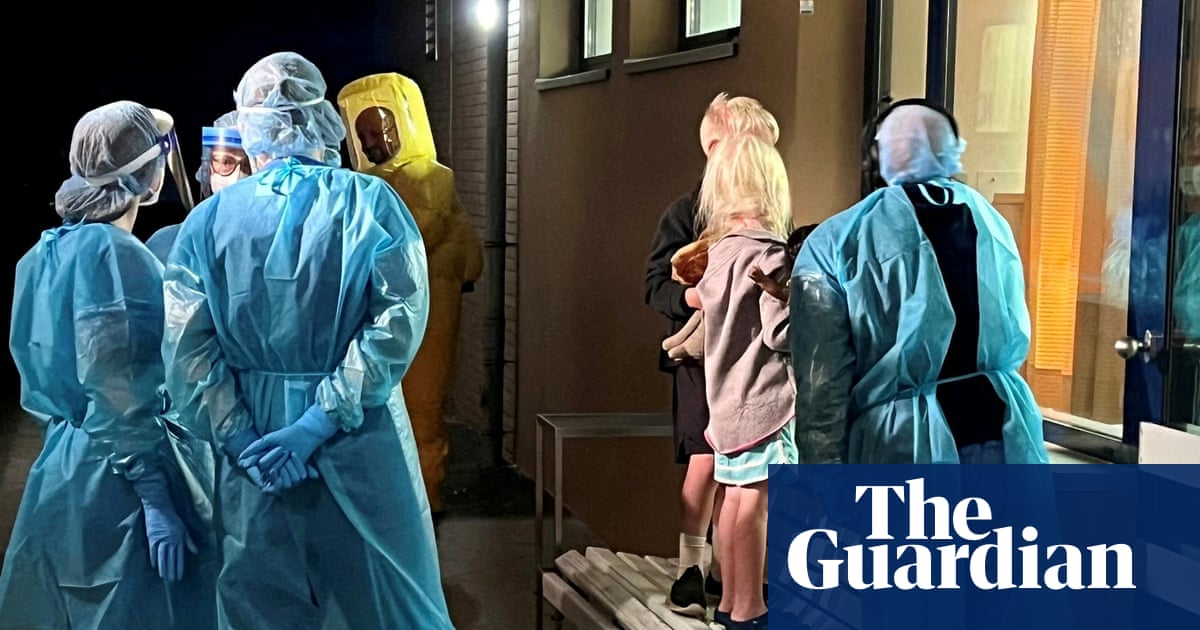

The Trump administration has announced a temporary halt on deporting refugees to the Democratic Republic of the Congo (DRC) amidst a worsening Ebola outbreak, as per a report by Politico. However, experts contend that this decision may not effectively curb the spread of the disease.
The policy has left at least one woman stranded. After being relocated to Kinshasa, the capital city of the DRC, officials are now refusing her return to the United States due to the travel restrictions, despite a court order mandating her repatriation.
Adriana Zapata, aged 55, initially fled from Colombia to the U.S. but was deported to Kinshasa over a month ago. The DRC has indicated it cannot meet her extensive medical needs. A U.S. judge has ordered her return, but American authorities cite the newly imposed travel ban as the reason for not complying with the order.
“I’m extremely concerned about her safety,” expressed Zapata’s attorney, Lauren O’Neal, to the Gothamist. “I fear for her life and hope we can bring her back before it’s too late.”
Unnamed officials informed Politico of the risk that immigration agents could potentially be exposed to the virus during travel, which might inadvertently bring it closer to U.S. borders due to current immigration strategies. They also noted that legal ramifications play a role in the decision, as deporting individuals to a country experiencing an Ebola outbreak might be used in legal defenses.
“The government’s rationale implies that if it’s unsafe for individuals to travel here from the DRC, it’s equally dangerous to send them there,” commented Jeremy Konyndyk, president of Refugees International and a former lead on the Ebola response at the U.S. Agency for International Development (USAID) during the 2014-15 crisis.
As long as the US has a ban on travelers from the DRC, Uganda and South Sudan, “on what grounds could it possibly be safe to deport people there?” Konyndyk asked.
It’s not clear what happens next to refugees who were already moved against their will to countries affected by or near the outbreak. At least 37 people have been moved to these countries in recent months, according to Gillian Brockell, an independent journalist who tracks third-country removals by the US.
Brockell suspects US officials are using the travel ban as an excuse to not return Zapata. Sending people in detention centers to African nations far from home is a common threat, Brockell said, “so to publicly take one of their main scare tactics off the table, they are only going to do that if it helps them in some way”.
The US government has evacuated people from Ebola-affected regions before – including patients with active Ebola cases. One of the world’s leading experts on high-risk medical evacuations, the former state department official William Walters, is now an Immigration and Customs Enforcement (ICE) contractor, Brockell pointed out.
“The Trump administration could absolutely return Adriana Zapata to the US; telling the judge it can’t be done just isn’t true,” she said.
ICE “follows all applicable health and safety guidelines, including those outlined in the US Department of State’s travel advisories, when conducting removal operations”, said a spokesperson for the US Department of Homeland Security (DHS). But the DHS did not respond to the Guardian’s questions about Zapata’s return and the agency’s third-country removal plans during the Ebola outbreak, including whether flights to Uganda, South Sudan and Rwanda would continue.
Sending immigrants against their will to other countries could risk violating international law, said Camille Mackler, an immigration lawyer: “Basically, the US can’t send people back to where they will be persecuted, so we’re exporting our immigration enforcement.”
There are no official numbers, but experts estimate that 8,000 to 15,000 people have been flown to third countries.
“We’ve already seen that people who are being detained by immigration are not receiving adequate medical care,” Mackler said. “They’re taking no protections for them, and then not thinking about the ripple effect that can have.”
If the outbreak continues expanding, there’s a chance detainees in the affected areas could get sick themselves – and if they were then sent to their countries of origin, they would be bringing the virus to South and Central America, where countries have little experience battling the viral hemorrhagic fever.
The US Centers for Disease Control and Prevention (CDC) says it has plans in place to test and monitor passengers from the region. The US announced on Thursday that all passengers traveling from the DRC, Uganda and South Sudan would be diverted to the Washington-Dulles international airport for screening.
“The US is putting in place travel measures to limit risk,” said Satish Pillai, the CDC’s Ebola response lead.
Even passengers from places like Kinshasa, with no known Ebola cases, will be monitored because “the outbreak in the affected area continues to expand”, Pillai said at a press conference on Friday.
“That is why CDC has initiated entry screening processes, which is a part of an overall broader, layered public health approach, starting with exit screening, airline illness reporting and public health monitoring after arrival,” Pillai said.
Measures like these mean it’s very unlikely travelers – including Zapata – will bring Ebola into the United States, said Alexandra Phelan, an associate professor at the Johns Hopkins Bloomberg School of Public Health and senior scholar at the Johns Hopkins Center for Health Security.
The “proper and equitable process that also protects public health” would be to bring Zapata to the US, per the judge’s order, and have her undergo the same health protocols as returning US citizens and residents at Dulles, Phelan said. That could include quarantine if there has been any high-risk exposure – though that’s “unlikely if she has remained in Kinshasa, which is not a known active transmission location”, Phelan added.
“If the Trump administration is serious about countering the spread of Ebola, the US government should restore health-related humanitarian funding it gutted across Africa; designate temporary protected status for the Democratic Republic of [the] Congo, Uganda and South Sudan; and halt all deportation flights to the region – including flights involving Latin Americans and other third-country nationals,” said Yael Schacher, director for the Americas and Europe at Refugees International.


