
Deaths from an ongoing Ebola crisis have surged 63 percent over the last week as officials fear an impending pandemic.
The World Health Organization said Thursday that 48 cases of the disease have been confirmed in the Democratic Republic of the Congo (DRC).
Although the number has decreased from 68 last week, this reduction follows a surge in deaths, which have increased from 19 on September 15 to 31 by September 18, including at least four healthcare workers.
World Health Organization chief Tedros Adhanom Ghebreyesus noted Thursday: ‘It has been two weeks since the DRC government declared an Ebola outbreak.
‘So far, 48 confirmed and probable cases have been reported, and 31 people have died.’
However, two patients have recovered so far and been discharged. Another 16 are being treated, and the WHO has sent 14 tons of medical supplies.
The unsettling update aligns with ongoing vaccination initiatives in the Kasai province of the DRC for individuals exposed to Ebola and frontline health workers.
An initial shipment of 400 doses of the Ervebo vaccine, approved by the FDA and used exclusively during outbreaks, has been sent to Bulape, a current Ebola hotspot in the Kasai province, with an additional 1,600 doses expected in the coming days.

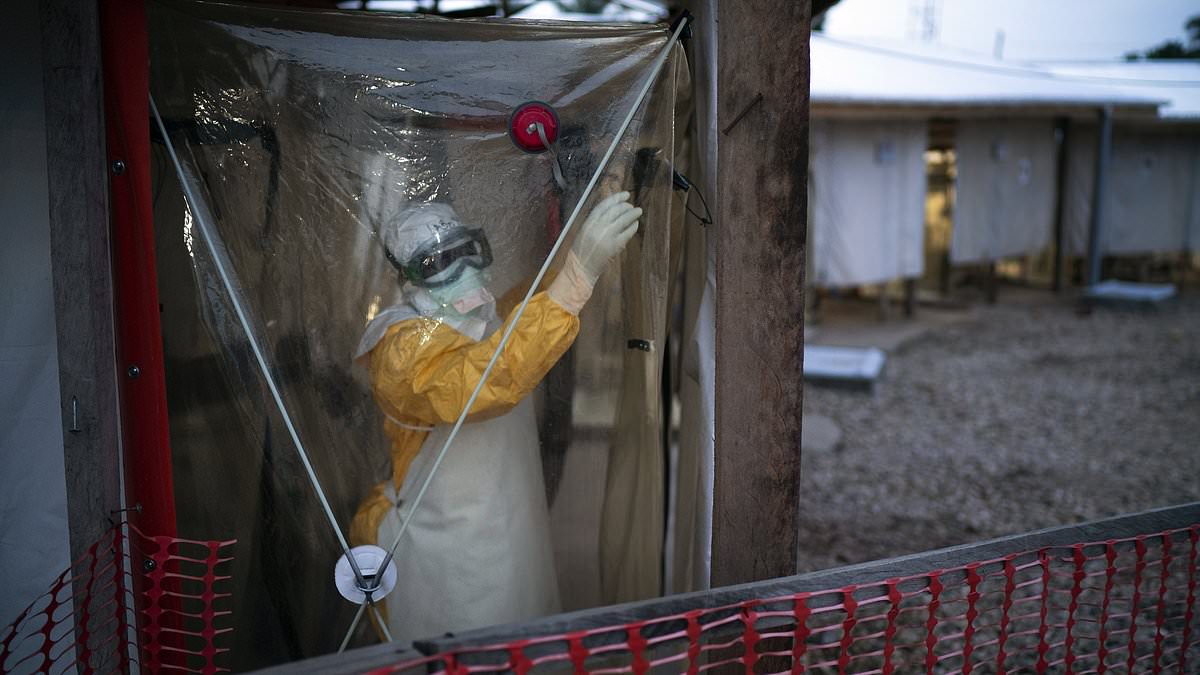
A man in protective gear stands outside an Ebola treatment center in Bulape, Democratic Republic of the Congo, on September 7. This image was shared by Doctors Without Borders.
The CDC reported Thursday that no Ebola cases linked to this outbreak have been detected in the United States or outside of the DRC, and the risk of spread to the US ‘is considered low at this time.’
Ebola’s presence in DRC dates back to 1976, and the latest outbreak is the 16th in the country and the seventh in Kasai province.
Previous outbreaks in 2018 and 2020 in eastern Congo killed more than 1,000 people each.
The largest Ebola outbreak occurred in 2014 to 2016 in West Africa when more than 28,600 cases were reported.
Francois Mingambengele, administrator of the Mweka territory, which includes Bulape, told Reuters earlier this month: ‘It’s a crisis, and cases are multiplying.’
Ebola spreads through contact with the blood or body fluids of an infected person, as well as contact with contaminated objects or infected animals such as bats or primates.
Symptoms include fever, headache, muscle pain and weakness, diarrhea, vomiting, abdominal pain and unexplained bleeding or bruising.
Ebola can cause serious disease and has a mortality rate as high as 90 percent without treatment.
The current outbreak is caused by the Zaire ebolavirus species, which kills 36 to 90 percent of patients. It is the most common virulent ebolavirus species and is thought to be transmitted from animal reservoirs, likely bats, to humans.
Residents in some areas have been placed in confinement to prevent the spread. Local officials have also erected multiple checkpoints along the border to prevent people from traveling in or out of the Kasai area.
There are currently two FDA-approved treatments for Ebola: Inmazeb and Ebanga.

A health worker wearing a protective suit enters an isolation pod to treat a patient at a treatment center in Beni, Democratic Republic of Congo, during a 2019 Ebola outbreak

A healthcare worker sprays a room during the funeral of Kavugho Cindi Dorcas, who is suspected to have died of Ebola in the DRC in 2018

A healthcare worker puts on protective equipment during the 2018 Ebola outbreak in the DRC
The first confirmed case in the DRC’s current outbreak, according to the WHO, was a pregnant woman who went to Bulape General Reference Hospital on August 20 with a high fever, bloody stool, excessive bleeding and weakness.
She died five days later from organ failure, and testing on September 4 confirmed Ebola.
Earlier this year, another outbreak was declared in Uganda, with 12 confirmed cases and two probable, as well as four deaths. The outbreak was declared over in April.
The Sudan Virus, a rare virus that causes a severe form of Ebola hemorrhagic fever, also causes bleeding from the eyes, nose, gums and other body parts, organ failure and death.

Healthcare workers carry the coffin of a baby suspected of dying from Ebola in the DRC in 2018

Healthcare workers treat an unidentified Ebola patient in the DRC in 2018
In February of this year, two suspected Ebola cases were detected in the US. Patients were transported from a New York City urgent care facility to a hospital after they exhibited symptoms of the disease.
Officials suspected they could have had Ebola infections because the patients had recently traveled from Uganda, where an outbreak was ongoing at the time.
It was later confirmed that they did not have Ebola, but it was not revealed what illness they were suffering from.
The first person to have a confirmed Ebola infection in the US was a man from Liberia in 2014. He had traveled to the US, where he began experiencing symptoms.
After tests confirmed the illness on September 30, 2014, he became the first US patient to have the disease. He died a week later.