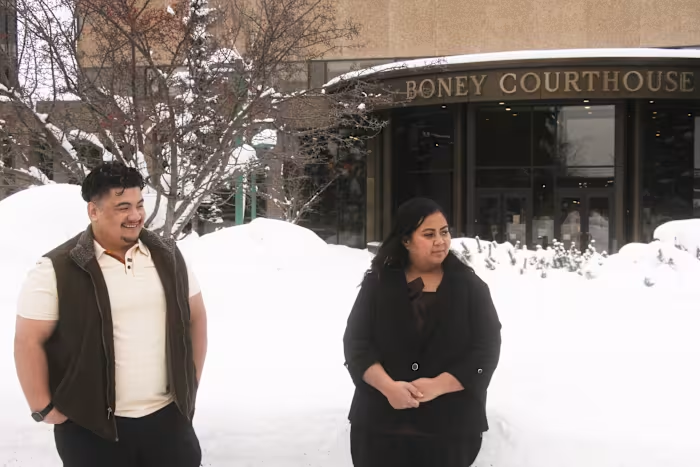


ANCHORAGE, Alaska – Alaska prosecutors are dismissing voter-misconduct cases against a group of residents born in American Samoa after a state appeals court overturned felony charges against a woman who mistakenly marked that she was a U.S. citizen.
The Alaska Department of Law announced the decision Friday, one week after a three-judge Court of Appeals panel ruled that state law requires prosecutors to show defendants had a “consciousness of wrongdoing” and intended to violate the law when they incorrectly completed voter-registration forms.
The panel identified problems with a state trooper’s questioning of Tupe Smith, whose case prompted the ruling, along with flaws in the grand jury process that produced her indictment. The court overturned a lower-court decision that had allowed the charges against Smith to proceed.
Acting Alaska Attorney General Cori Mills said in a statement that prosecutors reviewed the appeals court’s ruling and the facts of the cases before determining they could not prove the allegations against Smith and the other defendants beyond a reasonable doubt. Smith’s husband, Michael Pese, also faced charges.
“We respect the role of the courts in interpreting Alaska law and will faithfully execute our duty to apply the law and carefully evaluate our prosecutorial decisions,” Mills said.
In a statement issued last week, Smith’s attorney, Whitney Brown, praised the Court of Appeals ruling, saying it “establishes an important safeguard against imposing felony liability for an honest mistake.”
The court “made clear that Alaska law requires more than simply showing that a statement was false — the State must prove a person acted with a consciousness of wrongdoing,” Brown said. “That distinction makes a world of difference to Ms. Smith and helps ensure that Alaska’s voter-misconduct statute is applied as the legislature intended going forward.”
Eleven people from Whittier, a small community about 50 miles (820 kilometers) southeast of Anchorage, were charged with falsely claiming U.S. citizenship when registering to vote or attempting to cast ballots. Messages seeking comment were left with their attorneys.
American Samoa is the only U.S. territory where people born there are not automatically granted U.S. citizenship. Instead, they are classified as U.S. nationals. Citizenship is available through routes such as naturalization, but the process can be costly and difficult to navigate.
American Samoans may serve in the U.S. military, obtain American passports and vote in elections in American Samoa. However, they generally cannot hold public office in the United States or participate in most U.S. elections.
Smith was arrested after she won a seat on a regional school board in 2023. She has said that she relied on incorrect information from Whittier election officials when she identified herself as a U.S. citizen on voter-registration forms.
According to court documents, Smith said she identifies herself as a U.S. national on official paperwork. But when voter-registration forms did not offer that option, city representatives told her it was appropriate to select U.S. citizen, she said.
Prosecutors contended that Smith falsely and deliberately claimed citizenship, pointing to warnings on voter registration forms she filled out in 2020 and 2022 that noncitizens “are not eligible to vote.”
The Court of Appeals panel said in its ruling that toward the end of a police interview, a state trooper asked Smith “a long compound question that implied that Smith actually knew she was not eligible to vote” but wanted to be involved in the school board.
When Smith, whose native language is not English, did not respond right away, another state trooper clarified, “He’s asking you,” and the first trooper again presented his question, which the panel describe as “a lengthy and complex statement containing four individual questions.”
Smith answered “Yes,” the panel said, leading to her arrest and indictment on two counts of felony voter misconduct.