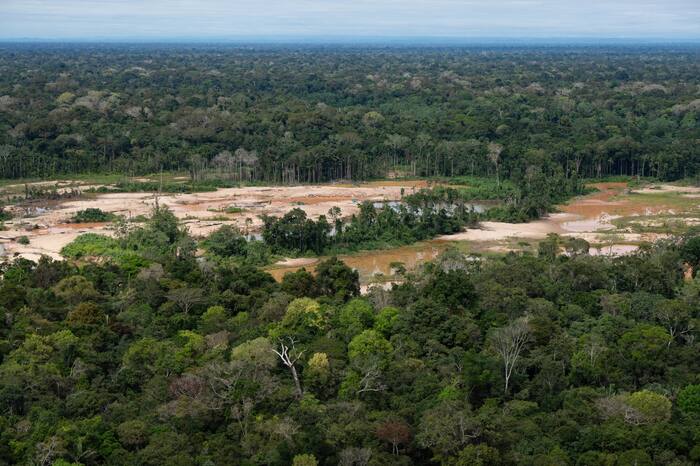


BOGOTA – Indigenous leaders from throughout the Amazon are bringing their campaign against illegal mining, drug trafficking and deforestation to a United Nations meeting in Vienna beginning Monday.
More than a dozen representatives from Indigenous communities in Peru, Brazil, Colombia and Ecuador are attending the Oct. 19-23 U.N. conference on transnational organized crime, known as COP13.
They are urging governments to target the financial systems that support environmental crimes and to give Indigenous peoples a stronger role in defending their ancestral lands and helping shape a proposed international agreement.
Criminal networks threaten Indigenous territories
Galois Flores, who represents Peru’s Autonomous Territorial Government of the Wampis Nation, told The Associated Press that illegal gold mining, logging and drug trafficking are placing increasing strain on Indigenous communities.
“Deforestation and pollution in the Amazon are no longer just environmental problems, but a crisis of transnational organized crime and security,” Flores said.
Mercury released by gold mining is polluting rivers used for fishing and drinking water, Flores said. Criminal groups also possess weapons, financial resources and the power to intimidate communities. To counter illegal mining, the Wampis have set up two monitoring posts, each staffed by 14 Indigenous guards. Flores said those who challenge the criminal groups are facing threats and violence.
The Kakataibo people in Peru’s central Amazon face similar dangers. Indigenous leaders say drug traffickers have established illegal coca plantations and processing laboratories in ancestral forests. Marcelo Odicio, president of the Federation of Native Kakataibo Communities, said six Kakataibo leaders have been killed since 2020 and that community representatives regularly receive threats.
In neighboring Brazil, Ashaninka leader Francisco Piyako Apiwtxa described threats linked to illegal logging, drug trafficking and roads used to move illicit goods. He said at least five heavily armed, masked men entered an Ashaninka community in July, threatening families while looking for Indigenous leaders. With government protection inadequate, Piyako said, Indigenous communities have been left to confront criminal organizations on their own.
“Our territories, our homes, our waters, the future of our children are at stake,” he said.
In Colombia’s southern Putumayo region, Indigenous leader Ingry Mojanajinsoy said armed groups that once depended primarily on drug trafficking are moving more deeply into illegal mining. She said the damage does not stop at territorial boundaries: Even mining outside Indigenous lands can send pollution downstream, contaminating rivers and fish that communities rely on for food.
Global Witness, an environmental and human rights organization, reported that at least 105 land and environmental defenders were killed in Latin America in 2025. That represented 85% of the 124 killings recorded worldwide. Colombia had the highest number in the region, with 39 deaths, followed by Brazil with 26.
Push for an international environmental crime agreement
The Vienna conference is bringing together countries that operate under a U.N. treaty aimed at combating transnational organized crime. Governments are expected to consider opening negotiations on a new protocol focused on environmental crimes such as illegal mining, logging and wildlife trafficking.
Raphael Hoetmer, Western Amazon Program Director at Amazon Watch, said organized crime and illicit economies now pose serious threats to the Amazon, Indigenous peoples and the global climate.
He faulted governments for relying heavily on military operations and raids, arguing that such measures do little to resolve the root causes of the crisis and can expose Indigenous communities to further violence.
Instead, Indigenous representatives are calling for stronger land rights, greater backing for community-led territorial protection and a meaningful voice in international policymaking.
“The conference should not only agree to begin negotiating a protocol against crimes that affect the environment, but also ensure that Indigenous peoples are seriously consulted in the process,” Hoetmer said.
The U.N. Office on Drugs and Crime said it collaborates with Indigenous communities across Latin America to combat organized crime and environmental threats. The agency pointed to a project in Brazil that helps communities track illegal gold mining and strengthen cooperation with authorities.
The initiative has also helped establish the foundation for a national system to identify and respond to environmental crimes, said UNODC spokesperson Alejandra Silva. The agency did not clarify whether Indigenous representatives would receive a formal role in negotiations over the proposed protocol.
Flores called for environmental crimes to be treated as seriously as drug and arms trafficking, including tracing illicit financial flows and disrupting markets for illegally mined gold. Odicio urged governments to recognize Indigenous territorial guards and protect threatened leaders.
Flores said isolated police operations are insufficient because illegal operators often return once security forces withdraw. Soldiers made a similar observation to AP during an illegal mining raid in Peru in August, saying miners would wait for troops to leave before restarting work.
“We do not want to leave future generations rivers poisoned with mercury, destroyed forests and communities controlled by criminal violence,” Flores said.
___
The Associated Press’ climate and environmental coverage receives financial support from multiple private foundations. AP is solely responsible for all content. Find AP’s standards for working with philanthropies, a list of supporters and funded coverage areas at AP.org.


