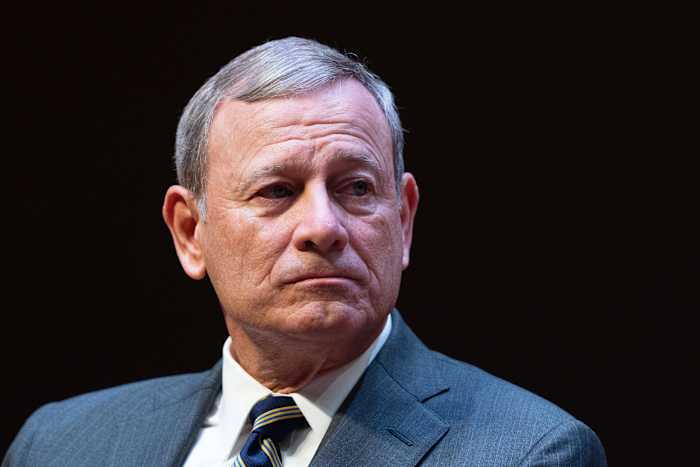


HERSHEY, Pa. – In a recent address, Chief Justice John Roberts sought to clarify the role of Supreme Court justices, asserting that they are not “political actors” and emphasizing that their decisions, despite sometimes being unpopular, are grounded in law.
Speaking to a conference of judges and lawyers from the 3rd U.S. Circuit in Pennsylvania, Roberts expressed concern that the public may misunderstand the court’s function. “At a fundamental level, people believe we’re making policy decisions, suggesting how things should be, rather than interpreting the law,” he explained. “This perception that we are purely political actors is, in my view, a misinterpretation of our work.”
Roberts’ comments come amidst a period of waning public confidence in the Supreme Court, notably following a ruling that significantly weakened the Voting Rights Act. This recent decision invalidated a predominantly Black congressional district in Louisiana, citing it as an unconstitutional racial gerrymander. The ruling has raised concerns about minority representation in Congress and could facilitate further redistricting efforts potentially benefiting Republican aspirations to maintain control of the House.
The conservative-majority court has made several pivotal decisions in recent years, including overturning the constitutional right to abortion, broadening gun rights, and terminating affirmative action in higher education. Despite these controversial rulings, Roberts maintained that the court operates independently of political influence. “We are simply not part of the political process,” he stated, refraining from discussing specific cases.
In recent years, the conservative majority court has also handed down landmark rulings overturning the constitutional right to abortion, expanding gun rights and ending affirmative action in higher education.
Roberts didn’t reference any specific decisions in his remarks, but said the court is “simply not part of the political process.”
Opinions, he said, are based on the Constitution — though he acknowledged disagreement with some outcomes. “One thing we have to do is make decisions that are unpopular,” he said.
Criticism, he said, should focus on rulings rather than personal attacks. He condemned the targeting of lower-court judges, a sentiment he’s repeated amid rising threats to the judiciary. “That’s not appropriate and it can lead to very serious problems,” he said.
High-profile criticism of judges in personal terms has come from Republican President Donald Trump, who also targeted Roberts and other justices who voted against him in the opinion that struck down tariffs the president levied under an emergency-powers law.


