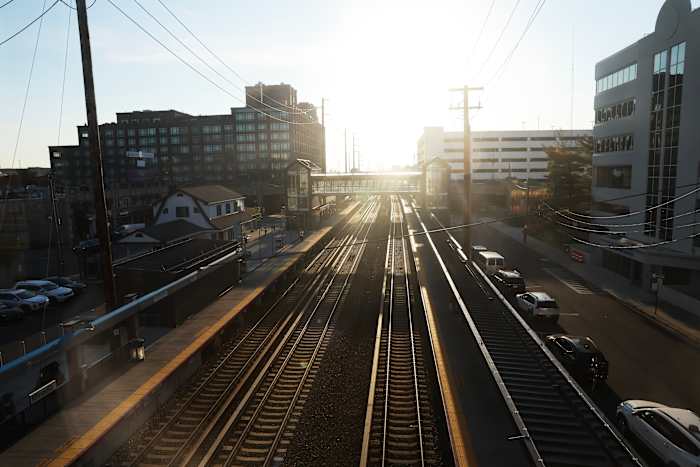


NEW YORK – Suburban commuters around New York City faced a complex web of transportation options, juggling cars, buses, and subways to reach their workplaces on Monday. This challenge arose as the Long Island Rail Road strike, affecting the country’s busiest commuter rail service, stretched into its third consecutive day.
On Sunday, union representatives for the rail workforce and officials from the Metropolitan Transportation Agency, which oversees the rail operations, were deep in negotiations. Their discussions continued until nearly 1 a.m. but ended without a resolution, despite efforts from the National Mediation Board and New York Governor Kathy Hochul to mediate. Union negotiators reconvened early Monday morning, aiming to break the deadlock.
Among those affected was Katie Dolgow, a first-grade teacher working in Manhattan. She reported that her morning commute from Long Island to Queens already took an hour, as many commuters flocked to the region’s notoriously congested roadways. Her primary worry, however, was the journey home.
“I need to pick up my son from daycare by 5:30. The return trip will be even longer,” Dolgow explained. “I’m a teacher, so I’ll have to leave work at 1:30.”
Meanwhile, picketers made their presence felt early in the day.
“We’re only asking for a fair adjustment to our wages to keep up with the cost of living,” stated Byron Lee, a locomotive engineer, stationed outside Penn Station in midtown Manhattan. “There’s a perception that we don’t deserve it.”
‘The skyrocketing cost of living’
The LIRR serves hundreds of thousands of commuters who live along a 118-mile-long (190-kilometer-long) land mass that includes Brooklyn and Queens in New York City and the Hamptons, a summertime playground for the rich and famous near its eastern tip. The railroad has long provided commuters relief from its rush-hour clogged highways.
Most of its riders live outside New York City in two counties populated by nearly three million people.
The railroad closed down and workers went on strike at 12:01 a.m. Saturday after five unions representing about half its workforce walked off the job for the first time in three decades.
The International Association of Machinists and Aerospace Workers and the Transportation Communications Union said in a statement Sunday that workers “are not asking for special treatment — they are simply fighting to keep up with the skyrocketing cost of living in the New York region after years without a raise.”
Workers have gone years without a new contract
The unions and the MTA have been negotiating a new contract since 2023, but talks have stalled over salaries and healthcare. The Trump administration got involved in September after unions asked for the appointment of a panel of experts, but they still couldn’t reach a deal.
At a news conference Sunday, Hochul said workers would lose every dollar they would gain with a new contract by remaining on strike for three days.
MTA Chairman Janno Lieber also urged a fast resolution.
“We are headed in a positive direction but we have to get it finished,” Lieber told WABC-TV.
Sports fans felt the pain first
The first to be affected by the walkout — the LIRR’s first since a two-day strike in 1994 — were the many sports fans who wanted to see the Yankees and Mets battle or the Knicks’ playoff run at Madison Square Garden, which is located directly above the railroad’s Penn Station hub in Manhattan.
Federal law makes it extremely difficult for rail workers to walk out and even allows Congress to block a strike, but lawmakers have not intervened as they did with the nation’s freight railroads in 2022.
Would-be commuters were greeted by train departure boards that listed ghost trains marked “No Passengers” rather than upcoming trains listed by destination.
Essential workers among the roughly 250,000 weekday LIRR riders took buses into the city from six locations on Long Island starting at 4 a.m. Monday. The evening rush-hour commute runs from around 3 p.m. to 7 p.m.
Hochul and Trump trade blame
Hochul, a Democrat, has blamed the Trump administration for cutting mediation short in September and pushing the unions toward a strike. Trump, a Republican, said on his Truth Social platform that he had nothing to do with it.
“No, Kathy, it’s your fault, and now looking over the facts, you should not have allowed this to happen,” Trump said.
Hochul urged companies and agencies that employ workers from Long Island to let them work from home whenever possible.
“It’s impossible to fully replace LIRR service. So effective Monday, I’m asking that regular commuters who can work from home, should. Please do so,” she said.
The MTA has said the unions’ initial demands to raise salaries would result in large fare increases and be disproportionate to other unionized workers’ pay.
The unions, which represent locomotive engineers, machinists, signalmen and others, have said more substantial raises are warranted to help workers keep up with inflation and rising living costs. ___
McCormack reported from Concord, New Hampshire. Associated Press writers Ted Shaffrey and Joseph Frederick in New York; Josh Funk in Omaha, Nebraska; and Christopher Weber in Los Angeles contributed.


