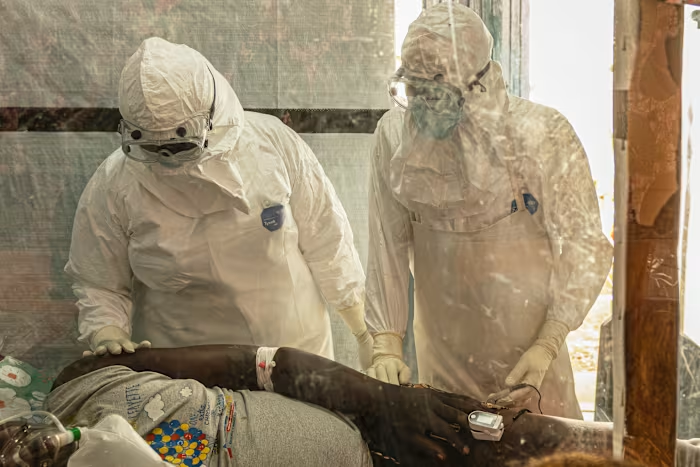


Scientists on Thursday launched a closely watched clinical study of two potential Ebola treatments, aiming to counter a worsening outbreak in eastern Congo, while the World Health Organization confirmed that the first participant had been enrolled.
The strain behind the current outbreak, known as Bundibugyo, is a less common cause of Ebola disease, and no targeted treatments or vaccines are available for it. More than 1,400 cases have been recorded so far, with 438 deaths, WHO Director-General Tedros Adhanom Ghebreyesus said Thursday.
Basic supportive treatment can improve outcomes, particularly when patients receive care early, and the WHO says over 200 people have recovered. Still, health officials say more effective tools are urgently needed.
The trial “offers real hope that we can deliver concrete results for – and with – the communities at the heart of the outbreak,” Tedros said in a statement.
The study will examine whether two medicines can boost patients’ chances of survival. One is remdesivir, Gilead Sciences’ broad-spectrum antiviral approved for COVID-19, which has shown preliminary laboratory signs of activity against the virus now spreading. The other is MBP134, an experimental antibody therapy from Mapp Biopharmaceutical designed to target Ebola viruses, including Bundibugyo.
Every patient taking part will receive the current best standard of care and will then be randomly assigned to also get remdesivir, MBP134, both treatments or neither, according to WHO research adviser Dr. Vasee Moorthy. Researchers will monitor survival for 28 days after treatment begins.
Moorthy warned that it may take months, and perhaps up to 1,000 participants, to determine whether either drug is effective. If one treatment proves strongly beneficial, however, researchers may be able to reach conclusions sooner and with fewer patients.
For now, the trial is available at just one Ebola treatment center in Congo’s Ituri province. The area has faced severe violence, including attacks affecting health workers responding to a virus that spreads through contact with bodily fluids from infected patients. Officials intend to add more sites when security conditions allow.
Moorthy said enough of each drug had been donated by Gilead and the U.S. government, which has funded MBP134 research and owns those doses, for the trial. If either proves effective, the next step would be ensuring patients can continue to access the treatment outside the study.
The WHO-supported trial is a collaboration between Congo’s national biomedical research institute INRB, Britain’s Oxford University, Antwerp’s Institute of Tropical Medicine and other international health groups.
—-
The Associated Press Health and Science Department receives support from the Howard Hughes Medical Institute’s Department of Science Education and the Robert Wood Johnson Foundation. The AP is solely responsible for all content.