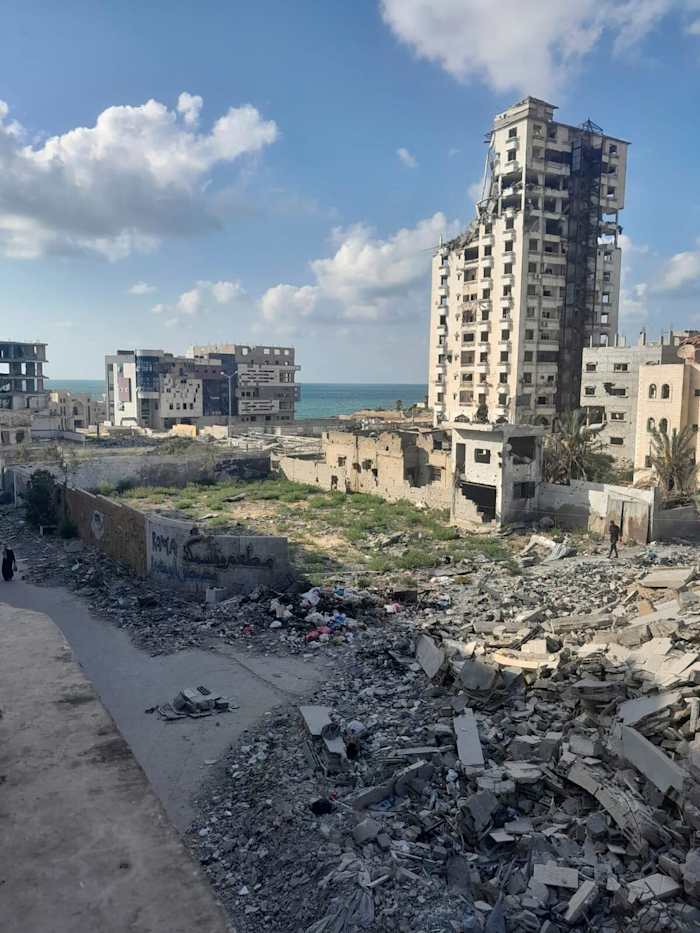

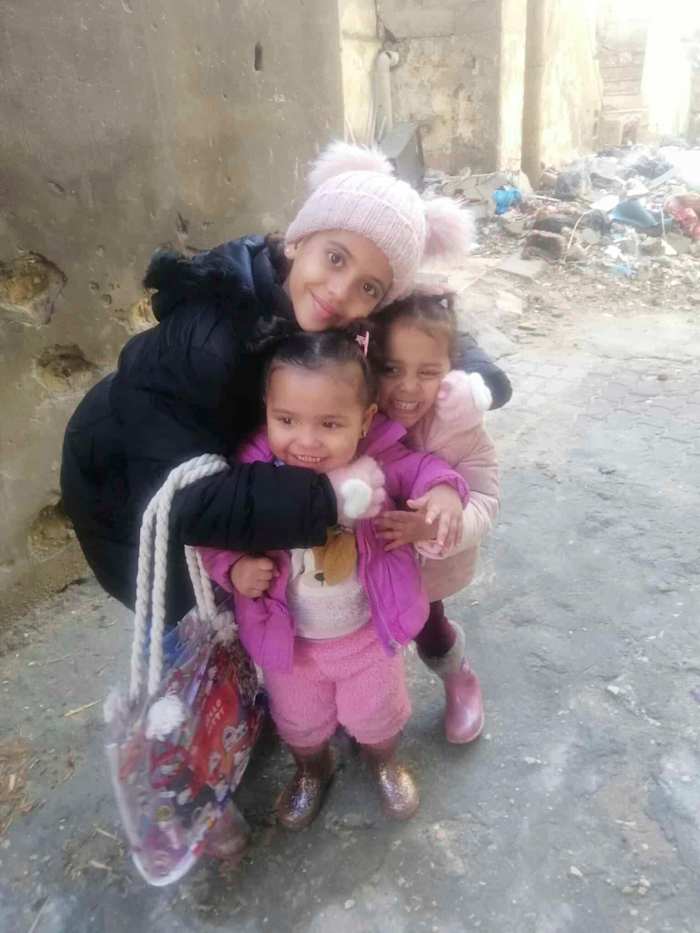
In Gaza City, the walls of the dimly lit basement where Noor Abu Hassira and her three daughters are taking shelter are constantly rattled by nearby explosions. They have limited visibility through a small elevated window, but the persistent sound of drones and thunderous airstrikes indicates that Israeli forces are advancing closer.
Despite receiving Israeli evacuation warnings, Abu Hassira remains in the city. She suffers from severe leg injuries due to an airstrike that obliterated her home at the conflict’s onset. Like many others in the war-torn area, she cannot afford the $2,000 needed to relocate to southern Gaza and set up a tent in a displacement camp.
While the majority of Gaza City’s residents have evacuated south at various times during the 23-month-long conflict, Abu Hassira has mostly remained confined to bed. She has had to pack up and move within the city 11 different times to evade Israeli attacks. Her husband is detained in an Israeli prison, and she is left with her young daughters—Jouri, Maria, and Maha—among the hundreds of thousands still residing in Gaza City, which had a population of a million before the war.
“It feels like we’re just waiting to die, I don’t really care that much anymore,” Abu Hassira wrote over text.
The stated purpose of Israel’s military campaign is to dismantle Hamas and rescue hostages taken during the initial assault that sparked the war. The Israeli authorities claim they are making efforts to reduce civilian casualties.
If the Abu Hassira family could somehow make it to the south, their troubles would not be over.
“I’m afraid to live in a tent with my daughters. I’m afraid we will drown in the winter. I’m afraid of insects. How will we get water?” she said.
An airstrike destroyed their home
Prior to the war, eight months earlier, Abu Hassira and her family had moved into an apartment in Gaza City. She was employed as a medical lab technician, and her husband, Raed, worked as a journalist for a media organization alleged to be linked to Hamas. Abu Hassira insists that her husband was not associated with the militant group.
Jouri, their oldest, was in elementary school. Maria was about to start kindergarten. Maha was just a baby.
“We worked and saved for 10 years to have a comfortable, nice home — our dream house. Now it’s gone,” she said.
After a militant attack led by Hamas on October 7, 2023, resulted in 1,200 Israeli deaths and 251 kidnappings, Israel retaliated with intense airstrikes on Gaza and launched a ground invasion. In December, during these assaults, the building where the Abu Hassira family lived was hit.
The blast collapsed a concrete pillar that pinned Abu Hassira under the rubble, shattering her shoulders, back and legs and knocking her into a coma. Her daughters were also buried in the rubble, though all survived.
Israeli troops raided the hospital
Abu Hassira awoke at Shifa Hospital. Her daughter, Maria, lay beside her with a fractured skull.
Israeli forces had raided the hospital weeks earlier, accusing Hamas of sheltering there. Supplies were running low. It was packed with displaced families and doctors were preoccupied with a steady flow of casualties coming through the gates.
Her husband sent the other two girls to stay with an uncle so he could care for the mother and daughter at the hospital.
“He would change my diapers, my clothes,” Abu Hassira said. “I lay on my back for three months, and he took care of me, combed my hair, and bathed me.”
In March 2024, Israeli troops raided the hospital again, arresting scores of men, including Abu Hassira’s husband. He is now one of hundreds of Palestinian men Israel has rounded up during the war whose whereabouts and legal status remain unknown.
She hasn’t heard from him, but Addameer, a Palestinian legal aid group, said an attorney visited him in an Israeli prison last November. Israel’s prison service, Shin Bet intelligence agency and military declined to say why he was arrested or where he was being held.
“Maha was just over a year old when they took her father away,” Abu Hassira said. “She’s never once said the word ‘daddy.’”
She feared her daughters would die
Israel’s military said it killed some 200 militants over two weeks of fighting inside the sprawling Shifa hospital. The World Health Organization said 21 patients died during the siege. Israel denied harming civilians.
Abu Hassira, who said soldiers told her to leave, fled the incursion with a single bag, leaving her wheelchair and most of her clothes and food behind. The family spent the rest of the year moving from one place to another as Israel carried out raids in and around Gaza City.
“The hardest part is living at other people’s homes … especially with small children, and everything is expensive. I had no clothes or belongings, so I had to use theirs,” she said.
In the fall of 2024, Israel largely sealed off northern Gaza, including Gaza City, launching major ground operations and heavily restricting humanitarian aid. Clean water was hard to find. They ate little more than bread. Jouri, her oldest, grew malnourished and sick.
“I felt weak, lonely, helpless,” Abu Hassira said. “I was terrified my daughters would die and I couldn’t do anything for them.”
A neighbor volunteered to take Jouri to a malnutrition program where the girl began to recover.
In January, a long-awaited ceasefire took hold, raising hopes that the war would wind down. Hundreds of thousands of people returned to Gaza City, Abu Hassira’s extended family was reunited, and Israel allowed humanitarian aid to flow in.
The war resumes
But Israel shattered the ceasefire in March, launching more airstrikes after halting imports of food, medicine and other goods — a complete blockade that would only be eased 2 ½ months later.
In Gaza City, families like the Abu Hassiras are often without food, which costs 10 times what it did before the war: a kilogram (2.2 pounds) of sugar around $180, a kilogram of flour around $60.
Over 65,000 Palestinians have been killed in the war, according to Gaza’s Health Ministry, which doesn’t distinguish between civilians and combatants. The ministry is part of the Hamas-run government, but U.N. agencies and many independent experts view its figures as the most reliable estimate of casualties.
In August, international experts determined Gaza City was experiencing famine. Weeks later, Israel launched an offensive to occupy the city, saying it was needed to pressure Hamas into releasing 48 remaining hostages, around 20 of them believed by Israel to be alive.
Abu Hassira has seen the evacuation leaflets dropped by Israeli aircraft. Many of her neighbors have packed up and left.
But she can barely walk, and a truck ride south would cost around $900. A tent would cost around $1,100, she says, and who knows where they would put it. The Israeli-designated humanitarian zone largely consists of crowded camps and demolished buildings. Families who have moved to new grounds for the displaced have found them sparse and lawless, with armed gangs patrolling the area to demand rent.
For now, Abu Hassira says she and her daughters will remain in her parents’ basement in the once-upscale Rimal neighborhood, near the Mediterranean Sea. She says she can’t cook or wash, and spends her days sitting in a chair or lying down. She needs help to use the bathroom.
“I wish my daughters and I would die together before we are forced to leave,” she said. “We are exhausted.”
___
Frankel reported from Jerusalem. Abou AlJoud reported from Beirut.
___
Copyright 2025 The Associated Press. All rights reserved. This material may not be published, broadcast, rewritten or redistributed without permission.