
Share this @internewscast.com
ST. LOUIS (KTVI) — Hidden deep beneath St. Louis’ Forest Park, about 30 feet underground, is an intricate network of tunnels. These tunnels are part of the River Des Peres, with over four miles of its almost 10-mile journey running beneath the city.
The river, originally built in the 1890s, gradually became a dumping ground, accumulating all sorts of waste. During the early 1900s, as the city expanded, the river’s increasingly foul odor and appearance became problematic, particularly with the 1904 World’s Fair approaching.
“Initially, people were dumping waste with buckets into creeks, which later evolved into direct piping into local streams and the Mississippi River. Back then, wastewater treatment wasn’t available,” explained Sean Stone, Senior Public Affairs Specialist for the St. Louis Metropolitan Sewer District. “With lots of development happening and no waste treatment, everything was discharged into the River Des Peres before eventually reaching the Mississippi River.”

To address the unsightly and smelly issue, an initial enclosure was made. However, a more extensive and long-lasting solution emerged in the form of a tunnel system, which remains vital to St. Louis’ wastewater infrastructure today.
Reporters from Nexstar’s KTVI observed this system firsthand at the Forest Park Junction Chain, a pivotal intersection where various tunnels converge. This intersection links multiple lines of the system, where stormwater from Forest Park joins the wastewater flow.

“St. Louis operates a combined sewer system, meaning it handles both wastewater and stormwater within the same piping. This setup is quite common in many older urban areas,” Stone noted. “The flow moves through the River Des Peres System, eventually dropping into another tunnel that leads to our Lemay Wastewater Treatment Plant.”
Despite the name, though, MSD officials urge residents to know that this is unlike a typical river, and strongly advise against going into the waters or entering the tunnels themselves.

“This is an active wastewater system right now. This is a mixture of what’s coming from people’s homes that includes the washing machine, their sink, the dishwasher, their shower and their toilets. You have the threat of sewer gas and H2S hydrogen sulfide,” Stone added.
When heavy rainfall comes, the water rises several feet within minutes, creating an unsafe environment. Stone said that there have been recent times the tunnels look full, especially with the consistent rain St. Louis experienced in the spring.
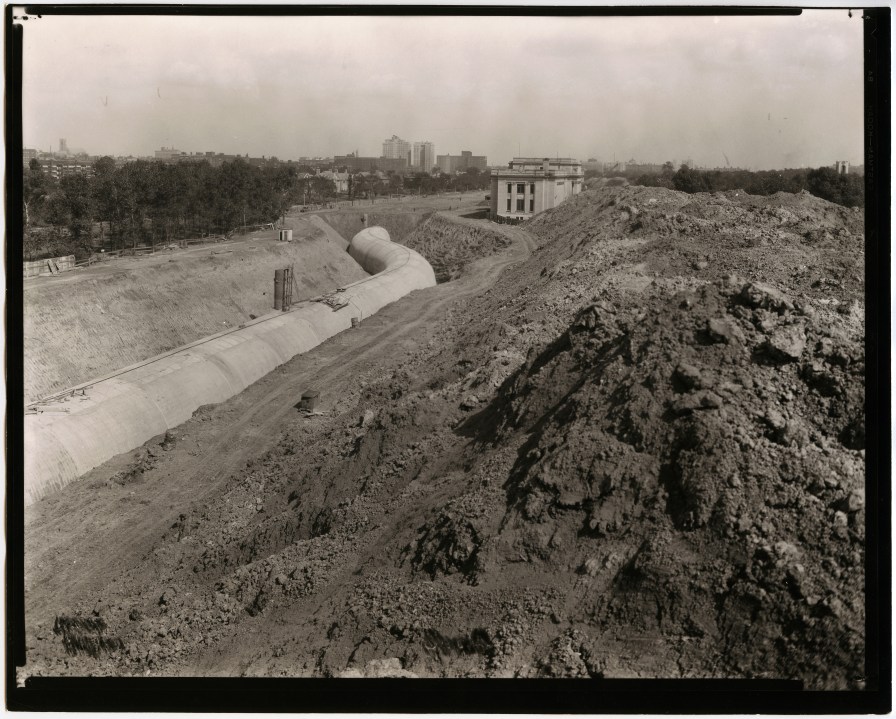
The design of the sewage and drainage works was deemed a National Historic Civil Engineering Landmark in 1988. Looking up inside the system, the imprints of the wood that was used as a concrete form when first originally built.
“When we build tunnels now, we’re using these giant tunnel boring machine, sometimes that are 22 feet in diameter, 500 feet long…and it’s driving and drilling a hole over miles. They didn’t do that 100 years ago. They didn’t have that. They used steam shovels and manual labor to dig this trench that they were able to put a 29 by 23 foot tunnel,” Stone said. “It’s really one of the most amazing engineering feats of a century ago.”
In terms of maintaining the structural integrity, Stone added that MSD along with specialized contractors are consistently monitoring the system. While there are no plans to expand this particular tunnel network, MSD will be expanding the system in upcoming years with 15 to 16 miles of tunnels beneath the existing ones, which would be up to 250 feet underground.
The new addition will support the existing tunnels when they reach capacity, bringing the wastewater into the Lemay Wastewater Treatment Plant. According to Stone, it would add roughly 300 million gallons of additional capacity to the entire River Des Peres System.
That project is anticipated to be completed by the late 2030s.