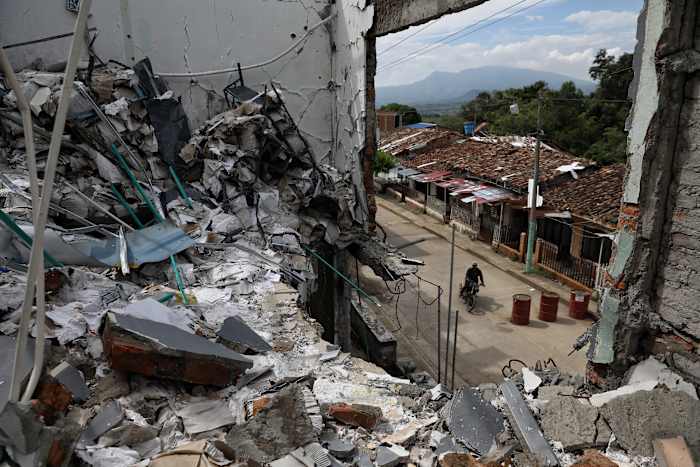


JAMUNDI – Just a short walk across the street separates Gladys Marín from the polling station set to open this Sunday in her hometown in Colombia. Despite the convenience, she’s uncertain if she’ll venture out to cast her vote for the upcoming presidential election, as concerns for her safety loom larger than the opportunity to participate.
Marín lives in the southwest village of Potrerito, a stone’s throw—less than 100 meters—from the local police station. This proximity has become a liability, as the station has been repeatedly targeted with explosives delivered by drones. The authorities attribute these attacks to a rebel faction that dismissed a peace treaty made with the Colombian government a decade ago.
“You have to stay alert to what is happening because we live very close to the police station,” Marín shared while standing on her porch, just about 470 kilometers from Bogotá, the nation’s capital.
On May 31, Colombians will head to the polls to choose their next president and vice president, with the election serving as a de facto referendum on President Gustavo Petro’s policies. Central to the debate is his contentious “total peace” plan, aimed at negotiating with the remaining rebel factions in the country.
Under Petro’s administration, the violence linked to these armed groups appears to have intensified.
The Electoral Observation Mission in Colombia reports that approximately 386 municipalities, equating to a third of the nation, are susceptible to aggression from illegal armed groups. The Ideas for Peace Foundation, a think tank, estimates that around 27,000 individuals continue to be actively involved in armed conflicts across the country.
Drone attacks change the landscape of violence
In Robles, a neighboring town in the Jamundi municipality, the streets leading to the police station are blocked by improvised barricades. The police are entrenched in sentry posts, using shelters made of sandbags and black fabric to scan the sky for any approaching drones.
“You pass by the police station with this sense of dread, looking up, hoping you won’t run into a nasty surprise,” said Eucaris Zamora, who had to vacate her home after a cylinder bomb struck it in October, leaving the building partially destroyed.
Guillermo Londoño, a security official in the region of Valle del Cauca, where Jamundi is located, said illegal armed groups in the area have sought to maximize damage through simultaneous, “swarm-style” drone strikes, marking a shift from previous tactics, where attackers would launch attacks with a single drone, reload it, and then resume their assault.
Drones modified to drop explosives have altered the dynamics of Colombia’s armed conflict since 2024, posting one of the greatest threats to civilians and security forces alike, particularly along the Venezuelan border, in northern Bolivar province and in southwestern coastal areas.
Colombia’s Defense Ministry reported that drone attacks hit 333 targets in 2025, up from 61 such incidents recorded in 2024. Meanwhile, the army has recorded 107 drone attacks so far this year, which have claimed the lives of two soldiers.
The problem with Petro’s ‘total peace’ plan
Officials here believe their region has become a casualty of Petro’s “total peace” strategy, aimed at putting an end to one of the world’s longest-running conflicts.
Petro acknowledges that the initiative has failed to achieve its hoped-for outcome of disarming illegal networks, and his approach of being open to talk to every group has hardened up a notch. He has frozen negotiations with some groups due to their continuing violence, though he has kept dialogue open with other organizations.
A clear divide has emerged between candidates. On one side are those who favor continuing dialogue with illegal groups, such as Sen. Iván Cepeda, of Petro’s political movement. On the other are those who say they would dismantle such efforts and prioritize military pressure, such as Sen. Paloma Valencia, of the opposition Democratic Center, and Abelardo de la Espriella, a self-described admirer of Salvadoran President Nayib Bukele who has vowed to crack down on illegal armed groups.
Elizabeth Dickinson, a senior analyst at the International Crisis Group, believes the violence could worsen if a hawkish candidate is elected.
“Right-wing candidates propose a ‘hard-line’ response that could exacerbate the violence, because the armed groups will respond to pressure from security forces with terror-style attacks, as they lack the means to respond symmetrically, army-to-army,” Dickinson said.
In December, gunmen sowed terror in the small southern town of Buenos Aires, launching an attack on the police station that left several officers injured and reduced a local bank and nearby homes to rubble.
Among the wreckage was the home of 89-year-old Celimo Enrique Aguilar.
“I haven’t lost faith that, someday, one might be able to live in peace,” he said.
___