
Share this @internewscast.com
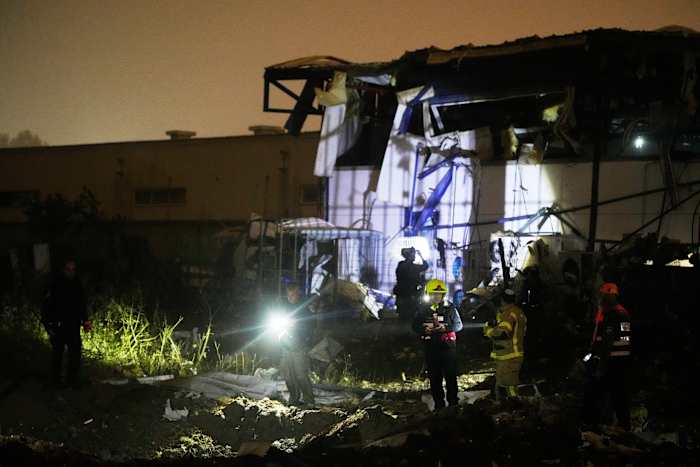
DUBAI – Tensions in the Middle East escalated as Iran launched attacks across the region, igniting fires at a Kuwaiti oil refinery. Meanwhile, American and Israeli forces conducted airstrikes on Iran early Friday, marking nearly five weeks of conflict as the U.N. Security Council prepared to discuss Iran’s control over the Strait of Hormuz.
Despite assertions by the U.S. and Israel that Iran’s military power has been severely diminished, Tehran remains undeterred, continuing its aggressive stance against Israel and its Gulf neighbors. On Friday, Iran targeted Kuwait’s Mina al-Ahmadi oil refinery with a drone strike.
This refinery has been repeatedly attacked during the ongoing conflict. Kuwait Petroleum Corp., a state-run entity, reported that firefighters are battling several fires. Additionally, air raid sirens blared in Bahrain, warning of potential Iranian strikes, while Israel detected incoming missiles.
Reports from activists indicate strikes in and around Tehran as well as in the central city of Isfahan, though precise details on the targets remain unclear.
Iran’s strategic attacks on Gulf energy facilities and its firm control over the Strait of Hormuz—through which a significant portion of the world’s oil and natural gas passes—have driven oil prices upward, affecting global economies.
As of early Friday, Brent crude oil, the global benchmark, stood at approximately $109 per barrel, marking an over 50% increase since February 28, when the conflict began with U.S. and Israeli attacks on Iran.
UN Security Council to take up Strait of Hormuz security question
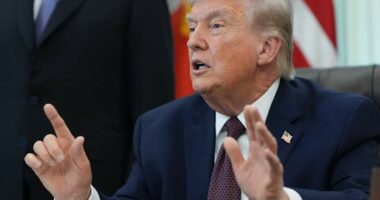
Shipping had flowed freely through the strait before the war, but U.S. President Donald Trump has said it’s not now Washington’s responsibility to get the waterway reopened, instead putting the onus on others, saying this week that the countries that depend more on fuel shipped through Hormuz should “build some delayed courage” and go “take it.”
The U.N. Security Council was expected to vote Saturday on a proposal from Bahrain that would authorize defensive action to ensure vessels can safely transit the strait. Bahrain’s initial draft would have allowed countries to “use all necessary means” to secure the strait, but Russia, China and France — who have veto power on the Council — expressed opposition to approving the use of force.
Speaking Thursday in South Korea, French President Emmanuel Macron said the American expectation that the Strait of Hormuz could be reopened by force was unrealistic.
Macron said a military operation “would take an infinite amount of time and would expose anyone passing through the strait to coastal threats from (Iran’s) Revolutionary Guard.” He added that reopening of the strait “can only be done in coordination with Iran,” through negotiations that would follow a potential ceasefire.
Talks organized by Britain and involving more than 40 countries focused on political rather than military means to secure the strait. The nations, which didn’t include the U.S., urged increased diplomatic pressure on Iran and possible sanctions.
Death toll keeps rising
More than 1,900 people have been killed in Iran during the war, while 19 have been reported dead in Israel. More than two dozen people have died in Gulf states and the occupied West Bank, while 13 U.S. service members have been killed.
More than 1,300 people have been killed and more than 1 million displaced in Lebanon, where Israel has launched a ground invasion in its fight with the pro-Iranian Hezbollah militant group. Ten Israeli soldiers have also died there.
___
Rising reported from Bangkok. AP journalists Sylvie Corbet in Paris and Edith M. Lederer at the United Nations contributed to this report.
Copyright 2026 The Associated Press. All rights reserved. This material may not be published, broadcast, rewritten or redistributed without permission.